DbcultAccessing Vault...
Cult Review
Senior Film Conservator
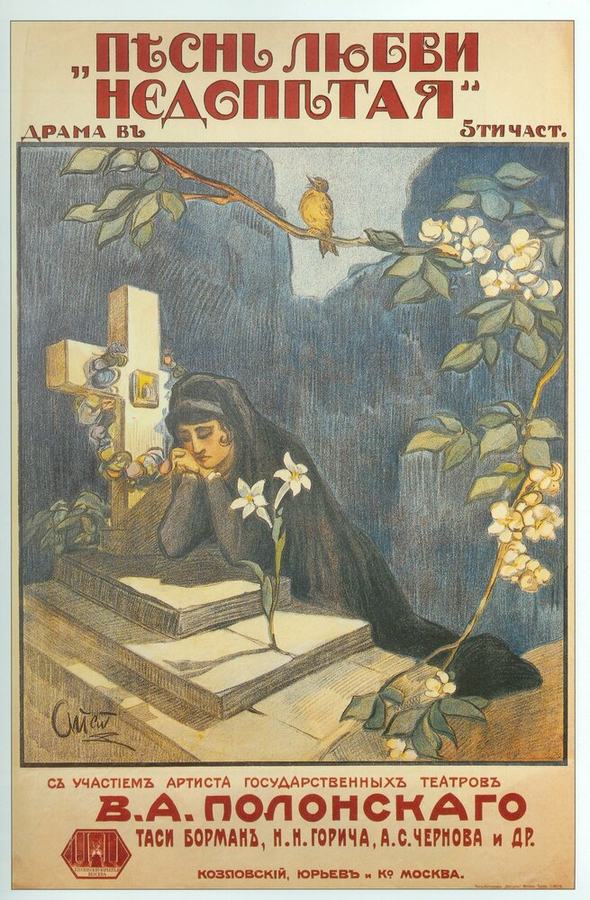
There are certain cinematic experiences that transcend the mere act of viewing; they become a visceral immersion into a bygone era, an emotional archaeology of human experience. Such is the enduring power of 'Pesn lyubvi nedopetaya', a silent film that, despite its lack of spoken dialogue, articulates the profound anguish of the human heart with an eloquence few modern productions can rival. To call it merely a melodrama would be to diminish its intricate emotional tapestry; it is, rather, a profound meditation on the sacrifices demanded by circumstance, the tyranny of societal expectation, and the haunting echo of a love that, by its very nature, could never fully blossom.
From its opening frames, the film establishes a world steeped in both stark realism and poetic romanticism. We are introduced to Elena, portrayed with breathtaking fragility and an incandescent inner fire by the inimitable Tasya Borman. Borman, a luminary of early Russian cinema, embodies Elena not merely as a character but as a living, breathing embodiment of aspiration and vulnerability. Her expressive eyes, the subtle tremor of her hands, the way her posture shifts from defiant hope to resigned despair – every gesture is a brushstroke in a masterpiece of silent acting. Elena's voice, though unheard by the audience, is rendered palpable through Borman's performance, a silent aria of longing that resonates deep within the soul.
Her counterpart, Dmitri, is brought to life by the equally compelling Lev Kuleshov, an actor whose later directorial prowess would redefine cinematic language. Here, Kuleshov demonstrates an innate understanding of internal struggle, portraying Dmitri as a man torn between the rigid dictates of his aristocratic world and the irresistible pull of a forbidden, profound connection. His love for Elena is an unspoken symphony, conveyed through fleeting glances, gestures of quiet admiration, and a pervasive melancholy that shadows his every scene. The chemistry between Borman and Kuleshov is not one of overt passion, but of a deeply empathetic understanding, a shared artistic sensibility that binds them across the chasm of their social strata. It is a testament to their skill that their unconsummated romance feels more potent, more tragic, than many fully realized on-screen relationships.
The narrative's central conflict is personified by Prince Volkov, portrayed with a chilling blend of charm and possessiveness by Vitold Polonsky. Polonsky, a master of the sophisticated villain, imbues Volkov with a predatory elegance, a man accustomed to acquiring whatever, or whoever, catches his eye. His patronage of Elena is less an act of benevolence and more an act of ownership, a gilded cage offered with a silken smile. The film cleverly avoids making Volkov a one-dimensional antagonist; instead, he represents the insidious power of wealth and status, a force that can both elevate and destroy, often simultaneously. Elena’s dilemma – to surrender her heart for the sake of her art and family, or to cling to an impossible love – forms the crux of the film’s emotional torment.
The supporting cast, including A. Chernova and
Visually, 'Pesn lyubvi nedopetaya' is a marvel of early cinematic artistry. The cinematography, though credited to an era where such distinctions were sometimes fluid, is masterfully composed, utilizing stark contrasts between light and shadow to mirror the characters' internal states. The opulent ballrooms where Volkov holds court are bathed in a deceptive glow, while the humble lodgings of Elena and the contemplative solitude of Dmitri are often rendered in chiaroscuro, emphasizing their emotional isolation. The use of close-ups, particularly on Borman's face, is extraordinarily effective, allowing the audience to read every flicker of hope, every pang of despair, without the need for intertitles. This visual storytelling is not merely functional; it is an art form in itself, communicating layers of meaning that dialogue might only clumsily articulate.
The film’s pacing is deliberate, allowing the emotional weight of each scene to fully settle. It builds its tragic momentum with a slow, inexorable grace, much like a classical symphony moving towards its inevitable, poignant resolution. There are no sudden dramatic twists for their own sake; instead, the narrative unfolds organically from the characters' motivations and the societal forces arrayed against them. This measured approach enhances the film's emotional impact, making the eventual heartbreak all the more devastating.
Thematic resonance is where 'Pesn lyubvi nedopetaya' truly shines. It explores the eternal conflict between art and commerce, love and duty, individual desire and societal expectation. Elena’s struggle to reconcile her artistic ambition with her personal integrity, and Dmitri’s quiet agony over his inability to transcend his class to claim his beloved, are themes that remain as relevant today as they were a century ago. It is a timeless exploration of the human condition, a testament to the enduring power of dreams and the crushing weight of reality.
Comparisons to other silent era dramas are inevitable, and 'Pesn lyubvi nedopetaya' holds its own with remarkable distinction. While films like Every Girl's Dream might explore similar aspirations of social mobility, 'Pesn lyubvi nedopetaya' delves deeper into the psychological cost of such pursuits, making Elena's journey far more complex and tragic. The raw emotionality it evokes might draw parallels to the intense character studies found in The Woman Who Dared, but here, the daring is internal, a silent rebellion against an unyielding fate. The film's portrayal of artistic struggle and unrequited love also brings to mind the nuanced romantic dilemmas of The Call of the Dance, though 'Pesn lyubvi nedopetaya' frames its romance within a more overtly tragic and socially constrained context, emphasizing the 'unsung' nature of its central love story.
The ending, without revealing specifics, is a masterclass in silent film pathos. It doesn't offer easy answers or convenient resolutions. Instead, it leaves the audience with a profound sense of melancholic beauty, a lingering understanding of what has been lost and what could never be. The 'unsung song' of the title isn't just Elena's unfulfilled artistic potential or Dmitri's unspoken love; it's the symphony of their joint future, silenced before it could fully begin. The final image, whatever its specific form, is etched into the viewer's memory, a powerful visual metaphor for the film's overarching theme of beautiful, yet unattainable, harmony.
In an era often dismissed as primitive in cinematic terms, 'Pesn lyubvi nedopetaya' stands as a towering achievement. It demonstrates that true artistry lies not in technological advancements but in the ability to tap into universal human emotions. The film's ability to communicate complex psychological states and societal critiques through purely visual means is a testament to the talent of its cast and crew. It reminds us that cinema, at its core, is a language of images and emotions, capable of conveying profound truths without uttering a single word.
For those who appreciate the historical depth of cinema, or simply seek a story of heart-wrenching beauty, this film is an essential viewing experience. It is a reminder of the foundational power of silent storytelling, a genre that demanded actors of immense talent and directors of visionary insight. It doesn't merely tell a story; it evokes a feeling, a memory of a love that was, and tragically, could not be. The enduring legacy of 'Pesn lyubvi nedopetaya' lies in its ability to resonate across generations, its 'unsung song' continuing to echo in the hearts of those who witness its silent, powerful lament.
The meticulous attention to period detail, from the costumes to the set designs, further immerses the viewer into the narrative's world. This isn't just a backdrop; it's an active participant in the story, reflecting the rigid social hierarchies and aesthetic sensibilities of the time. The contrast between the grandeur of aristocratic life and the stark simplicity of the working class is vividly portrayed, underscoring the insurmountable barriers that separate Elena and Dmitri. This visual dichotomy is central to understanding the choices characters are forced to make, not out of malice, but out of the sheer force of circumstance.
The film also subtly critiques the exploitative nature of patronage, a common theme in the arts throughout history. Volkov's 'generosity' is revealed to be a form of control, stifling Elena's authentic voice even as it provides her a platform. This exploration of artistic integrity versus financial necessity adds another layer of depth to Elena's tragic arc. Her internal conflict is not merely about love; it is about the very soul of her artistry, a struggle many artists, even today, can deeply identify with. This makes the film's commentary surprisingly modern, despite its historical setting.
Ultimately, 'Pesn lyubvi nedopetaya' is more than just a historical artifact; it's a vibrant, emotionally charged work of art that speaks to the timeless human experience of yearning, sacrifice, and the often-unrealized potential of love. Its silent frames are filled with a eloquence that transcends dialogue, proving that the most profound stories are often told not with words, but with the universal language of the heart. It’s a film that stays with you, long after the final fade to black, its 'unsung song' replaying in the quiet chambers of your mind, a haunting, beautiful melody of what might have been.
IMDb —
1917
Community
Log in to comment.