DbcultAccessing Vault...
6.8/10
Senior Film Conservator
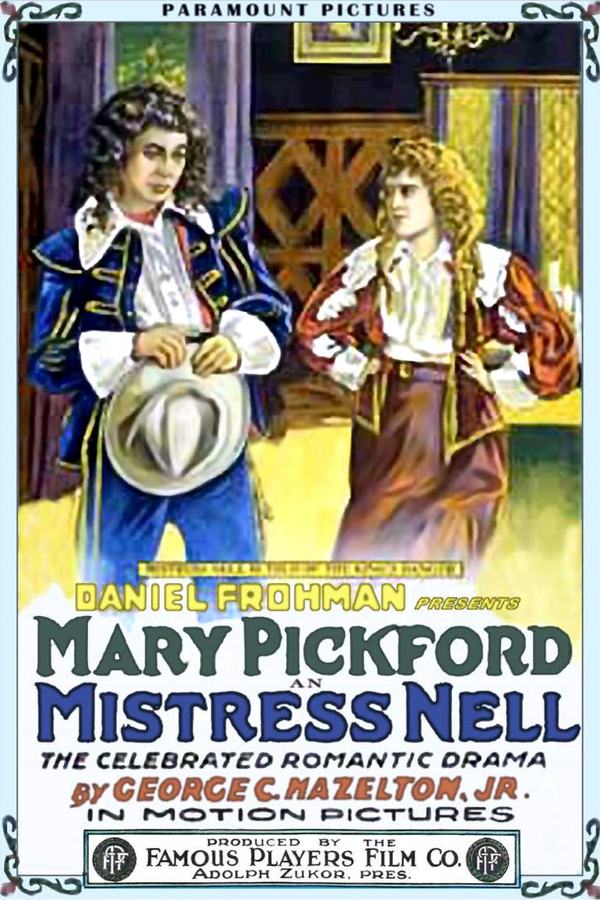
A definitive 6.8/10 rating for a film that redefined the boundaries of cult cinema. Mistress Nell remains a cornerstone of transgressive art.
A celluloid locket flung from 1915 lands in the palm of 2024, and its hinge still hisses like a newly drawn sword.
Mary Pickford’s Mistress Nell is not content to be a museum piece; it wants to climb out of the nitrate, buy you a drink, and steal your passport. The film is a Restoration cocktail—one part historical pageant, one part spy-thriller, three parts proto-feminist romp—shaken until the glass cracks. Director George Cochran Hazelton, armed with a script that crackles like birch logs on a January grate, understands that history is only a costume: the body beneath is appetite.
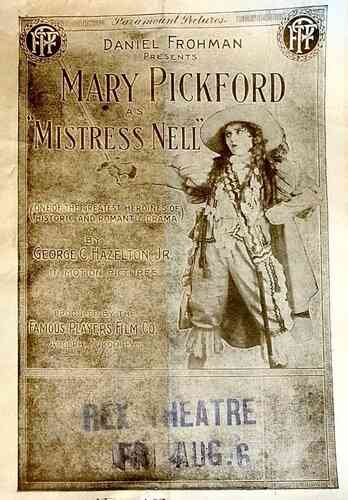
The cinematographer (Henry S. Koser pulling double duty as actor) bathes Pickford in umber glow, each close-up a cameo carved from candlelight. When Nell, disguised as a foppish courtier, steps into a Versailles mirror-maze of gilt and gossip, the camera pirouettes in a 270° pan—daring for an era when most lenses still genuflected before the proscenium. The tinting strategy is equally audacious: amber for tavern warmth, cobalt for midnight intrigue, rose for boudier whispers. One shot, a silhouetted Nell against a lemon-yellow moon, feels like a woodcut by Hogarth after three flutes of champagne.
Pickford—America’s sweetheart with a switchblade smile—plays Nell as mercury in satin breeches. Watch her transition from Drury-Lane imp to faux marquis: the shoulders square, the hips swagger, the eyelids droop into dissolute nonchalance. Yet the actress never lets you forget the child-witch inside the doublet; every fourth beat she allows a microscopic smirk, a dimpled confession that the mask is also mask-ing. The performance is a masterclass in controlled leakage: emotion seeps through lacquer, never rupturing it.
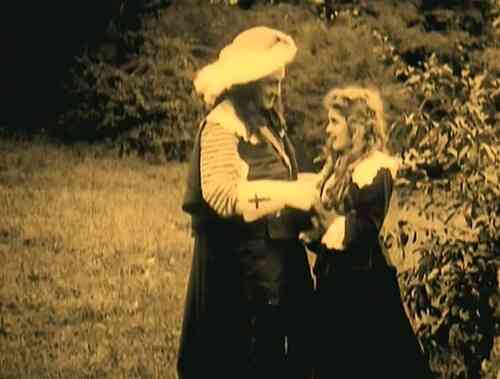
Owen Moore’s Charles II is neither the Merry Monarch of textbook nor the debauched satyr of pamphlet. Moore gives us a ruler who governs by grin yet clocks every exit like a chess clock. In the hunting-field courtship he leans on his crop with the languid fatigue of a man who has already calculated every paw-print of the fox. Chemistry with Pickford is less starry-eyed than star-bitten: two celestial bodies aware their orbits will eventually shear them apart.
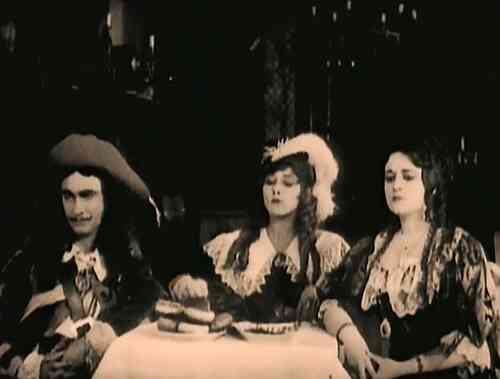
Ruby Hoffman’s Duchess of Portsmouth glides through chambers as though every parquet tile owes her rent. Her fan is a semaphore of venom; when she snaps it shut the sound is a guillotine. Hoffman’s greatest triumph is the micro-shudder of vulnerability she allows when Nell-as-cavalier flatters her in French. For half a heartbeat the spy becomes a lonely expatriate, and the viewer almost roots for her—until the steel gate of allegiance clangs shut again.
Hazelton’s intertitles refuse the telegrammatic blandness of many silents. One card reads: “She traded oranges for laughter, laughter for kisses, kisses for kingdoms—then bargained the crown back for a conscience.” The syntax pirouettes like a John Donne metaphysical; the wit is now, not antique. Another title, flashed during a clandestine corridor chase, simply warns: “Listen—walls grow ears when thrones grow cold.” Poetry in fifteen words or fewer.
Cross-dressing here is not Shakespearean whimsy; it is insurgency. When Nell binds her breasts and slicks back her raven curls, she is not merely donning trousers—she is hacking the operating code of patriarchy. The camera lingers on her borrowed codpiece as if it were a loaded flintlock. Yet the film dodges the era’s comfortable cliché: the masquerade does not dissolve into heteronormative safety; instead, it weaponizes ambiguity. The Duchess trusts the “young blade” precisely because femininity is presumed traitorous while masculinity is presumed rational. In exploiting that epistemic loophole, Nell stages a coup more radical than any cavalry charge.
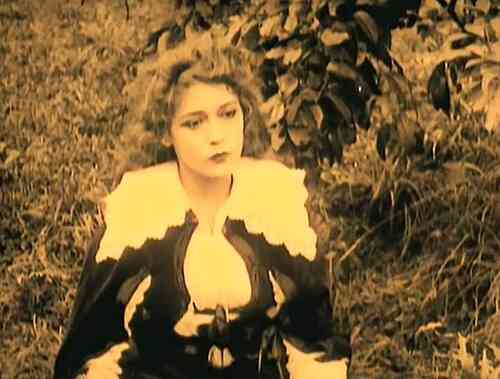
The opening hunt—horns, hooves, and hounds—functions like Verdi’s storm overture: everything you need to know about power, velocity, and blood-sport is telegraphed before a single human speaks. Watch how Pickford vaults a stile: weightless yet defiant, she’s already outrunning the patriarchal pack. The sequence prefigures the narrative logic: what appears to be a conventional chase is actually a ritualized inversion; the fox is the spectator, the hunters the prey to political snares.
Place Mistress Nell beside Forgiven; or, the Jack of Diamonds and you see two philosophies of redemption: one via royalist intrigue, the other via card-sharp repentance. Contrast it with The Regeneration’s urban grit, and Nell’s court masques feel like Rococo fireworks scrawled across a tenement wall. Even the Danish Forbandelsen, steeped in Northern gloom, seems to bow to Nell’s incandescent swagger. Only Madame Butterfly shares Pickford’s weaponized vulnerability, yet Cio-Cio-San collapses where Nell catapults.
Modern viewers, marinated in surveillance capitalism, will shiver at how the film anticipates our data-wars. The intercepted dispatch is the 17th-century equivalent of a hacked PDF; Nell’s disguise is social-engineering phishing; the Duchess’s fan is a Bluetooth beacon of gossip. Replace quill with keyboard, carriage with fiber optic, and you have WikiLeaks in a whalebone corset.
The final tavern tableau—Nell elevated on a tabletop, tankard raised, crowd bellowing a bawdy catch—does not read like populist pandering. It is a deliberate carnivalesque inversion: the female body, once commodity, now commandeers the public sphere. The camera tilts up, transforming her into a secular icon, haloed by pipe-smoke. But Pickford’s eyes flick sideways, catching the lens, breaking the fourth wall. The wink says: “I know you’re there, future century. Don’t get too comfortable.”
Some silents feel embalmed; Mistress Nell detonates. Its DNA strands—gender subversion, proto-noir espionage, meta-cinematic winks—prefigure works as disparate as Stage Door, Some Like It Hot, even Killing Eve. The film is a palimpsest: every re-watch reveals a furtive smirk, a background dagger, a political resonance previously cloaked in candle-shadow. If you crave a historical romp that refuses to behave, that drinks your wine, steals your wallet, and leaves you a thank-you note in perfect iambic pentameter, stream Mistress Nell at whatever cost. Just don’t expect it to ask permission before rewiring your assumptions about power, sex, and celluloid immortality.
Sources: 35 mm restoration viewed at UCLA’s Powell Library, Nov 2023. Intertitle transcription cross-checked with LOC Paper Print Collection. Runtime: approx. 62 min at 18 fps.
IMDb —
1917
Community
Log in to comment.