DbcultAccessing Vault...
Cult Review
Senior Film Conservator
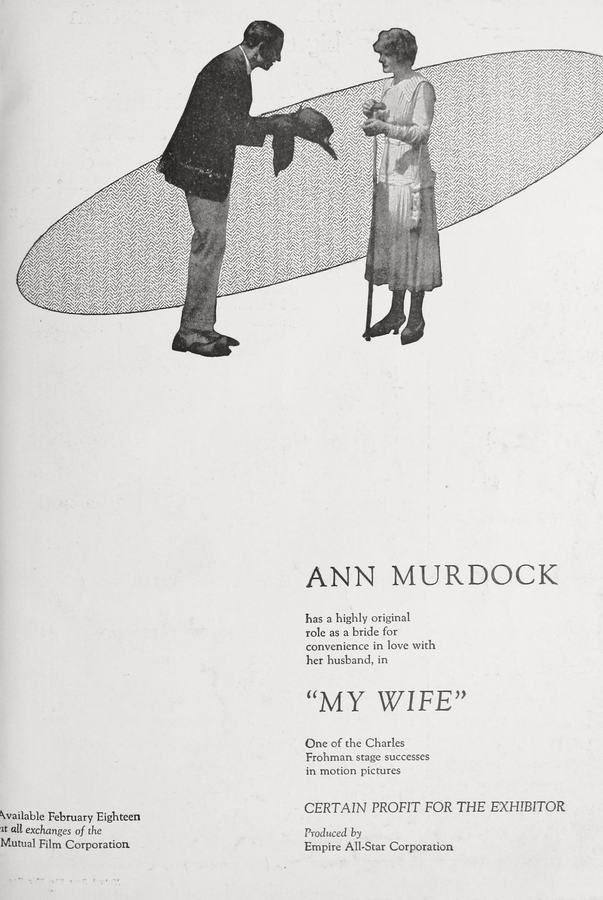
The 1918 cinematic landscape was a crucible of transition, caught between the burgeoning sophistication of narrative feature films and the lingering shadows of the Great War. Within this milieu, My Wife emerges not merely as a romantic farce, but as a poignant meditation on the commodification of affection. Directed with a keen eye for the domestic interior, the film leverages the screenplay by Michael Morton to explore the friction between legalistic obligation and the organic evolution of the human heart. While many contemporary reviewers might dismiss the 'inheritance by marriage' trope as a relic of Victorian melodrama, this production infuses the concept with a psychological depth that mirrors the era's anxieties regarding stability and social standing.
The performance of Anna Murdock as Beatrice Hammond provides the film’s emotional anchor. Murdock possesses a luminous screen presence, navigating the character's journey from a naive ward to a woman of agency with a subtlety that avoids the era's penchant for histrionics. Her interactions with Hubert Druce, portraying Gerald Eversleigh, create a fascinating dynamic of shifting power. Initially, Gerald is the quintessential protector—a man whose authority is derived from his guardianship. Yet, as the 'marriage of convenience' takes hold, Druce portrays a man increasingly haunted by the proximity of a love he cannot rightfully claim. This tension is far more sophisticated than the typical light comedies of the period, such as The Blue Mouse, which relied more heavily on situational absurdity than emotional resonance.
The structural integrity of the film relies on the looming specter of the war in France. Ronald Farwell, played by Rex McDougall, represents the kinetic energy of the youth, pulled away from the domestic sphere into the existential void of the conflict. His absence is the vacuum that Gerald fills, and his return serves as the narrative’s ultimate irony. In a brilliant subversion of the 'returned soldier' trope often seen in films like On the Fighting Line, Ronald does not return to reclaim his prize. Instead, he returns having found a different path, highlighting the transformative power of trauma and the unpredictable nature of human connection. The scene where Ronald offers to pay Gerald to remain married to Beatrice is a masterclass in social satire, exposing the transactional nature of their world while simultaneously liberating the protagonists from their self-imposed guilt.
"The genius of Morton’s writing lies in its ability to treat a million-dollar inheritance not as a reward, but as a catalyst for the stripping away of social masks. When the money becomes irrelevant, the truth of the marriage finally emerges from the shadows of the law."
Visually, the film utilizes the limited technology of the time to create a sense of intimacy. The interior sets of the Eversleigh estate are framed to emphasize both the luxury and the confinement of Beatrice’s situation. There is a specific use of light and shadow that suggests a burgeoning understanding of German Expressionist techniques, though tempered by American realism. The supporting cast, including Ferdinand Gottschalk and Amy Veness, provide a rich tapestry of social commentary, embodying the rigid expectations of a society that views marriage as a strategic alliance rather than a romantic endeavor. This thematic preoccupation with the legalities of the hearth draws interesting parallels to Assigned to His Wife, yet My Wife maintains a lighter, more ironic touch that prevents it from descending into pure bathos.
One cannot overlook the role of the French nurse, a character who remains largely off-screen but whose influence is profound. She represents the 'Other'—the world beyond the gilded cage of the American inheritance. Her presence suggests that the war has broken the traditional social contracts, allowing for new, more authentic pairings to emerge from the wreckage of the old order. This global perspective elevates the film from a simple domestic drama to a reflection of a world in flux. The resolution, where Beatrice discovers her love for Gerald, is handled with a delicate touch. It is not a sudden epiphany but a gradual realization that the safety and devotion Gerald offered under the guise of guardianship was, in fact, the foundation of a lasting partnership.
Comparing this to other works of the era, such as The Amazons, we see a distinct focus on the internal life of the female protagonist. While Beatrice is initially a pawn in her aunt’s game, her decision to approach Gerald with the plan shows an early flash of the agency that would define the 'New Woman' of the 1920s. She is not a passive victim of the will; she is an active participant in the manipulation of the law, even if she eventually finds herself ensnared by her own emotions. This complexity is what keeps My Wife relevant to a modern audience interested in the evolution of gender roles on screen.
The cinematography, though standard for 1918, excels in its close-ups. The camera lingers on Murdock’s face as she reads the will, capturing the flicker of panic and the subsequent resolve. These moments of quiet intensity are far more effective than the grander spectacles found in films like The Battle of Trafalgar. In the quiet rooms of the Eversleigh house, the real battles are fought—battles of conscience, of pride, and of the heart. The film understands that the most significant conflicts are often those that occur in the silence between spoken words.
The inclusion of Romaine Callender and James Kearney in the ensemble adds layers of period-specific texture. Each character seems to represent a different facet of the societal pressure cooker that Beatrice inhabits. The film’s pacing is deliberate, allowing the audience to feel the weight of the eighteen-year-old deadline. As the clock ticks toward the birthday that will decide her fortune, the tension becomes palpable, mirroring the suspense of a thriller despite the romantic trappings. This sense of impending doom is a hallmark of Morton’s dramatic style, often seen in his more serious theatrical works.
In the final act, the refusal of the money by Gerald is the ultimate act of defiance against the aunt’s ghostly control. By rejecting the financial incentive, Gerald purifies the marriage, transforming it from a legal sham into a legitimate union. This moral clarity is a refreshing departure from the cynical materialism that often pervades stories of this nature. It provides a satisfying emotional payoff that feels earned rather than forced. The film concludes not with a grand celebration of wealth, but with the quiet acknowledgment of a shared future based on mutual respect and affection.
While My Wife may not have the historical notoriety of The Shooting of Dan McGrew, its contribution to the development of the romantic dramedy is significant. It showcases a sophisticated understanding of character motivation and a willingness to subvert audience expectations. The film stands as a testament to the talent of Anna Murdock and the directorial vision that sought to find the human heart within the rigid structures of early 20th-century life. It is a work that rewards careful viewing, offering insights into the perennial struggle between the demands of the world and the desires of the soul.
Ultimately, the legacy of My Wife lies in its balance. It balances the high-stakes drama of a million-dollar inheritance with the intimate, often whispered emotions of its characters. It balances the tragedy of war with the hope of new beginnings. For the modern cinephile, it offers a window into a world that is at once alien and deeply familiar, proving that while the laws governing marriage and money may change, the complexities of love remain eternally consistent. It is a film that deserves a place in the conversation alongside other silent-era explorations of social morality, such as Enlighten Thy Daughter or The White Pearl.
The film's exploration of the 'guardian-ward' relationship also predates many of the more controversial treatments of the subject in later decades. Here, it is handled with a paternalistic grace that slowly evolves into a partnership of equals. Gerald’s initial reluctance to marry Beatrice, despite the financial benefits, establishes him as a man of integrity, which makes his eventual fall into love all the more compelling. He is not a predator but a man caught in a web of his own altruism. This nuance is essential to the film's success and distinguishes it from the more heavy-handed moralizing of films like The Corner.
As we look back at the 1918 release of My Wife, we see a production that was ahead of its time in its psychological complexity. The screenplay by Morton provides a blueprint for the screwball comedies that would dominate the 1930s, yet it retains a dramatic weight that is uniquely silent-era. The performances are grounded, the direction is purposeful, and the themes are universal. It remains a fascinating artifact of a time when cinema was discovering its power to not just tell stories, but to reflect the intricate, often contradictory nature of the human experience. In the pantheon of early American film, My Wife is a jewel of understated brilliance, a reminder that the most profound stories are often found in the most unlikely of arrangements.
IMDb 6.5
1918
Community
Log in to comment.