DbcultAccessing Vault...
Cult Review
Senior Film Conservator
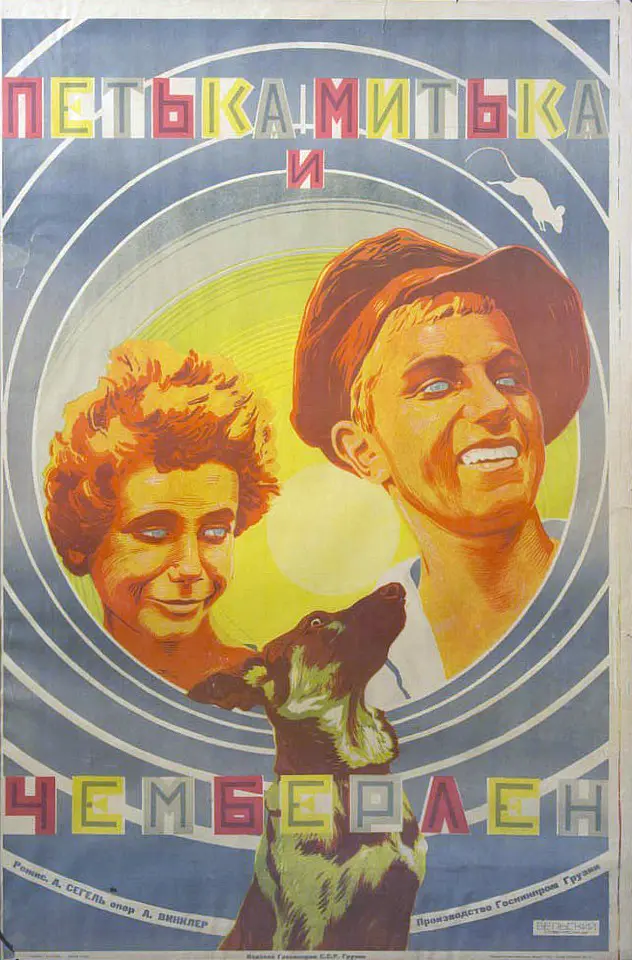
Mitka, Petka da Chemberleni is a historical curiosity that serves better as a political footnote than a piece of entertainment. Unless you are a scholar of 1920s Soviet agitprop, this film is likely to feel like a loud, visual tantrum that has lost its target. It is a film for people who enjoy the mechanics of early propaganda; it is definitely not for anyone seeking a coherent story or emotional depth.
For the average viewer, the answer is no. While it has a manic energy that keeps it from being completely static, the film is a one-note joke about British diplomacy that expired almost a century ago. It lacks the technical sophistication of the era's better-known works and relies entirely on the audience's knowledge of the 1927 Anglo-Soviet crisis.
1) This film works because it captures a very specific, raw moment of Soviet paranoia and pride through high-energy slapstick.
2) This film fails because it is narratively hollow and depends on caricatures that have no staying power beyond their original context.
3) You should watch it if you want to see how early cinema was used as a literal weapon of state satire.
Yuri Fiedler, who wrote, directed, and starred in this, clearly wasn't interested in the nuances of the medium. The film is as subtle as a brick to the head. It operates on the same frequency as a political cartoon in a daily newspaper—effective for five minutes, but exhausting over a longer duration. The way Fiedler uses the camera to loom over the 'Chamberlain' figure is effective in a primitive way, but it lacks the visual intelligence found in contemporary works like Jalousiens Magt.
The performance of the two boys, Mitka and Petka, is characterized by a hyperactive, almost twitchy enthusiasm. They aren't characters so much as they are symbols of the 'New Soviet Man' in miniature. Their movements are jerky and choreographed to look like they are winning a fight against an invisible giant. It is interesting to see how this compares to the more grounded heroism in American films of the same period, such as Moran of the Mounted. Where the American hero is an individual, Mitka and Petka are a collective unit of mockery.
The film is undeniably cheap. The sets look like they were cobbled together from whatever was lying around the studio, and the editing is more concerned with speed than clarity. This isn't necessarily a bad thing—the scrappiness adds a certain authenticity to its revolutionary fervor—but it makes for a difficult watch today. Unlike the polished production values of Stolen Goods, this film feels like it was made in a basement by people who were very angry at the British Foreign Office.
One debatable point is whether propaganda like this is actually more honest than modern 'prestige' biopics. Fiedler isn't pretending to give us a balanced view; he is screaming an opinion through a lens. There is something refreshing about that bluntness, even if the result is a film that is largely unwatchable as a piece of art. It doesn't try to manufacture emotional depth that isn't there. It just wants to make fun of a guy in a monocle.
Mitka, Petka da Chemberleni is a loud, historical echo. It’s a film that was meant to be consumed and discarded, like a flyer handed out at a rally. If you go in expecting a cinematic discovery, you will be disappointed. If you go in expecting a bizarre, aggressive piece of political theater, you might find enough to keep you awake. It is a relic of a time when cinema was still trying to figure out if it was an art form or a megaphone. In this case, it’s definitely a megaphone.
IMDb —
1926
Community
Log in to comment.