DbcultAccessing Vault...
Cult Review
Senior Film Conservator
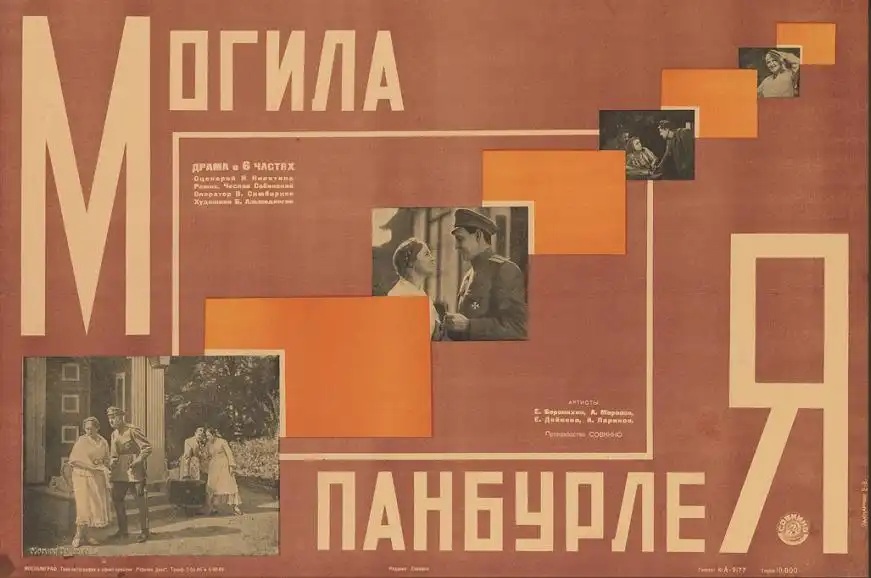
So, Mogila Panburleya from way back in 1928. Is it worth your time today? Look, if you’re someone who generally prefers films with sound, color, and maybe a spaceship, probably skip this one. But if you’ve got a soft spot for silent era stuff, especially the early Soviet kind that tried to capture real life and big ideas, then absolutely, give it a shot. It’s definitely not for folks who need a fast pace or clear-cut heroes and villains, but for those willing to settle into its rhythm, there’s something here.
The film opens with these long, sweeping shots of fields and a distant village. You really feel the vastness, the isolation. And the wind, even though it’s a silent film, you can almost *feel* it blowing through the grass. It’s less about showing off and more about just *being* there.
Aleksandr Larikov, who plays the lead, has this incredible stillness. His face carries so much without him having to do much. There’s a scene where he’s just sitting by a window, watching rain, and you can almost see his thoughts playing out. It’s not flashy, but it’s real.
Some of the crowd scenes are really something else. They’re messy, not choreographed in a modern way at all. People bump into each other, some are looking at the camera, others clearly aren’t paying attention. It gives it this raw, documentary-like vibe that makes you lean in. Like you’re really seeing a moment, not a performance. ✨
Then there are these quick cuts, almost jarring sometimes, usually to emphasize a point or a sudden shift in mood. One moment you’re seeing a wide shot of a community meeting, then suddenly it’s a tight close-up on someone’s tightly clenched fist. It’s effective, but it does make you jump a little.
The pacing, well, it’s a silent film, right? So it’s deliberate. Sometimes it feels a little *too* deliberate. There are moments where a reaction shot lingers for what feels like an eternity. You see every flicker of emotion, every uncertainty. It’s **demanding**, but also kind of rewarding if you let it wash over you.
I remember this one shot of a broken plow. It just sits there in the foreground for a long time, totally out of focus, while something else is happening behind it. It felt like a small, almost accidental detail, but it stuck with me. Like a quiet symbol of the struggle, without needing a big, dramatic speech about it. The everyday grind, you know?
Elena Deyneko, as the strong-willed woman trying to hold things together, has a fierce energy. She often seems to be the one propelling things forward, even when everyone else is feeling defeated. Her gaze is so direct, it’s **unsettling** sometimes.
There's this sequence involving some administrative building, and the way the camera angles make it look huge, almost oppressive. It's not subtle, but it gets the point across about power structures and how they loom over the characters' lives. The light and shadow play in those scenes are really quite good, too. You can feel the weight of the bureaucracy, even without a single line of dialogue.
One thing that felt a little odd was the score. I mean, it’s a silent film, so you expect a certain kind of music, but sometimes it just felt *off*. Like it was trying too hard to tell you what to feel, which kind of goes against the whole subtle visual storytelling the film mostly does so well. It’s a minor quibble, really, because the visuals themselves are strong enough to carry it.
The movie doesn’t really offer easy answers, which I appreciate. It just presents these lives, these situations. You see people trying to adapt, sometimes failing, sometimes finding small victories. It’s a snapshot, really. A rough, honest one.
It definitely made me think about other early Soviet films, like maybe even a bit of R-1 in its dedication to a certain kind of realism, though Mogila Panburleya feels a lot more grounded in the human element. It avoids the grand, sweeping propaganda of some of its contemporaries, focusing instead on the small scale.
Ultimately, this isn’t a film you’ll put on for a casual Friday night. It’s a commitment. But if you’re in the mood to engage with something that feels truly **of its time** and offers a glimpse into a world that’s long gone, then it’s a compelling watch. Just be prepared to meet it on its own terms.
IMDb —
1920
Community
Log in to comment.