DbcultAccessing Vault...
Cult Review
Senior Film Conservator
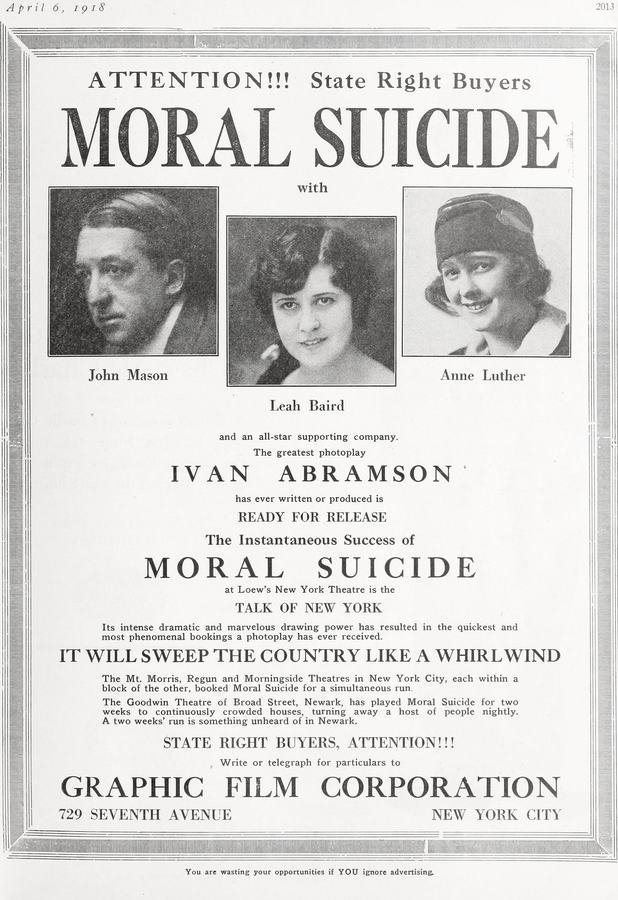
There exists a peculiar alchemy in cinema that transforms the crumbling of a family into a universal parable of human frailty. Moral Suicide, directed with aching precision by Ivan Abramson, achieves this with a narrative that is as much a study of psychological decay as it is a melodrama of excess. The Covington household, once a bastion of opulence, becomes a microcosm of societal rot, where the sins of the father reverberate through generations like a dissonant chord.
The film opens with Richard Covington (Sidney Mason), a man whose gilded age is rapidly tarnishing. His marriage to Fay Hope (Leah Baird) is less a union of souls and more a transaction of power—Fay’s seductive veneer masking a calculating mind that siphons Richard’s fortune. The cinematography here is telling: golden hues of wealth give way to shadowed corners, symbolizing the encroaching darkness of fiscal and emotional ruin. When Richard, in a fit of paternal disdain, banishes his daughter Beatrice (Anna Luther), the act is not merely a domestic rift but a symbolic severing of the family’s moral compass.
If Moral Suicide is a tragedy, it is one of flawed individuals navigating a labyrinth of their own making. Waverly (Claire Whitney), the elder daughter, is portrayed with a volatile intensity that borders on Shakespearean. Her impulsive murder of 'Lucky' Travers (John Mason), the man who both betrays and consumes her, is a crescendo of emotional chaos. The film’s use of close-ups during this scene—her eyes wide with a mix of rage and despair—captures the visceral collapse of a woman whose love has curdled into obsession.
Beatrice, by contrast, is the silent storm. Her role as a Secret Service agent, revealed in a climactic twist, reframes her earlier stoicism as a calculated strategy. Anna Luther’s performance is a masterclass in restraint; her measured glances and clipped dialogue suggest a woman who has long understood the futility of emotion in a world governed by pragmatism. The juxtaposition of Waverly and Beatrice—a firebrand and a strategist—mirrors the film’s central thesis: that survival in the face of moral decay demands either recklessness or cold detachment.
At its core, Moral Suicide interrogates the paradox of redemption in a narrative where every action is steeped in consequence. Richard’s journey from patriarch to a destitute sandwich-board man is a harrowing arc, rendered with unflinching honesty. The scene where he encounters Beatrice in New York—a fleeting moment of recognition between a father and daughter—echoes the futility of reunion in a family fractured by betrayal. The film’s palette here is stark: the cold, industrial grit of the city mirrors Richard’s internal desolation, a far cry from the gilded halls of his former estate.
The final act, wherein the family reunites after Waverly’s asylum release, is a masterstroke of narrative irony. The reunion is not a triumph but a hollow gesture, underscored by the characters’ inability to reconcile their past. The dialogue is laced with subtext—Rodman Daniels (James Morrison), Beatrice’s fiancé, becomes a symbol of societal order attempting to stitch together a torn family. Yet, the film resists providing catharsis, leaving the audience with the bitter aftertaste of unresolved tensions.
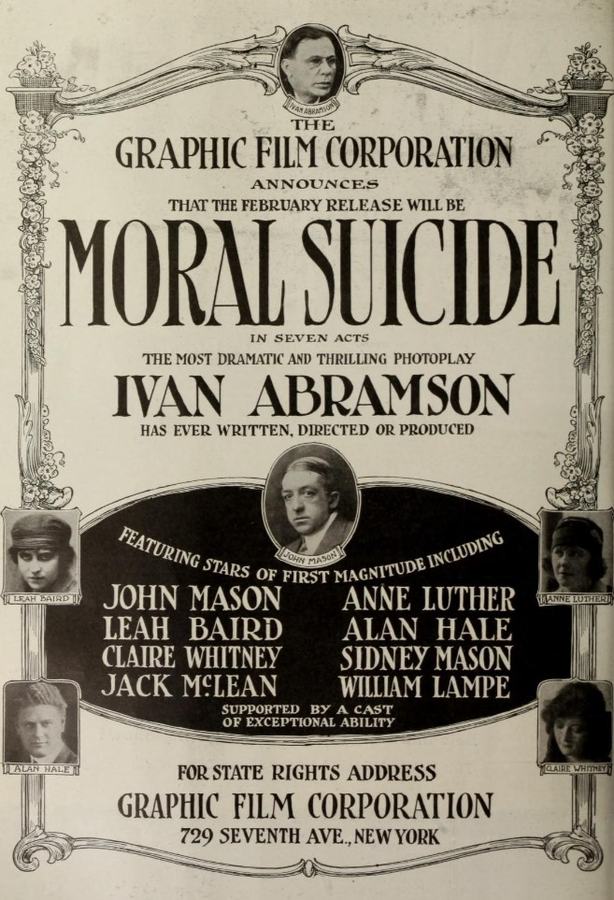
Visually, Moral Suicide is a feast of shadows and light. The use of chiaroscuro in Fay’s scenes—her face half-lit as she manipulates Richard—visually codifies her role as a figure of moral ambiguity. The recurring motif of mirrors, particularly in the Covington mansion, reflects the characters’ fractured identities. In one haunting sequence, Waverly gazes into a cracked mirror, her reflection splintered, symbolizing her psychological fragmentation post-act of violence.
The score, a dissonant blend of strings and eerie woodwinds, amplifies the sense of impending doom. During the asylum scenes, the music swells with a frenzied urgency, mirroring Waverly’s descent into madness. These auditory cues, coupled with the stark production design, create an atmosphere where even silence feels oppressive.
While Moral Suicide draws thematic parallels to other silent-era tragedies like The Long Trail, it distinguishes itself through its psychological depth. Unlike the more straightforward moralizing of The Actress’ Redemption, Abramson’s film is a labyrinth of ambiguity, where characters are both victims and architects of their downfall. The influence of Blackbirds is evident in the use of domestic spaces as sites of conflict, yet Moral Suicide transcends mere melodrama with its existential undertones.
Technically, the film’s pacing is deliberate, allowing the audience to marinate in the characters’ fates. The use of intertitles is sparse but impactful, with each phrase carrying the weight of a Shakespearean soliloquy. In this regard, it shares DNA with Il Potere Sovrano, though its emotional core is more intimate.
Moral Suicide is a film that lingers long after the final credits roll. It is a testament to the power of cinema to dissect the human condition with unflinching candor. The Covingtons’ saga is not merely a cautionary tale about greed or passion but a profound exploration of how individuals navigate the wreckage of their choices. In an era where moral absolutes often clash with the complexities of modern life, Abramson’s film remains a poignant reminder that the line between ruin and redemption is as thin as a shattered mirror.
For those seeking a visceral, intellectually stimulating experience, Moral Suicide is an essential viewing. Its legacy lies not in tidy resolutions but in the questions it leaves unanswered—a challenge to the audience to confront the shadows within themselves.
IMDb 6.3
1934
Community
Log in to comment.