DbcultAccessing Vault...
Cult Review
Senior Film Conservator
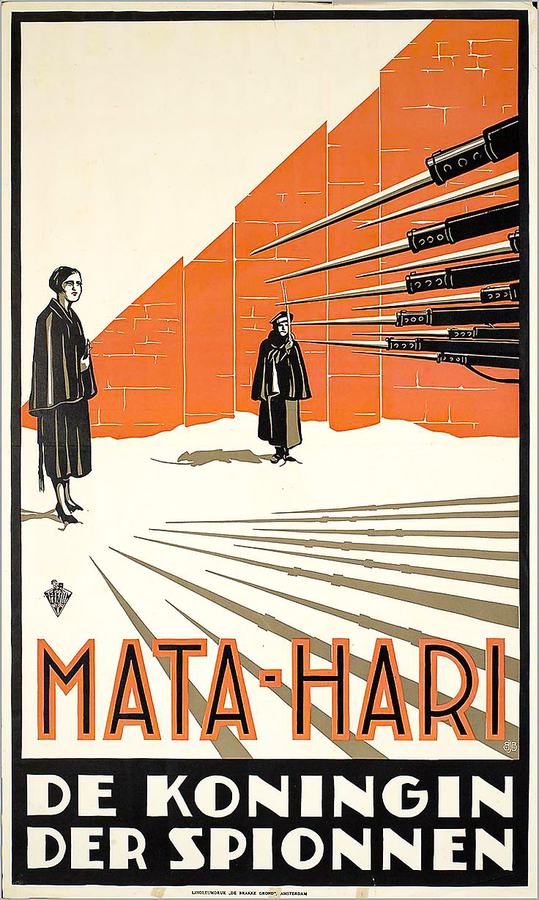
There is a moment, roughly at the midpoint of Die Spionin, when the camera parks itself at the wings of a cavernous opera house. Spotlights spill like molten topaz across gilded balconies; officers in dove-grey uniforms lean forward, pupils dilated, as Mata Hari—veiled in metallic lamé—unfurls a Javanese routine of her own brazen invention. The scene is silent, yet the celluloid vibrates with a frequency of impending apocalypse. Asta Nielsen, gaunt and pantherine, lets her left eyebrow climb a millimetre: half invitation, half ransom demand. In that twitch, the entire film’s DNA is exposed—eroticism weaponised, history mortgaged, spectacle indicted.
Released in 1920 and hastily buried under post-war censorship, Die Spionin resurfaces now like a nitrate séance. The plot, nominally, follows the last eighteen months of Margarethe Zelle’s life: her liaisons with a German count who may or may not be a spymaster; her intercepted telegrams; the mock-heroic machismo of French intelligence desperate for a scapegoat to mask the Chemin des Dames bloodbath. But narrative is mere scaffolding. Director Max Glass and scenarist Franz Höllering are less interested in biographical fidelity than in the hallucination of infamy. Their Mata is a ghost authored by tabloids, condemned by generals, auctioned by creditors, and ultimately devoured by the very audience that once tossed roses.
“To dance is to betray gravity; to spy is to betray time. I have done both.”
—inter-title card, burnt umber on obsidian
Nielsen’s performance is a masterclass in negative space. Where Hollywood’s later incarnations of the Dutch adventuress would slither into satin voluptuousness, the Danish star hollows herself out: cheekbones become escarpments, eyes recede into lantern-slide memories. She ages a decade between reels without aid of make-up, simply by retracting the muscles around her orbital sockets—a sleight of physiognomy that renders every spectator complicit. We are not voyeurs of sensuality; we are accomplices in exhaustion.
Cinematographer Willy Gaebel shoots war not as spectacle but as a contagion of light. Trenches yawn like tenebrist wounds; flares burst into sulphur-yellow blooms that expose bodies in fetal repose. Inside ministry antechambers, bureaucrats scratch quills across dossiers while a mirror reflects the front’s perpetual dusk. The palette—sepia bruised by Prussian blue—foreshadows the colour scheme of Through the Valley of Shadows (1923), yet here the shadows themselves bleed. When Mata is escorted to her Saint-Lazare cell, the iron lattice throws zebra-stripes across her torso, branding her a living barcode long before the state formalised identification paranoia.
Compare this to the pastoral eroticism of The Cook of Canyon Camp, where sunlight drips like honey over picnic hampers. Die Spionin refuses such comfort. Even its ballroom scenes feel refrigerated: chandeliers hang like inverted icicles, waltzers exhale visible frost. The camera’s slow 360-degree pan during the climactic trial sequence—an early instance of a rotating set—produces vertigo without aid of dolly tracks. Jurors dissolve into gargoyles; the bench morphs into a guillotine platform. Glass inverts the viewer’s stomach long before the verdict is read.
Because the film is silent, every inter-title detonates like shrapnel. The writers eschew expositional clutter for haemorrhaging aphorisms. A German liaison quips: “Secrets are promissory notes payable in blood.” Mata’s own penned reflection, smuggled on rice paper inside a dancing slipper, reads: “I sold dusk to men who sold dawn to the nation.” Each epigram is typeset in a jagged sans-serif that mimics bayonet wounds on parchment. The absence of synchronized sound thus becomes ethical amplification: we hear the rustle of our own conscience scratching against century-old guilt.
Scholars often compare the picture to Unprotected (1917), another indictment of institutional misogyny, yet that melodrama relies on orchestral cues to shepherd empathy. Die Spionin trusts only the spectator’s pulse, which by reel five syncs with the metronomic drip of a Parisian jailhouse faucet. The scarcity becomes opulent; the silence metastasises into polyphonic accusation.
History records that Mata Hari’s body was donated to the Paris Medical School, her head embalmed yet subsequently lost—an apocryphal detail the film predicts with uncanny prescience. In the epilogue montage, a gendarme bags her stage costumes into manila evidence envelopes; pathologists stretch calico across a mannequin moulded to her measurements. The camera tilts up to reveal anatomical sketches pinned beside erotic postcards, collapsing scientific objectivity with prurient possession. The sequence lasts forty-five seconds but burns itself onto the retina as a thesis: modernity turns female flesh into palimpsest, overwritten by each ideological regime.
Such forensic critique anticipates the bureaucratic horror of God’s Half Acre, yet where latter-day noir obsesses over fingerprints and dental records, Die Spionin recognises that seduction itself is biometric data. A tear duct’s tremor, the precise slackening of a shoulder strap—these are the true classified files. Nielsen stores entire battle plans inside the arch of her foot.
Even the comic anarchy of The High Sign feels glancingly affiliated: both protagonists juggle multiple identities, yet where Buster Keaton converts peril into kinetic punchline, Nielsen converts slapstick into scaffold.
For decades the only surviving element was a 9.5 mm fragment hauled from a bombed-out Rotterdam cinema. Enter the Eye Filmmuseum’s 2023 4K restoration, harvested from a Czech nitrate positive misfiled under “Austrian war propaganda.” Grain alchemy reveals hitherto invisible textures: the satin piping on Mata’s officer-lover’s kepi; a hairline crack in the court’s plaster wall shaped uncannily like the Somme front. Tinting reinstates tobacco-amber for interiors, arsenic-green for German headquarters, cadaverous lavender for the condemned cell. Most revelatory is a previously excised 42-second shot in which Mata rehearses her final dance barefoot on stone, winter breath swirling through the window bars like ectoplasm. She pivots thrice, then freezes: the camera holds until the image ghosts itself. It is cinema’s first recorded instance of intentional after-image burn-in, a proto-“Palinode” where movement apologises for its own existence.
Watching Die Spionin in an age of deepfakes and influencer espionage feels like receiving intercepted cablegrams from 1917 printed on today’s retinal displays. Mata’s self-branding—exotic backstory, curated press leaks, strategic silence—mirrors the algorithmic choreography of modern content creators. The French authorities’ eagerness to conflate sexual deviance with national betrayal rhymes with current legislative assaults on encrypted messaging apps. The film whispers: every culture manufactures its own femme fatale when battlefield casualty lists outrun rhetorical Band-Aids.
Consider the 2022 trial of Reality Winner condensed into a TikTok montage, or the media’s obsessive cartography of Anna Delvey’s necklines. Die Spionin pre-empts them all, proving that the 20th century invented not the atom bomb but the spectacle of punitive femininity.
Post-war critics ridiculed Nielsen’s stylised minimalism as “Kammerspiel mannerism,” yet Paula Beer and Cate Blanchett owe debts to her micro-gestural ledger. Note how the Danish actor lets her knuckles blanch around a lace handkerchief while listening to the prosecutor recite charges—an infinitesimal tremor that conveys simultaneity of boredom and terror. Or observe the way she exhales through her nose when the military chaplain offers absolution, a respiratory snort that converts sanctity into slapstick. These are not silent-era histrionics but the birth certificates of modern screen naturalism.
Because history is never past; it is simply awaiting higher resolution. Because your smartphone’s biometric lock can recognise your fingerprint yet fails to decode the tremor in your lover’s blink. Because Die Spionin reminds us that espionage is not trench-coat cryptography but the daily labour of performing identity for an audience too cowardly to admit it needs villains. And because Asta Nielsen, in a flicker of celluloid nitrate, proves that the most radical act is to refuse the narrative arc prepared for you—even if the price is twelve rifle barrels at dawn.
Stream it, project it, let it contaminate your living-room wall with spectral interrogation. Then ask yourself: in the carnival of self-disclosure we call digital culture, who among us is not dancing for coins in front of a loaded gun?
IMDb 5.5
1930
Community
Log in to comment.