DbcultAccessing Vault...
Cult Review
Senior Film Conservator
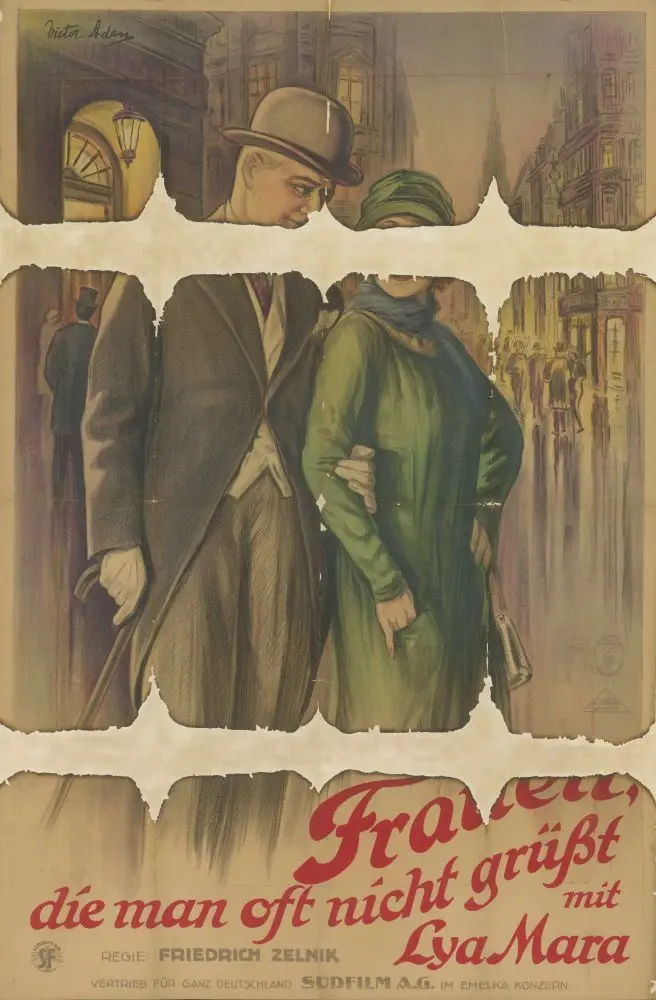
In the realm of cinematic storytelling, few films have managed to captivate audiences with the same level of intrigue and sophistication as 'Frauen, die man oft nicht grüßt'. This masterpiece, crafted by the visionary minds of Helmuth Orthmann and Hans Behrendt, is a complex tapestry of human emotions, relationships, and the art of deception.
The film's narrative is expertly woven around the lives of its protagonists, Oreste Bilancia and Margarete Kupfer, whose paths intersect in a dance of fate and circumstance. As the story unfolds, the audience is drawn into a world of moral ambiguity, where the lines between right and wrong are constantly blurred.
One of the most striking aspects of 'Frauen, die man oft nicht grüßt' is its use of character development. The cast, which includes Hertha von Walther, Viktor Senger, and Elena Lunda, delivers performances that are at once nuanced and captivating. Each character is multidimensional, with a rich inner life that adds depth and complexity to the narrative.
The film's themes of deception and facade are expertly explored through the character of Oreste Bilancia, whose charismatic presence belies a deeper sense of vulnerability. As the story progresses, Bilancia's character is revealed to be a master manipulator, using his charm and wit to navigate the complex web of relationships that surrounds him.
In this sense, 'Frauen, die man oft nicht grüßt' can be seen as a commentary on the social masks we wear, and the ways in which we present ourselves to the world. The film's use of costume and set design adds to this sense of artifice, creating a world that is at once luxurious and superficial.
A closer examination of the film's narrative structure reveals a non-linear approach, with unexpected plot twists that keep the audience engaged and invested. This approach is reminiscent of other films that have successfully employed similar techniques, such as One of the Finest and The Midnight Girl.
The cinematography in 'Frauen, die man oft nicht grüßt' is equally impressive, with a use of lighting and shadow that adds to the overall sense of tension and unease. The film's score, while not overly prominent, provides a subtle underscore to the action on screen, adding to the overall sense of unease and uncertainty.
In terms of its place within the broader cinematic landscape, 'Frauen, die man oft nicht grüßt' can be seen as part of a larger tradition of films that explore themes of deception and morality. Other films, such as The Jail Bird and The Volcano, also explore these themes, albeit in different ways.
One of the key strengths of 'Frauen, die man oft nicht grüßt' is its ability to balance complex themes with engaging storytelling. The film's pacing is expertly managed, with a narrative that flows smoothly and keeps the audience engaged. This is a testament to the skill of the filmmakers, who have managed to craft a film that is both intellectually stimulating and emotionally resonant.
In conclusion, 'Frauen, die man oft nicht grüßt' is a masterpiece of cinematic storytelling, with a complex narrative, nuanced characters, and a thought-provoking exploration of human connection and deception. While it may not be to everyone's taste, this film is a must-watch for anyone interested in exploring the intricacies of the human condition.
For those looking to explore similar films, The Delicious Little Devil and Jack O'Clubs are both worth checking out. Additionally, Kino-pravda no. 7 and My Dog, Pal offer interesting perspectives on the role of cinema in shaping our perceptions of reality.
Ultimately, 'Frauen, die man oft nicht grüßt' is a film that will leave you questioning the nature of reality and the human condition. Its complex themes, engaging narrative, and nuanced characters make it a must-watch for anyone interested in exploring the intricacies of the human experience.

IMDb —
1916
Community
Log in to comment.