DbcultAccessing Vault...
6.6/10
Senior Film Conservator
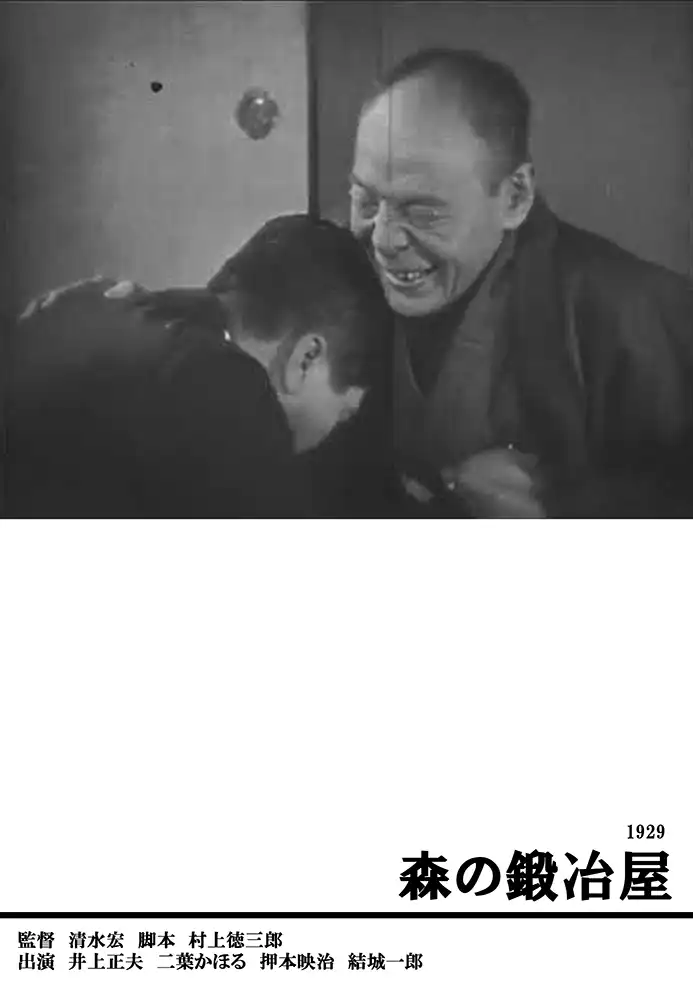
A definitive 6.6/10 rating for a film that redefined the boundaries of cult cinema. Mori no kajiya remains a cornerstone of transgressive art.
You should probably watch this if you like old movies that don't try to be too clever. It is a great pick for a Sunday afternoon when you want to feel something but don't want to get a headache from a complicated plot. People who hate slow pacing or reading title cards will probably find it boring though.
Kyosuke is the blacksmith and he is a big, sturdy guy. He spends a lot of time hitting hot metal with a hammer. You can almost smell the soot and the sweat in his shop. The way the sparks fly in the black and white footage looks really cool.
He has two sons, Jiro and Ichiro. They seem like good kids who just enjoy running around the trees. But then Jiro falls. It happens fast and it’s one of those moments that makes your stomach drop a little. He is crippled after the fall and the whole mood of the house just shifts.
The movie gets very quiet here. Not just because it is a silent film, but the energy feels heavy. Kyosuke looks like he’s aged ten years in five minutes. It’s the kind of acting where you don't need words to know he feels guilty. Masao Inoue plays the dad and he has these very heavy, sad eyes.
Ichiro is the brother who isn't hurt. He decides he has to do something about it. He decides he’s going to be a doctor. Just like that. It’s a bit of a leap, but in these old stories, people have big goals and they just go for them.
He leaves for the city to study. The city in this movie feels like a different planet compared to the forest. It’s loud and crowded and everyone is in a rush. I liked the contrast between the tall trees and the tall buildings. It makes Ichiro look very small and out of place.
I noticed that his medical books look incredibly heavy. He carries them around like they are blocks of lead. There is a scene where he is studying by a tiny lamp and he looks totally exhausted. You can tell he is doing it all for Jiro. The brotherly bond is really the heart of the whole thing.
Kinuyo Tanaka shows up in this too. She is very young here but she already has that screen presence. She doesn't have a huge role but every time she’s on screen, the movie feels a bit brighter. She has a way of looking at the camera that feels very realy and honest.
Some of the medical stuff is a little bit silly by today’s standards. He talks about "curing" his brother like it’s a simple puzzle to solve. But back then, medicine probably felt like magic to people living in the woods. I didn't mind the lack of realism because the emotions felt right.
There is a scene where Jiro is sitting by the window looking out at the forest. It goes on for a long time. Maybe a bit too long. I started looking at the wallpaper in the background because the shot didn't change for a while. It’s a very pretty forest, though.
I wonder if the director, Tokusaburō Murakami, was a fan of movies like The Orphan. There’s a similar vibe of family members being separated by fate. It’s a classic trope for a reason. It works on your heartstrings without even trying that hard.
The ending is pretty much what you expect. It doesn't throw any wild curveballs at you. It’s a very straight line from A to B. But sometimes a straight line is exactly what you need. It’s comforting in a way.
One thing that bugged me was the makeup on the older characters. It looks a bit thick and cakey in some of the close-ups. You can tell they were trying to make them look more "country," but it just looks like white powder. It’s a small thing, but once you see it, it’s hard to un-see.
The music in the version I saw was a bit repetitive. It was just the same three piano chords over and over during the sad parts. I think I would have preferred total silence for some of those scenes. The actors were doing enough with their faces that the music felt like it was trying too hard to tell me how to feel.
Overall, it’s a solid piece of history. It isn't a masterpiece that will change your life, but it’s a nice story. It makes you want to call your siblings and make sure they are okay. Kyosuke’s hammer hitting the anvil is a sound that stayed with me after it ended.
I liked the dog too. There is a dog that appears in the background of the village scenes. It doesn't do anything important but it looks like a very good boy. Small details like that make the world feel lived in. It’s a dusty, sweet little film.
IMDb —
1926
Community
Log in to comment.