DbcultAccessing Vault...
Cult Review
Senior Film Conservator
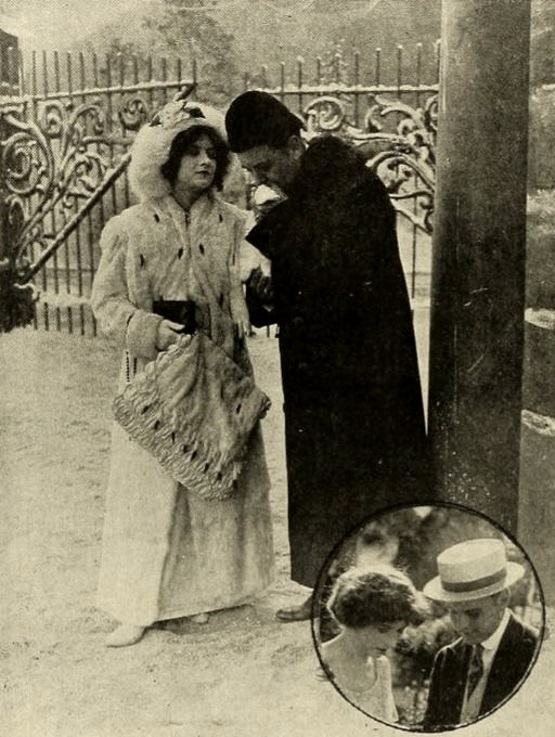
A cathedral of silence glowers in 1913 nitrate: Moths.
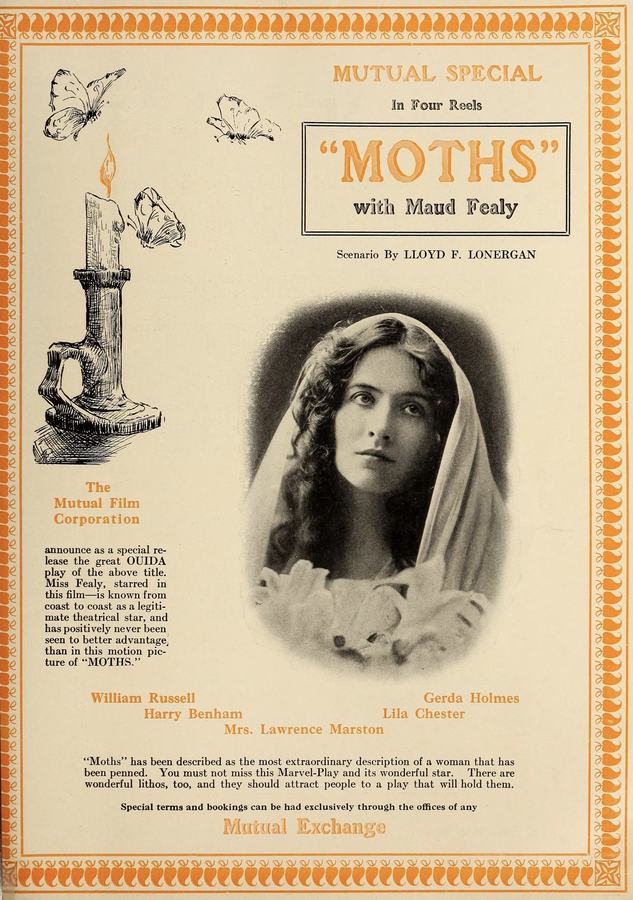
Imagine a frost-laced intertitle arriving like a death-knell: "To save her mother’s name, she will bury her own heartbeat." The screen, already trembling with sepia emulsion, exhales this premise through veils of cigarette smoke and whale-oil perfume. Director Lloyd Lonergan—never shy of melodrama’s razor—adapts Ouida’s incandescent novel into a chamber piece where every close-up feels pried open by surgical forceps.
Maude Fealy, ivory-complexioned and combustibly demure, incarnates Marie de L’Orme, a doll-like cosmopolite whose soul vibrates at 432 Hz each time Harry Benham’s opera tenor Armand unleashes a tremulous high note. Their first encounter occurs behind the garnet drapes of Opéra-Comique: he sings; she listens, gloved fingers tightening around a program until the parchment splits. No kiss is exchanged, yet the cutaway to a gaslight’s quivering mantle tells us a universe has tilted.
Enter William Russell as Count Voronoff, a man carved from glacial marble, fur-collared, epaulettes flashing like guillotine blades. His proposal is less courtship than acquisition: a merger of Franco banking and Muscovite land. Gerda Holmes’ Baronne—Marie’s dragon-mother—accepts on behalf of honor, blood, and the trembling family crest. Cut to a wedding banquet staged in a cavernous set dripping with candelabra: ice sculptures of swans bleed under chandeliers; servants glide like chess bishops; the bride’s smile is embalmed.
Nitrate poetry unfurls.
Lonergan’s visual grammar favors tableaux vivants held just long enough for discomfort to pool. In one breathtaking iris-shot, Marie stands between two mirrors—her reflection triplicated into infinity—while a moth beats against the kerosene lamp, leaving powdery wing-prints on the glass. Metaphor? Unsubtle, but the blunt ache works because Fealy lets us watch her pupils dilate with self-recognition: she is the insect.
Armand pursues, Voronoff polices, the Baronne hisses platitudes. A letter smuggled in a bouquet of lily-of-the-valley arranges a midnight rendezvous aboard a Thames barge decked with faded bunting. Fog swallows the set; only the tenor’s aria and the lapping tide punctuate the hush. When Voronoff’s Cossack henchmen abduct Armand, the film flirts with swashbuckling sensationalism, yet the violence is chiefly emotional: Marie, arriving seconds too late, cradles her lover’s crushed sheet music in the rain—paper dissolving like communion wafers on her tongue.
What rescues Moths from mere femme-martyrology is its willingness to indict the matriarchal conveyor belt that packages daughters for sacrifice. Holmes, beneath powdered wig and beauty-patch armor, delivers monologues on lineage with the cold precision of a stock-market ticker. She is Lady Macbeth rewritten by Balzac—all ledger, no lactation.
Design deserves ovation.
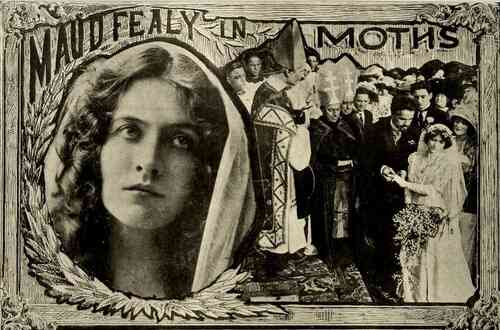
Art director Carl Stahl festoons Russian parlors with onion-dome stencils, samovars, and iconostasis screens gilded enough to rival Les Amours de la reine Élisabeth’s Versailles excess. Costumers drape Fealy in corded silk that shifts from dove-grey (Parisian innocence) to blood-amber (marital bed) to funereal onyx (final rebellion). Tinting alternates cerulean for Russian snowstorms, rose for flashback reveries, sickly viridian for moral rot—an operatic spectrum worthy of Parsifal’s Wagnerian chromatics.
Musically, exhibitors in 1913 often accompanied the reel with Tchaikovsky adagios punctuated by a lone tenor’s offstage libiamo. Modern viewers streaming a restored 4K print from George Eastman House can select a commissioned score by Alexandra Gardner that layers glass harmonica over heartbeat-like timpani—an aural equivalent of moth wings brushing against human ventricles.
Fealy’s micro-gestures—a left eyelid flutter when Armand sings, the way her shoulder-blades pinch as if corset strings were tied to church bells—convey interior detonation without modern-method histrionics. Benham, though denied the intertitle space afforded to Fealy, weaponizes his tenor physique: shoulders thrown back, diaphragm thrust forward, a living exclamation point of romantic idealism. Russell, saddled with villainy, resists mustache-twirling; instead he plays Voronoff as bruised ego incarnate, a man who equates possession with adoration and is genuinely bewildered when it fails to breed affection.
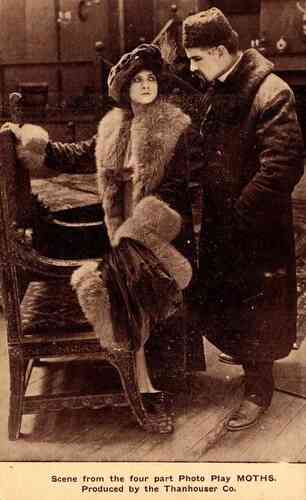
The finale—shot in a single, unforgiving long take—locks us in a bedroom where Marie, swathed in smoke from a shattered lamp, decides between the vial of prussic acid and the open window overlooking Neva ice. Lonergan withholds cutaway; we watch Fealy’s pupils oscillate, her breath frost the lens, her hand tremble like the aforementioned moth. Then—jump cut to a shimmering opera house box where Armand, voice cracked but alive, sees Marie slip in, cloaked, eyes afire. No subtitle clarifies whether she is ghost or flesh, wife or runaway. The curtain falls on his high-C, her silent scream, and the audience left to jury the afterlife.
Compare this ambiguity to the moral absolutism of From the Manger to the Cross or the docu-stoicism of The Corbett-Fitzsimmons Fight; Moths dares irresolution, forecasting the psychological open endings that would not dominate art-houses until the 1960s.
Cinematographer Blair Smith exploits early 3-strip tinting and vignette masks shaped like Fabergé egg ovals, predating Dante’s Inferno’s expressionist silhouettes by a full decade. Depth is suggested via diagonal staging: characters stride from background cavern to foreground carpet in the same unbroken shot, a proto-deep-focus flourish achieved with arc lights and reflective muslin rather than lenses.
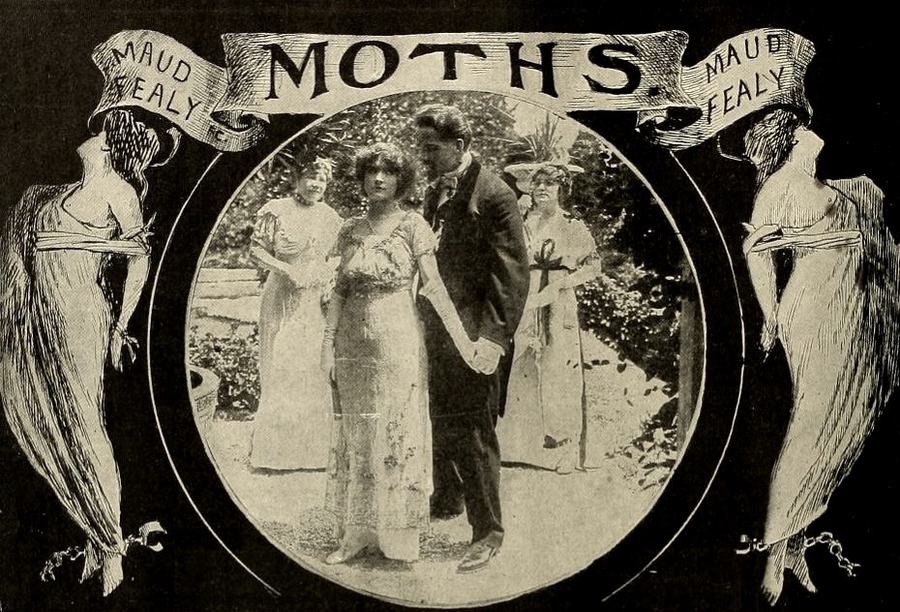
Socially, the film vibrates on proto-feminist frequencies. Marie’s tragedy is systemic: patriarchy weaponizes motherhood, aristocracy monetizes affection, church sanctifies obedience. Yet her final act—whether suicide or escape—reclaims narrative agency. In 1913, such a stance lands like a brick through stained glass; contemporary critics at Moving Picture World called the plot relentlessly French
(read: indecent), while Vanity Fair praised its delicate brutality
.
An unnecessary comic-relief valet (played by an uncredited James Lackaye) jolts tonal cohesion every time he pratfalls over bear-skin rugs. One reel—likely reel 4 in original release—survives only in Dutch nitrate, causing a subtitle language hiccup that modern restorations paper over with digital English overlays. Finally, Ouida’s source novel embeds a backstory on Voronoff’s Freemasonry dabbling; the film trims it, rendering his obsession with lineage feel more generic.
Still, these flecks of dust cannot cloud the mirror’s tragic gleam. Moths is a pre-Code jewel smuggled out of the Edwardian era, its wings beating against the suffocating bell jar of social expectation. Watch it for Fealy’s translucent agony, for the opera-within-cinema meta-narrative, for the chiaroscuro snow that anticipates The Student of Prague’s gothic shimmer. Watch it because, a century on, we still trade authentic song for security, still pin wings to cork boards labeled success.
Restoration devotees should note the alternate Library of Congress ending where Marie’s silhouette dissolves into an actual moth superimposed via double exposure—an arguably too-literary device excised from most circulating prints. Both conclusions exist on Blu-ray, allowing curatorial debate in living rooms rather than academic cloisters.
Verdict: Moths is essential viewing for anyone mapping the DNA of modern melodrama, feminist counter-readings, or simply the luminous fragility of silent acting. It stings, it soars, it leaves powder on your fingertips. Let it flutter into your watchlist before time’s flame chars another frame.
IMDb 6.4
1934
Community
Log in to comment.