DbcultAccessing Vault...
Cult Review
Senior Film Conservator

Few films capture the visceral shockwaves of World War I with the unflinching intimacy of Rupert Hughes' 1919 tour-de-force. While contemporaries like Over the Top glorified battlefield heroics, Hughes and screenwriter Kathryn Stuart plunge into war's corrosive effect on civilian psyches, crafting a narrative where physical survival often demands moral compromise. The opening idyll—sun-dappled Belgian gardens where Leonie reads poetry to her mother—shatters not with artillery, but with the sickeningly polite arrival of German officers demanding quarter. Director Hughes weaponizes silence: the absence of diegetic sound amplifies the chilling scrape of boot heels on hardwood, the silent collapse of Madame Maret’s composure as her drawing room becomes an interrogation chamber.
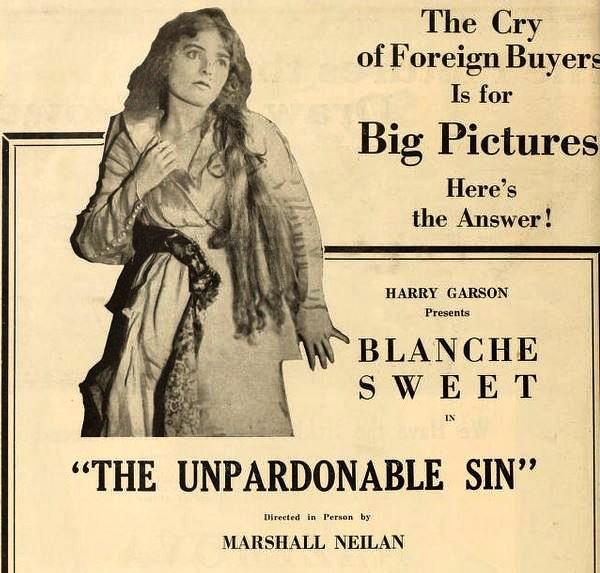
Blanche Sweet’s dual embodiment of sisters Leonie and Jeanne represents silent cinema’s nuanced apex. Leonie moves with haunted grace, her wide eyes reflecting horrors too profound for intertitles—particularly in the much-debated sequence where Prussian Captain Von Gortz (a chillingly bureaucratic Edwin Stevens) “inspects” her bedchamber. Sweet conveys violation through trembling fingers pressed against wallpaper, a spine rigid with terror. Contrastingly, Jeanne radiates incandescent fury, her journey from New York socialite to hardened aviator mapped through costuming: silks devolve into mud-caked trousers, a pearl-handled pistol gleaming against rough wool. Sweet’s physicality shifts completely—Leonie’s delicate gestures replaced by Jeanne’s athletic prowl through black-market alleys and bombed-out convents.
Hughes constructs Belgium as a liminal nightmare space. Cinematographer John Leezer’s expressionist flourishes—distorted shadows of barbed wire creeping across refugee faces, ceilings that seem to press downward in prison cells—predate German Expressionism’s golden age. The director’s background in gritty Westerns like The Range Boss manifests in taut chase sequences: Jeanne’s flight across no-man’s-land, lit only by star shells, transforms Flanders mud into a lunar hellscape. Yet the film’s true audacity lies in implicating commerce in atrocity. Wallace Beery’s magnificently slimy Von Eberhard—trading Red Cross parcels for information—operates alongside domestic profiteers, culminating in a devastating betrayal involving a lace smuggler (Dick Curtis) exploiting starving children.
Thematic resonance with later Hughes works like Mortmain appears in the corrosive power of secrets. Jeanne’s discovery of her sister’s trauma fractures her quest: rescue becomes retribution. Hughes stages their reunion with brutal restraint—no melodramatic embrace, just Leonie’s hollow stare past Jeanne’s shoulder, fingers worrying at a frayed blanket. This psychological realism extends to the controversial climax: Jeanne cornering Von Gortz not on a battlefield, but in a requisitioned opera house during a performance of Faust. As Méphistophélés sings of damnation onstage, Jeanne’s pistol wavers between justice and vengeance. The resolution—intercut with Madame Maret’s whispered confession to a priest—forces audiences to ponder whether absolution requires bloodshed.

Supporting players etch indelible grotesques. Bull Montana’s smuggler, Raspy, communicates menace through simian posture and guttural snarls, his clawed hand snatching bread from orphans. Wesley Barry’s turn as a quick-fingered urchin provides unsettling comic relief—a precursor to the streetwise kids in Shoe Palace Pinkus, but darkened by desperation. Mary Alden’s Madame Maret achieves profound pathos when her maternal piety curdles into something terrifying—her third-act monologue (conveyed via an unusually lengthy intertitle) lands like a theological grenade, questioning divine justice amidst man-made hell.
Textural authenticity elevates the production beyond propaganda. Costume designer Helen Rose sourced actual Belgian widows’ weeds—coarse, ash-grey fabric that seems to absorb light—contrasting sharply with German officers’ impeccably tailored uniforms. Scenes in the occupied village utilized newsreel footage of bombed-out Ypres churches, their skeletal spires looming behind actors. This commitment to verisimilitude grounds even the more contrived espionage subplots, like Jeanne’s aerial reconnaissance mission echoing real-life female war pilots.

The film’s legacy remains complex. Banned in several U.S. cities for its sexual implication and anticlerical themes, it nonetheless influenced later trench-set melodramas like The Moment of Victory. Hughes’ refusal to sanitize occupation brutality—forced labor, systemic rape, child starvation—feels startlingly modern compared to the jingoistic thrillers dominating 1919, such as Officer 666. Contemporary critics overlooked its formal innovations (deep focus shots during the convent raid predate Welles by decades) to debate its morality. Yet the film’s power resides precisely in this moral ambiguity. When Jeanne ultimately chooses familial love over vigilante violence—lowering her weapon as Von Gortz escapes—it’s not triumph we feel, but sickening relief. Hughes suggests that in war, the unpardonable sin isn’t atrocity, but the preservation of humanity at any cost.
Restoration comparisons reveal fascinating details: surviving prints show Leezer’s meticulous tinting techniques—amber for candlelit interiors, steel-blue for trench scenes, hellish crimson during the opera house climax. These choices transcend mere mood-setting; the color becomes psychological commentary. Notice how Leonie’s prison cell shifts from sickly green to utter blackness as hope expires. Such sophistication in visual storytelling rivals the symbolic palette of Tepeyac.
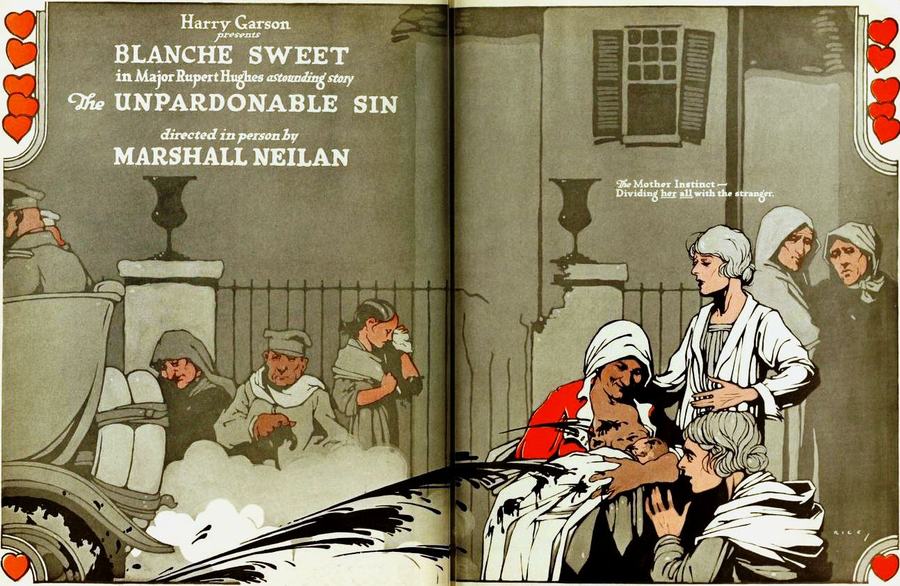
Ultimately, the film belongs to Blanche Sweet. Her ability to differentiate identical twins through gesture alone remains a masterclass in physical acting. Watch Leonie’s hands—always clasped tightly in her lap, as if containing collapse—versus Jeanne’s restless, calloused palms constantly testing knife edges or gunmetal. This duality reflects the film’s core tension: the civilized self versus the primal survivor. In an era when female roles often defaulted to victimhood (as in Martha's Vindication) or decorative romance, Sweet’s Jeanne emerges as one of silent cinema’s most complex action heroines—flawed, furious, and profoundly human.
Modern viewers may grapple with its melodramatic conventions—coincidental meetings, last-minute rescues—but these elements heighten rather than diminish its impact. Hughes understood that war shatters narrative logic; absurdity permeates survival. The Unpardonable Sin endures not as a relic, but as a scorching inquiry into ethics under occupation. Its closing image—mother and daughters silhouetted against a ravaged cathedral, embracing not in joy but shared desolation—offers no easy redemption. Only the uneasy knowledge that some scars outlast treaties, and forgiveness may be the ultimate luxury of peace.
IMDb 5.5
1935
Community
Log in to comment.