DbcultAccessing Vault...
6.7/10
Senior Film Conservator

A definitive 6.7/10 rating for a film that redefined the boundaries of cult cinema. Mysteries of India, Part I: Truth remains a cornerstone of transgressive art.
The first thing that strikes you is the smell—no, not onscreen, but in your memory afterwards—of sandalwood burning too fast, of marigolds crushed under elephant tethers, of iron from a bloodied nose. Mysteries of India Part I: Truth doesn’t merely depict these aromas; it weaponizes them, turns olfaction into a narrative device so that every whiff of the prince’s paranoia lingers like an uninvited guest.
Lang and von Harbou, still honeymooning in both matrimony and aesthetic sadism, craft a kammerspiel disguised as a colonial pageant. The plot—adultery punished by labyrinthine hunt—sounds almost Jacobean, yet the treatment is quintessentially Weimar: expressionistic shadows slashed across ivory walls, erotic dread that makes Women’s Weapons look like a polite tea service, and a racial imaginary that oscillates between fetish and terror faster than a spy swapping passports.
Production designer Otto Hunte, two years away from birthing the Metropolis skyline, here erects a fortress of vertiginous ramps and impossible overhangs. Watch how corridors telescope into darkness like lunar caverns, while courtyards open to skies so overexposed they resemble incandescent parchment. The palace is a panopticon without a center: every arch frames another arch, every mirror reflects a mirror, until space itself becomes a Möbius strip where fugitives chase their own footprints.
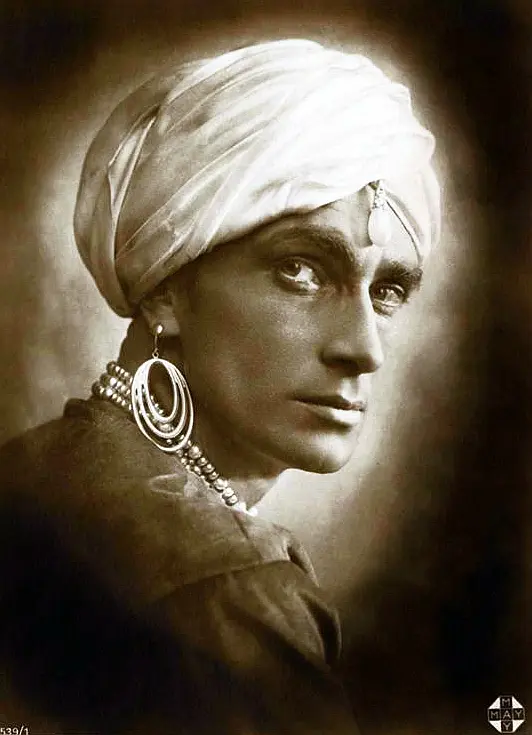
Within this Escheresque prison, Mia May’s Sujata performs a danse macabre of survival. Critics often deride May as “merely beautiful,” but here she weaponizes beauty as both armor and Achilles heel. Notice the micro-gesture when she lowers her veil: a millimeter adjustment that transforms the veil from bridal innocence to executioner’s hood. Her eyes—caught in relentless iris shots—glint with the same feral intelligence you’d find in Lola’s femme fatale, yet suffused with devotional melancholy, as though she were a temple statue suddenly cursed with sentience.
As Prince Jai Singh, Veidt elongates his limbs until he resembles a thuggee strangling rope given human form. His grin—achieved with prosthetic cheek inserts—slides sideways like a river breaking its banks. In one bravura sequence he interrogates a eunuch by letting a live cobra sip water from a silver chalice placed on the servant’s shaved head; the camera alternates between the reptile’s hooded eyes and Veidt’s unblinking stare, until viewer and victim alike cannot parse where serpent ends and sovereign begins. It’s a set-piece so perverse it makes the crucible of divine judgment feel like kindergarten hopscotch.
Do not mistake this for orientalist kitsch. Yes, turbans are oversized, the Ganges appears to flow through Bavaria, and the sitar on the soundtrack is actually a zither slowed to half-speed. Yet Lang’s mis-en-scène exposes the machinery of exoticism itself. When German miners dynamite a hillside to rescue Sujata, the explosion reveals an ancient frieze of apsaras dancing—an allegory that colonial violence unearths the very past it professes to civilize. The film thus anticipates Edward Said by six decades, while never surrendering its appetite for sensuous spectacle.
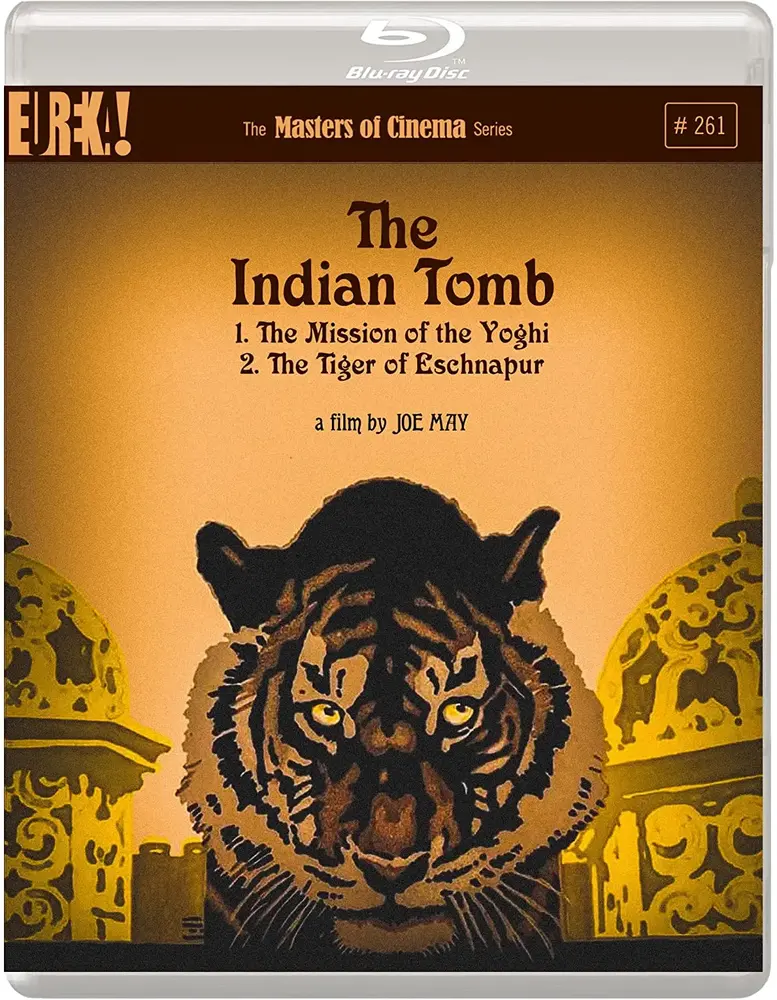
Escape narratives usually hinge on geography: cross the river, scale the wall, breach the border. Truth reconceptualizes escape as temporal. Each time Sujata bolts, the film loops back to earlier tableaux—her wedding night, her deflowering, her first glimpse of the lover—projected onto smoke screens by a wandering bioscope wallah. Past and present thus collapse into a möbius strip of memory, so that running away becomes indistinguishable from running deeper inside oneself. In this Möbius ontology, the pursuer and pursued share the same skin, a theme Lang will refine two years later in Dr. Mabuse.
Watch how von Harbou’s intertitles fracture language into mantric staccato: “I was / am / will be / his / not his.” The verbs shimmy like ankle bells, refusing fixity. Combined with Lang’s editing—an average shot length of 3.4 seconds, unheard-of in 1921—the prose-poem titles create a tempo rubato that makes violence feel both predestined and improvisational. One cut ricochets from a close-up of shackled ankles to a wide shot of monsoon clouds, so that the clink of iron bleeds into thunder as if nature itself were a co-conspirator.
Though shot on orthochromatic stock, the film achieves chromatic hallucination through tinting: deep ambers for palace interiors, cyanic blues for moonlit desert, sickly yellows for opium dens. Legend has it that Lang personally dipped each print in henna solution to give Sujata’s close-ups the tint of scorched earth. Whether apocryphal or not, the result is a celluloid that appears to exfoliate, as though the emulsion were flaking off in real time—an analogue metaphor for a woman shedding imposed identities.
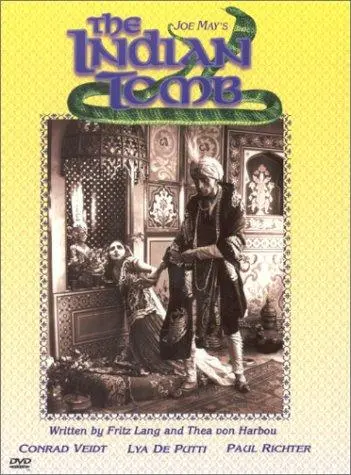
Where Ruth’s innocence is a static tableau, Sujata’s guilt is a kinetic assault. Both films end with heroines gazing at their own reflection, yet Ruth’s mirror restores moral order while Sujata’s shatters it into kaleidoscopic doubt. Likewise, the Rip Van Winkle slumber is a masculine fantasy of escape-through-stasis; Sujata’s insomnia propels her into a fugue state where every blink risks capture. Lang thus inverts the Rip Van Winkle paradigm: consciousness itself becomes the uncanny valley.
Most archival prints lack the penultimate reel—approximately nine minutes—where Sujata disguises herself as a nautch boy. Film historians mourn the loss, yet the very absence amplifies the myth. Like the furrowed earth that refuses to disclose buried seeds, the missing reel invites us to inhabit the ellipsis. We become co-authors, projecting our own nightmares of gendered camouflage onto that void. In an era when digital restorations promise wholeness, Truth dares to celebrate lacunae, proving that the most radical act of spectatorship is to imagine what the censor snipped away.
So when the lights rise and the desert wind of 1921 still seems to scrape your cheeks, you realize this isn’t exotica resurrected; it is the birth-cry of modern cinema disguised as a colonial fever dream. Watch it, then watch your own pulse—you’ll find the same arrhythmic stutter as Sujata’s hunted heart. And that, dear reader, is the most truthful mirror any film has ever held up to you.
IMDb 6.2
1921
Community
Log in to comment.