DbcultAccessing Vault...
4.7/10
Senior Film Conservator
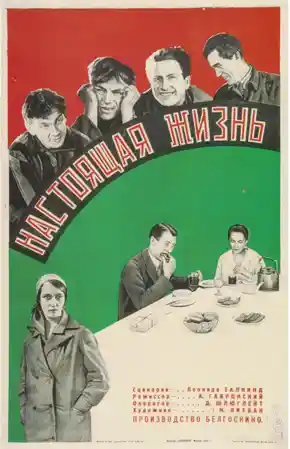
A definitive 4.7/10 rating for a film that redefined the boundaries of cult cinema. Nastojashhaja zhizn remains a cornerstone of transgressive art.
So, "Nastojashhaja zhizn." Is it worth finding today? For the curious film buff, absolutely. If you're into seeing how stories were told back then, how emotions were conveyed without a single spoken word, you might actually get something out of this. But if you need fast pacing, clear plot points, or really, any modern cinematic bells and whistles, you'll probably hate it. This one’s for the patient crowd, the ones who don't mind a film taking its sweet, deliberate time. 🕰️
The story, what there is of a conventional story, centers on A. Shelaputina's character. She’s this young woman, kinda trapped.
You feel it in her eyes, even through the slightly grainy footage. She wants more.
There’s this recurring shot of her looking out a window. It’s always framed just so, like the window itself is a cage. Not subtle, no, but effective. You can almost hear the sighs she isn't allowed to make.
Anna Zarzhitskaya plays someone else, a bit more worldly. Her character just carries this air of knowing too much. Every time she looks at Shelaputina, it's a whole paragraph of unspoken advice or warning.
The pacing can be wild. One minute, a scene holds for what feels like an eternity on a single, conflicted expression. Then, suddenly, a montage of quick cuts showing the passage of time, almost jarringly fast. It keeps you on your toes, or sometimes, just makes you wonder if the projectionist fell asleep.
I remember this one specific scene, late in the film, where Konstantin Fedotov's character just chases a hat down a street. It goes on for a solid minute, maybe more. It feels so out of place, almost comical, amidst all the heavy drama. Was it meant to be lighthearted? A metaphor? Or did they just need to fill time? I'm still not sure. 🤔
And the score! Oh man, the piano. It works so hard here. Every emotion, every tiny shift in mood, the piano is there, pushing it, pulling it. Sometimes it's a bit much, really hammering home a feeling you already got. But then, it'll hit a melancholic note that just perfectly captures a silent tear.
Yevgeniya Melnikova’s performance, even in a smaller role, felt pretty strong. There’s a scene where she’s just sitting, peeling an apple. But the way she does it, the slow, methodical movements, suggests a whole world of quiet resignation. You don't need dialogue when someone can act like that with an apple.
The film feels very much of its time. The way people dress, the carriages, the little shops. It’s a snapshot. Sometimes the acting feels a little... big, you know? Like they’re performing for the back row of a huge theater. But then, that’s part of its charm, too.
There’s a small subplot about a letter that goes missing. It's a classic setup. The drama that unfolds from this one lost piece of paper feels almost quaint now. But in the moment, you really feel the tension. Will it be found? What will happen?
Viktor Kulakov, his character is quite the scoundrel. He has this smirk, almost a grimace, that tells you everything you need to know about his intentions. Not a complex character, but he certainly gets the job done as the antagonist.
I noticed a few times the camera would linger on objects – a teacup, a wilting flower, a book lying open. It’s a neat little trick, making everyday things carry a symbolic weight. Sometimes it lands, sometimes it feels a bit heavy-handed.
It’s definitely not a film that holds your hand. You have to lean in, interpret, and sometimes just let the slow burn happen. It's a reminder that storytelling used to be a different beast entirely.
Not better, not worse, just... different.
The ending felt a little abrupt. Not quite a cliffhanger, but more like the story just... stops. You’re left to kind of piece together what happens next, or what should happen next. It's a choice, for sure. Makes you think, though.
Overall, "Nastojashhaja zhizn" is a curious artifact. It has its moments – moments of genuine beauty, moments of unexpected humor, and definitely moments where you check your watch. If you're looking for a smooth, easy watch, pass. But if you like digging into cinematic history and don't mind a bit of a rough gem, it might surprise you. It certainly made me think about how much we take for granted in modern film. ✨
IMDb —
1920
Community
Log in to comment.