DbcultAccessing Vault...
Cult Review
Senior Film Conservator
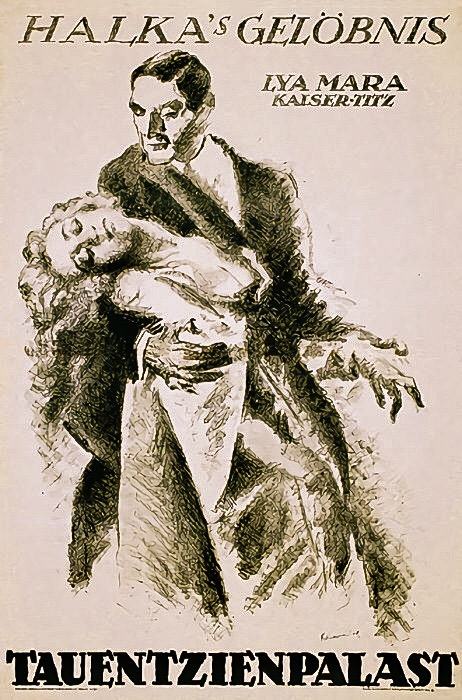
Stepping into the world of Halkas Gelöbnis is akin to unearthing a forgotten treasure from the golden age of German silent cinema. This film, a poignant relic from an era brimming with artistic innovation and societal upheaval, offers a profound exploration of human attachment, power dynamics, and the suffocating weight of an imposed future. It's a testament to the visceral storytelling capabilities of silent film, where every gesture, every flicker of an eye, and every carefully composed frame carries immense narrative and emotional weight. For those accustomed to the cacophony of modern cinema, the quiet intensity of Halkas Gelöbnis might initially feel disarming, but it quickly envelops the viewer in its melancholic embrace, revealing layers of psychological complexity that resonate long after the final reel.
The narrative unfurls with the return of Count Symon Barinowsky, portrayed with a compelling blend of aristocratic gravitas and unsettling possessiveness by Hans Albers. His long absence has shrouded him in an aura of mystery, and his re-entry into his ancestral home is not merely a homecoming but a declaration of intent. The landscape of his youth, once familiar and comforting, now feels charged with an unspoken tension, a sense of destiny awaiting its manifestation. Albers, even in the silent medium, projects a formidable presence, his commanding stature and intense gaze conveying a man accustomed to having his will obeyed, a man whose desires are not requests but pronouncements. His return is less about rekindling old affections and more about claiming what he perceives as his rightful due, a sentiment deeply rooted in the patriarchal structures of the time.
At the heart of this unfolding drama is Halka, his foster sister, brought to life with heartbreaking vulnerability and nascent strength by the extraordinary Lya Mara. Mara's performance is a masterclass in silent acting; her expressive eyes and delicate movements articulate a world of unspoken emotions. We witness Halka’s transformation from a girl on the cusp of womanhood into a figure ensnared by the count’s formidable demand. Her initial joy at Symon's return quickly morphs into apprehension, then quiet despair, as the true nature of his intentions becomes devastatingly clear. Halka is not merely a passive object of desire; Mara imbues her with an inner resilience, a subtle resistance that speaks volumes in its quiet defiance. Her struggle against Symon's claim isn't always overt; often, it’s a battle waged within the confines of her own spirit, visible only through the subtle tremors of her hands or the fleeting shadows across her face.
The central conflict stems from Symon's demand for Halka to be his, a 'Gelöbnis' or vow, perhaps made in childhood or implied by their unique foster relationship, that he now seeks to enforce with the full weight of his aristocratic authority. This isn't a plea for love, but an assertion of ownership, a patriarchal imperative that casts a long, ominous shadow over Halka’s burgeoning autonomy. The film brilliantly dissects the insidious nature of such claims, exploring how familial bonds can morph into instruments of control, and how societal expectations, particularly for women, can strip individuals of their most fundamental freedoms. The power imbalance is stark, making Halka's predicament feel both personal and universally resonant, touching upon themes of gender inequality that, sadly, remain pertinent even today.
The supporting cast, including Rudolf Lettinger and Erich Kaiser-Titz, further enriches the film's tapestry, portraying figures who either facilitate or silently observe the central drama, each adding a layer to the intricate social fabric within which Halka and Symon operate. Their performances, though perhaps less central, are crucial in grounding the narrative in a believable world, reflecting the societal norms and hierarchies that give Symon’s demands their perceived legitimacy. The film’s silent storytelling relies heavily on these nuanced portrayals, where every character contributes to the overall atmospheric tension and emotional depth.
Visually, Halkas Gelöbnis is a feast for the eyes, even if only fragments survive. The cinematography, characteristic of the era, employs dramatic lighting and evocative framing to heighten emotional impact. Shadows play a crucial role, often mirroring Halka’s inner turmoil or Symon’s imposing presence. The sets and costumes, while serving as authentic period details, also function as extensions of the characters' psychological states, contributing to the film's overall mood of romantic fatalism. The German Expressionist influence, though perhaps not as pronounced as in some contemporary works, can be felt in the deliberate composition and the emphasis on conveying inner experience through external visual cues. This commitment to visual storytelling allows the film to transcend the absence of spoken dialogue, communicating complex feelings and intentions with startling clarity.
The thematic threads woven through Halkas Gelöbnis resonate with many other films that explore the delicate balance between personal desire and societal pressures. The predicament of a woman caught in a web of expectation and possessive love finds a distant echo in films like Arms and the Girl, where external conflicts often mirror internal struggles, forcing heroines to navigate treacherous emotional landscapes. While the specific context differs, the underlying tension of a woman fighting for her agency against overwhelming forces is palpable.
The concept of being hunted or pursued, not necessarily by a villain in the conventional sense but by an inescapable fate or an overbearing claim, links Halkas Gelöbnis to the emotional core of a film like The Hunted Woman. Halka's struggle, though internal for much of the film, carries the weight of a chase, a race against an encroaching future she did not choose. This sense of psychological pursuit is one of the film's most potent elements, making her situation feel perpetually precarious.
Furthermore, the societal and legal constraints imposed on individuals, particularly concerning relationships and personal freedom, draw parallels with the themes explored in Alimony or Dommens dag. These films, in their various forms, often dissect how formal agreements or entrenched traditions can dictate personal lives, sometimes with devastating consequences. Symon's 'Gelöbnis' acts as a kind of pre-nuptial agreement of the soul, a binding promise from which Halka finds herself unable to escape, highlighting the rigid social contracts prevalent in many historical narratives.
The film's exploration of domestic drama and the quiet desperation within seemingly idyllic settings also brings to mind the nuanced portrayals found in films like Home, Sweet Home, albeit with a darker, more imposing edge. While the latter might focus on the comforts and challenges of domesticity, Halkas Gelöbnis twists this into a setting of entrapment, where the familiar becomes formidable. The tension between the comfort of home and the threat it represents for Halka is a powerful undercurrent throughout the narrative.
In a stark contrast to the overt romanticism or simpler narratives of some contemporaries, Halkas Gelöbnis delves into a more complex, almost morally ambiguous territory. Unlike the more straightforward emotional arcs one might find in films focused purely on Paz e Amor (Peace and Love), this film excavates the darker facets of human connection, where love can be intertwined with possessiveness, and peace remains an elusive dream. It's a narrative that challenges the audience to look beyond surface-level romance and confront the uncomfortable truths about power and desire. The film's refusal to offer easy answers is part of its enduring appeal, pushing it beyond mere melodrama into the realm of profound psychological inquiry.
The enduring power of Halkas Gelöbnis lies in its ability to transcend its silent medium and period setting, speaking to universal themes of human will, societal pressure, and the desperate yearning for freedom. Lya Mara's Halka remains a compelling figure, her plight a poignant reminder of the struggles faced by women constrained by circumstance and expectation. Hans Albers's Symon, meanwhile, is a fascinating study in aristocratic entitlement, a character whose motivations, though rooted in tradition, feel chillingly relevant in any discussion of control and agency. The film, even without its full restoration, offers a glimpse into the profound artistic achievements of its time, demonstrating how a story, stripped of dialogue, can still speak volumes through its visual poetry and the sheer emotive power of its performers.
It’s a cinematic experience that encourages introspection, provoking thought on the nature of promises, the boundaries of love, and the price of autonomy. Halkas Gelöbnis isn't just a historical artifact; it's a vibrant, emotionally charged piece of storytelling that continues to captivate and challenge, proving that some narratives are so fundamentally human they require no spoken word to resonate deeply within the soul. Its legacy, though perhaps less widely known than some of its contemporaries, is undeniable for those who seek out the profound and often haunting beauty of early cinema. It stands as a powerful testament to the timeless art of dramatic expression.

IMDb 4.1
1933
Community
Log in to comment.