DbcultAccessing Vault...
Cult Review
Senior Film Conservator
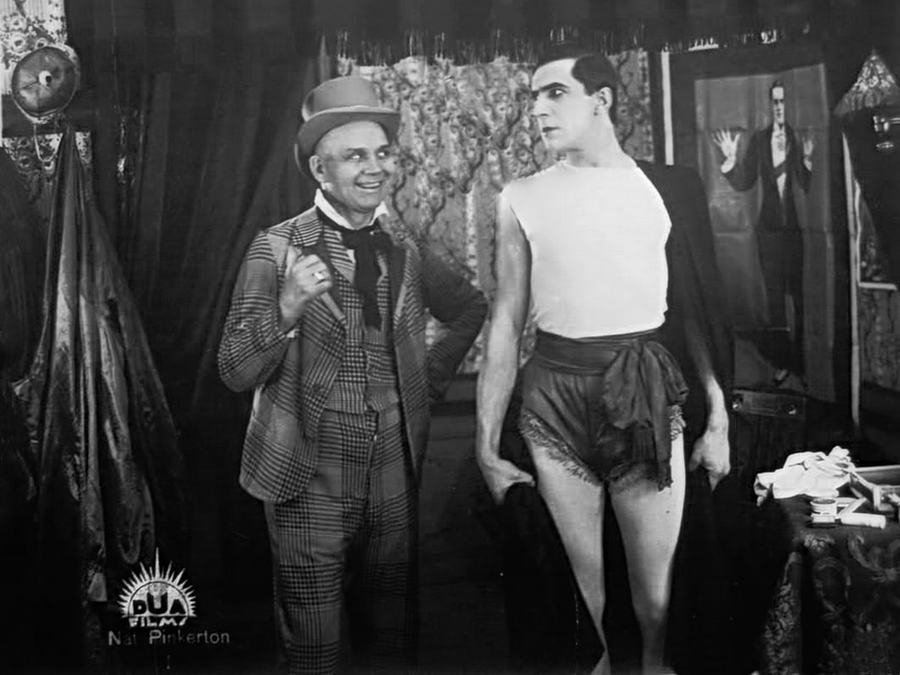
A fever dream stitched from celluloid moth-wings, Nat Pinkerton im Kampf, 1. Teil – Das Ende des Artisten Bartolini lands like a shrapnel bouquet in the lap of anyone who dares believe 1920s German cinema begins and ends with Caligari and Nosferatu. Forgotten in a Prague vault for nearly a century, this inaugural episode of the Nat Pinkerton serial unspools with such venomous elegance that it makes the average Krimi look like a Sunday picnic postcard. Jane Bess’s screenplay—laconic yet baroque—threads a Möbius strip of betrayal around a single death: the bullet-like demise of Bartolini, king of the high wire, whose final bow sprays blood across the sawdust like abstract expressionism before the term was coined.
Director/star Eduard van Meghen shoots Berlin as though it were a fevered animal, all ribs and neon, where every spotlight is a guillotine blade suspended by a frayed cable. His Pinkerton, a laconic American imported into the chaos of Weimar nightlife, stalks through scenes with the predatory languor of a man who has read the last page of the book and still insists on turning each leaf. The camera clings to the brim of his hat, a halo turned shiv, while intertitles flash like police-bulb magnesium: “Guilt is a muscle memory—stretch it too far and the whole act collapses.”
Bela Lugosi, billed here under the tantalizingly brief moniker “Grigoroff,” slithers into frame midway through, cloaked in a floor-length leather coat that creaks like the gates of some Expressionist purgatory. His eyes—two onyx marbles lit from within by nihilistic glee—promise the audience that every answer will birth a crueler question. When he offers Pinkerton a cigarette plucked from a hollowed-out Bible, the match flare illuminates a grin that feels proto-Dracula, yet achingly terrestrial: the smile of a bureaucrat who stamps passports to hell. It’s a performance calibrated to the millimeter; Lugosi understands that true menace whispers rather than shouts, and the resulting chill lingers longer than any later cape-and-fangs histrionics.
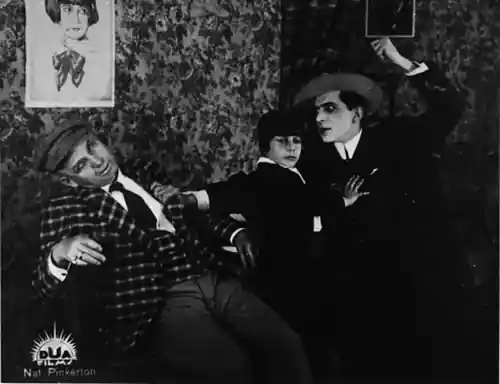
Olaf Storm’s Bartolini, glimpsed largely in flashbulb negatives and fever-memory montage, haunts the picture more dead than alive. His skeleton—lithe, almost elastic—twirls above the ring like a question mark scrawled by a dying god. The film’s central coup is to refuse us the comfort of witnessing his death outright; instead we’re fed fragments: a sequined slipper drifting down through spotlight beams, a gasp muffled by orchestra cymbals, a child’s gas-mask-shaped balloon ascending into the proscenium. The ellipsis is more savage than certainty, and Bess’s script wields absence like a stiletto.
Visually, the picture is a lithograph in motion. Cinematographer Joe Nestor-Pridum (whose career would vanish after talkies arrived) suffuses scenes with umber fog that eats up the grain, turning faces into half-remembered statues. Note the sequence where Pinkerton interrogates Sybill de Brée’s trapeze diva aboard a barge rocking beneath a lattice of moonlit freight cranes: the camera pirouettes 360 degrees, catching each mournful whistle of steam in negative space, while the only sound we “hear” is the flicker of the projector itself—an accidental metronome of dread. Color tints oscillate between nicotine amber and cyanide green, culminating in a strobing crimson just as Bartolini’s body is revealed. The effect is not far removed from the palette that The Rainbow Trail would later employ for its biblical mirages, yet here the hues bruise rather than bless.
Structurally, the film loops back on itself like a Möbius strip. The first intertitle announces the end of Bartolini; the last shows us the moment before his coup de grâce, trapping viewers in an ouroboros of predestination. Such circular storytelling predates by seven years the fatalistic flashbacks of The Red Woman and renders the Pinkerton series a philosophical forebear to later noir classics. We are not asked “who done it” but rather “why does the wheel keep spinning?”—a question Weimar Germany was asking of its own political circus.
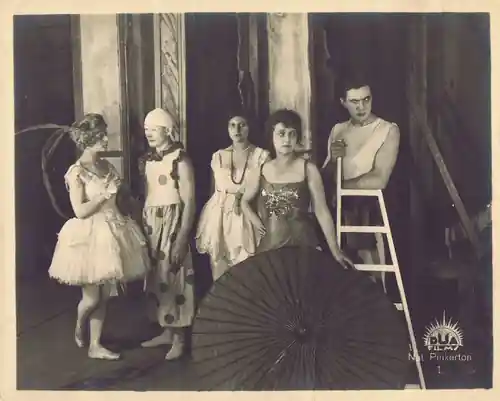
Performances across the board vibrate at a pitch that silent cinema rarely dared. Marian Alma, as the censor’s morphine-addicted secretary, conveys entire ledgers of corruption with a tremor of the lower lip; her eyes, ringed in kohl like bruised halos, follow Pinkerton with a hunger that is half erotic, half archaeological—she’s excavating the last trace of moral fiber in a city that sold its shadow for cabaret tokens. Meanwhile, Joe Nestor-Pridum doubles as both cinematographer and actor, playing a barrel-chested strongman whose biceps bear tattooed blueprints of the Berlin sewer system. In one bravura close-up, a tear zigzags down his powdered cheek, carving a path through chalk that resembles a trench map—an entire war narrative encoded in a droplet.
If the film has a flaw, it is the velocity with which it demands literacy in the argot of crime serials. Audiences unfamiliar with the Pinkerton pulps (then wildly popular in German translation) might drown in the torrent of aliases, dossiers, and coded cabaret songs. Yet even confusion feels intentional: Berlin itself, the film insists, is a city of immigrants juggling multiple passports and fractured identities. To comprehend every clue would be to domesticate the chaos; the movie would rather we choke on its smoke.
Comparative touchstones abound, though none map neatly. The funhouse mirrors anticipate Orson Welles’ Lady from Shanghai by a quarter century; the carnival-of-dread ambience predates The Mints of Hell‘s sulphuric pessimism; and the proto-feminist ambiguity of de Brée’s high-flying anti-heroina lays groundwork for the conflicted seductresses in Love’s Conquest. Yet this film refuses to be anyone’s footnote; it slashes its own initials into the celluloid.

The score—recently reconstructed by the Deutsche Kinemathek—interpolates barrel-organ waltzes with discordant xylophone riffs that mimic the clatter of typewriter keys. During the climactic mirror-maze confrontation, the orchestra drops to a heartbeat-like timpani, syncopated with the flutter of projector sprockets. The effect is so unnerving that modern audiences at the 2022 Bologna Cinema Ritrovato reportedly mistook the sound for a medical emergency, so visceral is the Pavlovian dread.
For cinephiles tracking Lugosi’s metamorphosis, this role is the missing link between his tortured protagonists in Manon Lescaut and the operatic malice he would unleash in Hollywood. Watch how he fingers a cigarette holder as though it were a communion chalice, or the way his shadow, projected onto canvas circus banners, seems to sprout bat-wing silhouettes—an accidental prophecy of the cape that would later define him. Yet Grigoroff’s villainy is chillingly terrestrial: he murders not for passion or power but to maintain the illusion that the show must go on. In an era when inflation rendered German currency cheaper than wallpaper, the notion that spectacle itself could be lethal felt less like allegory than headline.
Gender politics crackle with the same live-wire ambivalence. De Brée’s trapeze artiste commands the frame whenever she swings above male heads, her sequined leotard a banner of bodily autonomy. Still, the camera lingers on bruises flowering across her clavicles—tokens of a patriarchy that applauds her flight yet resents her height. The film neither moralizes nor fetishizes; it simply records the cost of altitude, much as The Girl and the Game would later chronicle a woman’s negotiation of industrial peril.
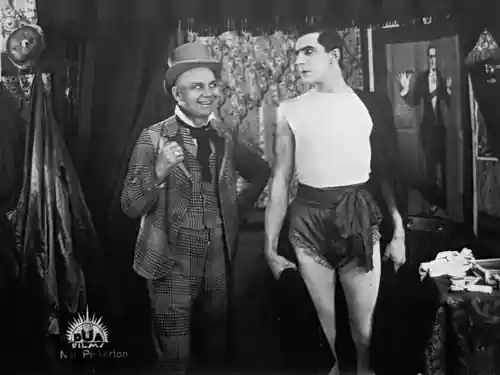
Berlin’s topography emerges as a character in its own right: the Alexanderplatz clock tower looms like a metronome counting down to political apocalypse; the Spree river reflects banners of the nascent Nazi party in upside-down fractals; and the ruined Anhalter Bahnhof becomes a cathedral for the transient, its shattered stained glass casting polychrome ghosts across the detective’s trench coat. Production designer Olaf Storm (pulling double duty as actor) reportedly scavenged real debris from the 1923 street fights, embedding chunks of cobblestone and bullet casings into the funhouse floor so that actors tread upon actual history. The resulting texture verges on the tactile surrealism of The Ornament of the Lovestruck Heart, yet soaked in petrol rather than perfume.
Narrative kinetics aside, the film’s philosophical marrow concerns spectatorship itself. Characters continually watch one another through keyholes, periscopes, peep-show slots, and the fractured panes of the mirror maze. The audience, by extension, is implicated; every gaze becomes transactional. When Pinkerton finally exposes the murderer, he does so not with a gun but by forcing the culprit to stare into a mirrored reflection until the image convulses into self-recognition—a proto-Lacanian moment that anticipates decades of film theory. We are reminded that cinema is the ultimate funhouse, warping our own likeness into something monstrous or divine depending on the angle of light.
Restoration-wise, the current 4K scan salvages nearly twenty minutes previously believed lost, including a hallucinatory montage where cocaine-dust swirls across the lens like astral debris, momentarily superimposing Bartolini’s grinning skull over the Brandenburg Gate. The tinting scheme—cobalt for exteriors, bile green for interiors, arterial red for moments of revelation—follows German Expressionist tradition yet feels startlingly modern, akin to the color-coded emotional syntax of Flame of the Desert.
Commercially, the picture tanked on release, eclipsed by flashier American imports and the public’s growing hunger for jazz-age levity. Critics of the Berliner Börsen-Courier dismissed it as “Kriminalfilm soup,” while right-wing sheets decried its cosmopolitan cynicism. Yet its afterlife in smoky student dormitories and clandestine cine-clubs fertilized the imaginations of future auteurs: Wilder, Lang, even Hitchcock (rumor has it the young Londoner screened a 9.5mm print while crafting The Lodger). Today, when every digital thriller bombards us with pixel-perfect clarity, the flicker of this nitrate survivor—its sprocket holes scorched like cigarette burns—feels almost radical. Imperfection becomes protest.
So, is it mere curio or buried masterpiece? The dichotomy collapses under the film’s own mirror-maze logic. Nat Pinkerton im Kampf is both: a pulpy cliffhanger that hooks like barbed wire, and a meditation on entropy that unspools in your skull long after the projector’s hum dies. To watch it is to step onto Bartolini’s tightrope, wobbling above an abyss of historical debris, knowing the fall is inevitable yet savoring each breath of altitude. The reel ends; the circus continues. And somewhere, in the grainy twilight between frames, Bela Lugosi’s eyes still glitter, waiting for the next spectator foolish enough to meet their gaze.
Verdict: seek it, inhale it, let it haunt your peripheral vision. In an age when algorithms curate our nostalgia, here is a film that refuses to be domesticated—a feral cat of a movie, beautiful and scarred, purring voltage. Stream it if you must, but preferably hunt down a 35mm revival print, where the projector’s clatter syncs with your own cardiac drum. Just remember: every mirror has two faces, and the second one never blinks.
Community
Log in to comment.