DbcultAccessing Vault...
Cult Review
Senior Film Conservator

Is the 1925 silent comedy New Brooms worth your time in the age of modern corporate satire? Short answer: yes, but only if you enjoy watching a smug 'nepo baby' get his ego systematically dismantled by the harsh realities of a balance sheet.
This film is specifically for viewers who appreciate the cynical wit of William C. deMille and the expressive range of Bessie Love; it is certainly not for those looking for the high-octane spectacle usually associated with the deMille name.
1) This film works because it treats its protagonist’s arrogance as a genuine character flaw rather than a charming quirk, making his eventual failure feel earned and cathartic.
2) This film fails because the third-act romantic misunderstanding—where Tom believes his father is pursuing his love interest—is a tired trope that feels tonally inconsistent with the sharper business satire of the first half.
3) You should watch it if you want to see a surprisingly modern critique of generational wealth and the 'disruptor' mindset long before Silicon Valley made it a cliché.
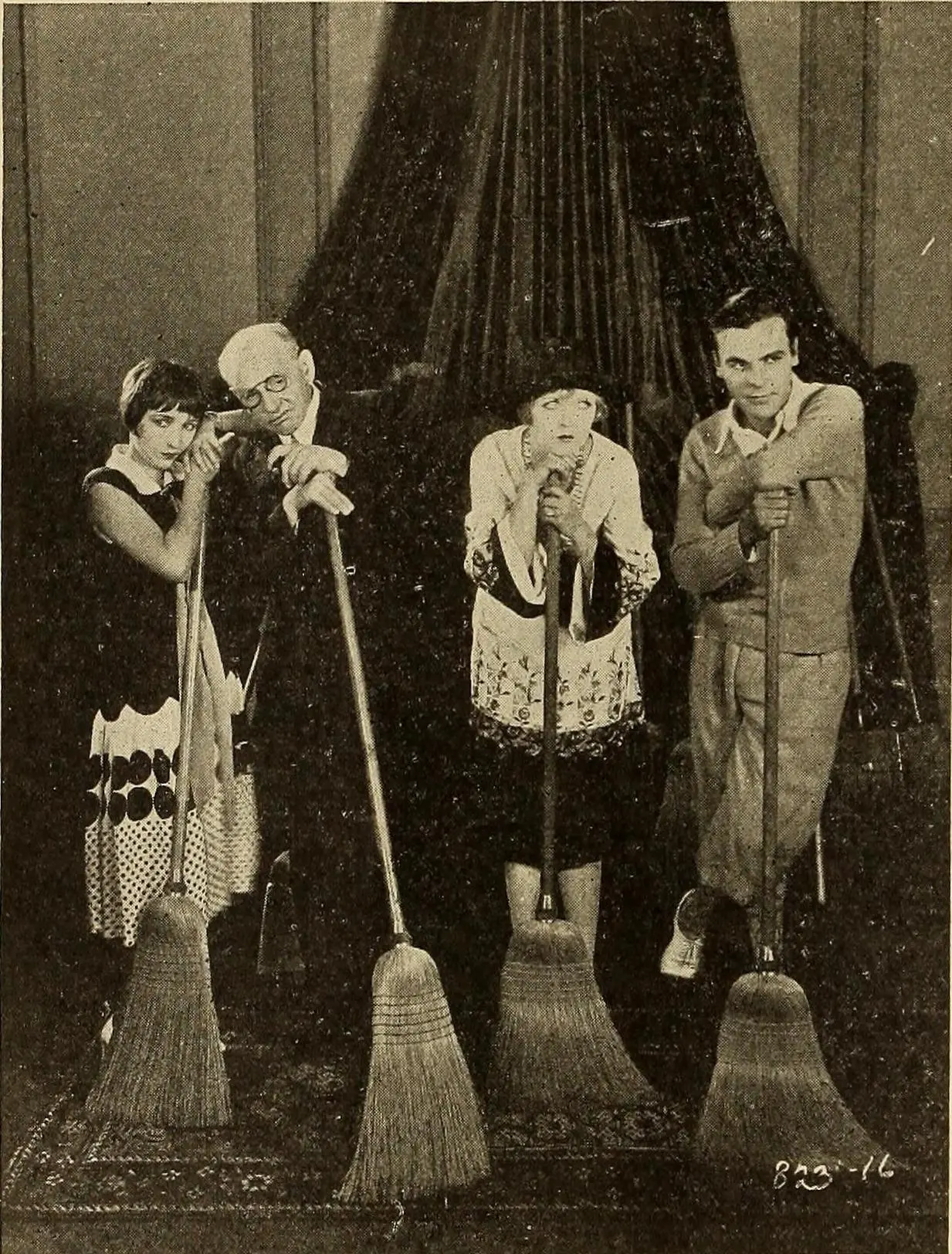
At its core, New Brooms is a study in unearned confidence. Neil Hamilton plays Thomas Bates Jr. with a punchable sincerity that is vital for the film to function. When he calls his father a 'grouch' for worrying about bills, you don't see a misunderstood visionary; you see a kid who has never had to balance a checkbook.

The 'broom factory' setting might seem quaint, but it serves as a perfect microcosm for the industrial friction of the 1920s. Unlike the more traditional heroics found in films like Big Dan, the stakes here are internal and economic. It is about the friction between the 'new' and the 'proven.'
One specific scene stands out: Tom’s first day in the manager’s chair. He doesn't just change the workflow; he attempts to revolutionize the very soul of the business without understanding how a single broom is actually made. It’s a moment of pure cringe-comedy that feels uncomfortably relevant today. It works. But it’s flawed.
Bessie Love, who audiences might recognize from her more whimsical turns in Betty and the Buccaneers, provides the film’s much-needed emotional grounding. As Geraldine, she isn't just a love interest; she is the observer of Tom’s slow-motion train wreck.

Her performance is subtle. In an era often defined by over-the-top pantomime, Love uses her eyes to convey a mixture of pity and attraction toward Tom. She knows he’s a fool, and she’s waiting for the world to teach him the lesson he refuses to learn from his father.
The transition of Geraldine from a family friend to a housekeeper is handled with a pragmatism that avoids the melodrama of other 1920s weepies like La belle Russe. She isn't a victim; she’s a worker. This shift in class dynamics adds a layer of tension to the romance that keeps the middle act from sagging too deeply into sentimentality.
While his brother Cecil was busy parting the Red Sea or staging massive orgies, William C. deMille was perfecting the art of the domestic interior. New Brooms is a masterclass in using limited space to create psychological pressure. The Bates household feels increasingly claustrophobic as Tom’s 'modern' management style begins to fail.

The pacing is deliberate. DeMille doesn't rush to the 'I told you so' moment. Instead, he lets the audience sit with Tom’s bad decisions. You feel the weight of every unpaid bill and every alienated employee. It’s a slow burn that pays off when the inevitable collapse occurs.
Compare this to the frantic energy of The Nervous Reporter. Where that film relies on external chaos, New Brooms finds its humor and drama in the quiet, agonizing realization that you are not as smart as you think you are. It’s a brutal, simple truth that deMille captures with surgical precision.
If you are looking for a film that explores the timeless tension between generations with a sharp, occasionally mean-spirited edge, then yes, New Brooms is essential viewing. It avoids the easy 'happily ever after' by forcing its protagonist to admit total, humiliating failure before he can earn his redemption.

However, if you struggle with the slower pacing of 1920s stage adaptations, the middle section might test your patience. The romantic subplot, particularly the mercenary Florence Levering, feels like a distraction from the far more interesting corporate drama. It’s a film that wants to be two things: a business satire and a romantic comedy. It succeeds much better at the former.
Pros:
- Sharp, relatable script that feels surprisingly contemporary.
- Strong, understated performances from the lead cast.
- Excellent use of sets to reflect the protagonist’s mental state.
Cons:
- A secondary romantic plot that lacks the bite of the main story.
- Some dated gender dynamics regarding the housekeeper role.
- The final resolution happens a bit too quickly after a long buildup.
New Brooms is a fascinating relic that manages to be more than just a historical curiosity. It is a cynical, well-acted, and intelligently directed piece of social commentary that proves the 'generation gap' is a story as old as time—or at least as old as the broom factory. It doesn't need grand spectacle to make its point. It just needs a pile of bills and a son who thinks he knows better. It’s a solid, if slightly uneven, entry in the silent era’s library of social satires. Watch it for the bite, stay for Bessie Love, and ignore the predictable romance.
IMDb 6.1
1933
Community
Log in to comment.