DbcultAccessing Vault...
Cult Review
Senior Film Conservator
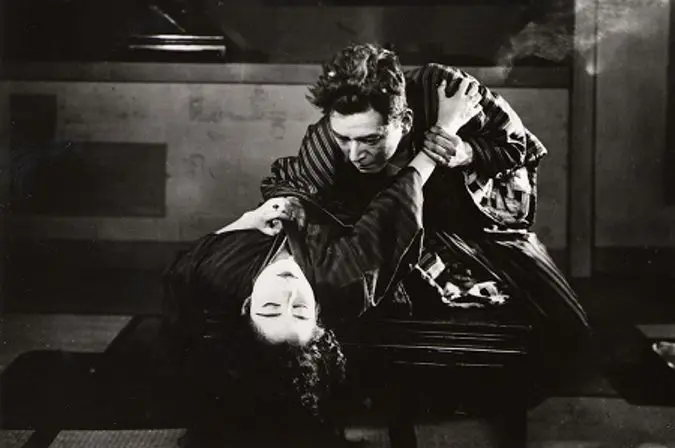
Is "Nichirin: Kôhen" worth your time in an age of instant gratification and CGI spectacles? Short answer: yes, but with significant caveats. This silent Japanese melodrama, a continuation of a larger narrative, demands a specific kind of engagement, rewarding those willing to immerse themselves in its historical and artistic context. It is a film for cinephiles, historians, and anyone curious about the foundational artistry of Japanese cinema, particularly the power of silent acting. Conversely, it is decidedly NOT for viewers seeking fast-paced action, modern narrative conventions, or those with little patience for the stylistic nuances of early 20th-century filmmaking.
Before delving deeper, let’s establish some critical points:
"Nichirin: Kôhen" emerges from the rich, often turbulent, landscape of early Japanese cinema, a period characterized by rapid artistic experimentation and a profound engagement with social issues. Directed by Minoru Murata, a figure often overshadowed by later luminaries but whose contributions were foundational, this film serves as a potent reminder of the silent era's capacity for complex storytelling. As the 'latter part' of a serialized narrative, it immediately immerses the viewer in an ongoing struggle, a technique common to the period, drawing on an assumed familiarity with its characters and their initial predicaments.
The film’s very existence, even in potentially fragmented forms, is a testament to the dedication of filmmakers and performers who were charting new artistic territories. It’s a window into a bygone era, not just cinematically, but culturally, reflecting the societal tensions and moral quandaries of Taishō-era Japan. This isn't just a movie; it's an artifact, pulsing with historical significance.
At its core, "Nichirin: Kôhen" is a searing melodrama, a genre that silent cinema embraced with an intensity often unmatched today. The narrative follows Hanae (Yoshiko Okada), a young woman from a once-proud, now-declining samurai family, forced into the precarious existence of a seamstress. Her family’s dire financial straits are exacerbated by the relentless machinations of Baron Sakamoto (Genzaburô Sasaya), a ruthless industrialist whose desire extends beyond Hanae’s ancestral land to Hanae herself.
The film opens with Hanae already having rejected Sakamoto’s advances, a choice that has plunged her family deeper into debt and despair. Her solace, the gentle artist Kenji (Eiji Takagi), finds himself increasingly marginalized, his family’s wealth unable to shield him from Sakamoto’s far-reaching influence. The stakes are instantly palpable. Murata, with writers Minoru Murata and Otokichi Mikami, crafts a narrative that feels both deeply personal and broadly allegorical, touching on themes of class struggle, patriarchal power, and the burden of honor.
The central conflict ignites when Hanae uncovers Sakamoto’s plot to frame Kenji’s father in a business scandal, a move designed to eliminate any remaining opposition. This revelation forces Hanae into an impossible dilemma: sacrifice her own happiness and perhaps her very being to Sakamoto to save those she loves, or expose the Baron, risking not only her own life but also the complete ruin of both her family and Kenji’s. This kind of moral crucible is where silent melodrama truly shines, and "Nichirin: Kôhen" exploits it to its fullest, extracting every drop of emotional anguish.
The narrative’s strength lies in its ability to build suspense through emotional rather than physical action. The tension isn't about explosions or car chases; it’s about the silent scream on Hanae’s face, the desperate glint in Kenji’s eyes, and the chilling, calculating smirk of Baron Sakamoto. The climax, a public confrontation at a society gala, is less about fisticuffs and more about the unveiling of truth, the shattering of reputations, and the raw power of a woman’s defiant stand against an oppressive system. It’s a powerful, if perhaps conventional, resolution for the era, but one delivered with undeniable emotional force.
In silent cinema, the actor’s face and body are the primary conduits of story and emotion. "Nichirin: Kôhen" boasts a cast that truly understands this artistry. Yoshiko Okada, as Hanae, delivers a performance of breathtaking vulnerability and quiet strength. Her expressions, from the subtle tremor of a lip to the wide, sorrowful gaze of her eyes, communicate layers of despair, resolve, and enduring love. There’s a particular scene where she receives a letter detailing her family’s impending eviction; her reaction, a slow crumpling of the paper followed by a single tear tracing a path down her cheek, is more impactful than any shouted dialogue could be. It’s a masterclass in controlled emotion.
Genzaburô Sasaya, as Baron Sakamoto, embodies villainy with a chilling restraint. He isn't a mustache-twirling caricature; rather, his menace comes from his cold, calculating demeanor and the subtle sneer that plays on his lips. His power is conveyed not just by his opulent surroundings but by the way others shrink in his presence. Sasaya’s performance makes Sakamoto a truly formidable and believable antagonist, a force of societal corruption personified. His scene where he offers Hanae a 'solution' to her problems, his face a mask of false benevolence, is genuinely unsettling.
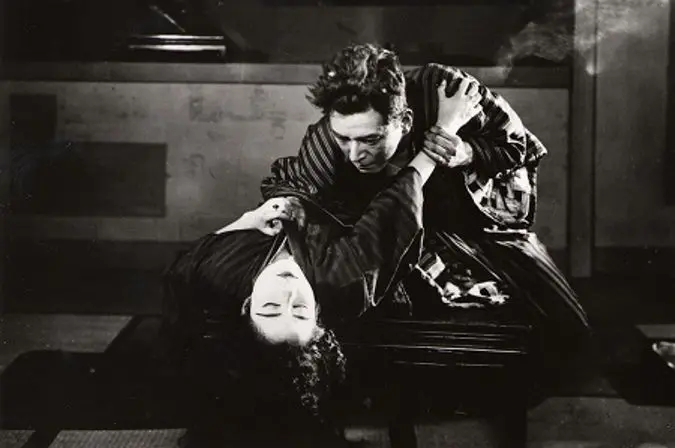
Eiji Takagi, as Kenji, provides the necessary contrast as the noble, if somewhat ineffectual, hero. His anguish over Hanae’s predicament and his helplessness against the Baron’s influence are palpable. While perhaps less dynamic than Okada or Sasaya, his sincere portrayal anchors the romantic core of the story, giving Hanae’s sacrifices a tangible emotional weight. The silent gaze shared between Kenji and Hanae across a crowded room, a moment of fleeting connection amidst their turmoil, speaks volumes about their enduring bond. It’s a testament to the power of non-verbal communication in film.
The ensemble cast, including Shōzō Nanbu and Kumeko Urabe, contribute effectively to the film's immersive world, populating it with characters who, despite their brief appearances, feel lived-in and authentic. Their reactions and background actions often add crucial context to the main drama, a detail that many modern films often overlook. The collective despair of Hanae’s family members, conveyed through their slumped shoulders and downcast eyes, reinforces the crushing weight of their circumstances.
Minoru Murata's direction in "Nichirin: Kôhen" showcases a keen understanding of cinematic language, even in its nascent stages. He employs a visual style that, while perhaps simple by today's standards, is incredibly effective in conveying mood and narrative. The film makes excellent use of deep focus and thoughtful shot composition, often framing characters against imposing backdrops that emphasize their vulnerability or the societal forces at play. For instance, a shot of Hanae walking through a bustling marketplace, her small figure dwarfed by towering buildings, visually articulates her isolation and the overwhelming nature of the city around her.
Murata's camera work, while not as overtly experimental as some of his contemporaries, is precise. He knows when to hold a close-up on an actor’s face, allowing their expressions to unfold, and when to pull back for an establishing shot that grounds the scene geographically and emotionally. The use of natural light, where possible, adds an authentic texture to the sets, making the lavish interiors of Sakamoto’s mansion feel opulent and suffocating, while Hanae’s humble dwelling appears stark but imbued with a sense of dignity.
The cinematography, though black and white, is rich in contrast, utilizing shadows to great effect, particularly in scenes involving Baron Sakamoto. The way he is often partially obscured by shadow or framed against a dimly lit background enhances his villainous aura. The film's visual storytelling is arguably its strongest suit, proving that complex emotions and narratives can be conveyed without a single spoken word. It reminds me somewhat of the visual poetry in The Garden of Resurrection, another film that relies heavily on evocative imagery.
The pacing of "Nichirin: Kôhen" is characteristic of silent cinema: deliberate and measured. This can be a challenge for modern viewers accustomed to rapid-fire editing. However, this slower pace is not a flaw; it's a feature. It allows the audience to fully absorb the emotional weight of each scene, to linger on the actors' expressions, and to reflect on the unfolding drama. The film builds its emotional crescendo incrementally, rather than rushing towards it. This deliberate rhythm creates a meditative, almost hypnotic, viewing experience, rewarding patience with profound emotional impact.
The tone is consistently melancholic, tinged with moments of fleeting hope and stark despair. It avoids cheap sentimentality, opting instead for a raw, honest portrayal of suffering and resilience. The film’s emotional landscape is rich, oscillating between the quiet desperation of Hanae’s family and the chilling confidence of the Baron. Murata maintains a consistent tonal integrity throughout, ensuring that even the most dramatic moments feel earned and authentic within the film’s established world. This commitment to tone is something I find increasingly rare in contemporary filmmaking, where tonal shifts can often feel jarring or unearned. It’s a stark contrast to the often bombastic approach seen in films like The Magnificent Brute.
Absolutely, for the right audience. If you approach "Nichirin: Kôhen" not as a direct competitor to modern blockbusters but as a vital piece of cinematic history and a masterclass in silent storytelling, it offers immense rewards. It is a film that demands your attention and patience, but repays it with a deep emotional resonance and a fascinating glimpse into the artistic sensibilities of a bygone era. It works. But it’s flawed. The slow burn might test some, but the payoff is substantial.
The performances, particularly Yoshiko Okada's, are timeless. They transcend the limitations of silent film, communicating universal human experiences of love, loss, and defiance. The film serves as a powerful reminder that storytelling, at its core, relies on compelling characters and universal themes, not just technological prowess. It’s a testament to the enduring power of human drama. Watching it today feels like uncovering a hidden gem, a whisper from the past that still resonates with surprising clarity.
It’s also an important historical document, showcasing the societal anxieties of early 20th-century Japan. The themes of class struggle, the plight of women, and the corrupting influence of power are as relevant today as they were then. In this sense, it offers more than just entertainment; it offers perspective. While it won't be for everyone, those who engage with it will find a rewarding and enriching experience. For those who enjoy deeper, more reflective cinema, this is a must-see. It's a challenging watch, but a profoundly rewarding one, much like piecing together fragments of a lost civilization.
"Nichirin: Kôhen" is a powerful, if challenging, cinematic experience. It stands as a testament to the enduring power of silent film to convey complex emotions and societal critiques. While its pacing and format demand a particular kind of engagement, the rewards are substantial. Yoshiko Okada's performance alone is worth the journey, anchoring a narrative that is both deeply personal and universally resonant. For those willing to step back in time and embrace the artistry of a bygone era, Murata's film offers a profound and moving glimpse into the heart of human struggle. It is not just a film; it is a vital piece of cinematic heritage that continues to speak volumes, even without a single spoken word. Highly recommended for the discerning cinephile.

IMDb 6.5
1934
Community
Log in to comment.