DbcultAccessing Vault...
Cult Review
Senior Film Conservator
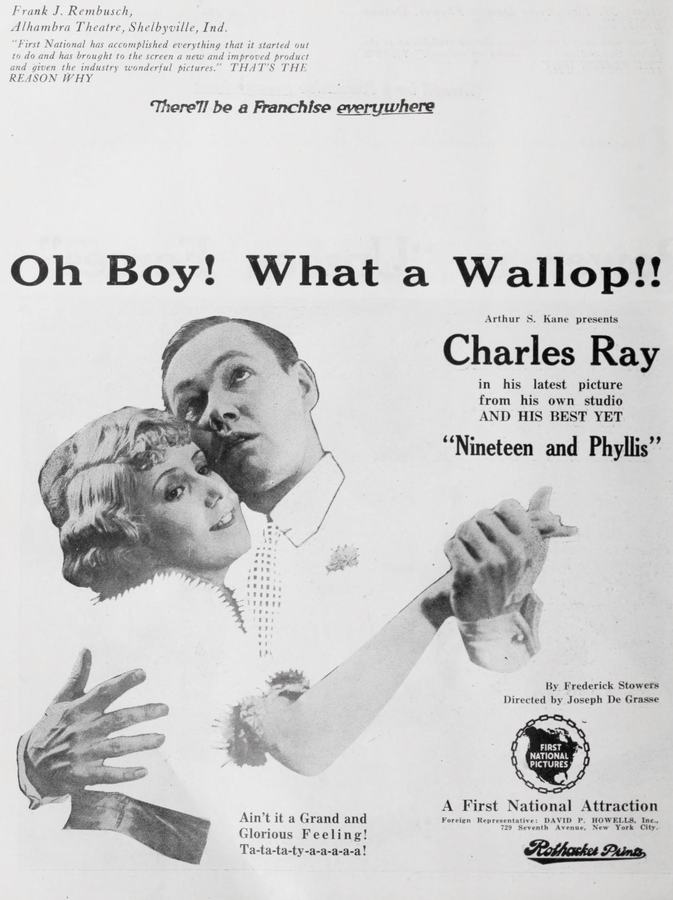
The first time Andrew Jackson Cavanaugh spots Phyllis through the apothecary window, the film itself seems to blush: a warm amber bloom creeps across the frame, as though the nitrate stock were surrendering to the heat of his gaze.
That blush is the key to Nineteen and Phyllis, a 1924 confection so fragile it feels assembled from sighs and unpaid rent. Director Joseph De Grasse, moonlighting from his usual Lon Chaney chillers, trades gothic gloom for something more insidious: the pastel cruelty of a small town that measures a man’s worth by the thickness of his billfold. The film’s currency—both literal and metaphorical—circulates in glances, gloves, and the hush that falls when the banker’s polished shoes hit the boardwalk.
Charles Ray, that perennial haystack-haired everyman, plays Andrew with a stammering physicality that borders on ballet. Notice how he shrinks inside his frayed coat as if trying to fold himself into a pocket of invisibility, only to expand—shoulders flung back like flags—when Phyllis (Clara Horton) drifts near. Horton, for her part, refuses the stereotype of the spoiled heiress; her Phyllis is a collector of moments, weighing each suitor’s gift not by price tag but by the risk it required. The rival, George Nichols’ Milford, is less a villain than a walking ledger book, his smile balanced in perfect double-entry precision: every charm debited by contempt.
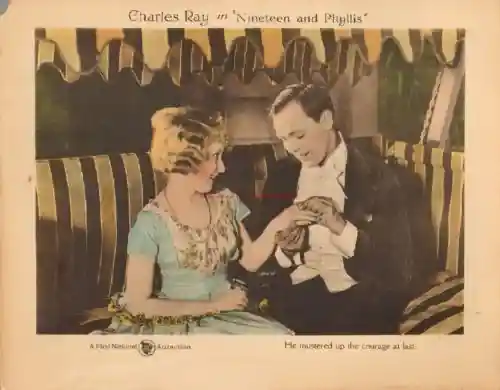
De Grasse and scenarist Bernard McConville stage capital as both set design and antagonist. When Milford tips the barber, coins tumble in fetishistic close-up, spinning like dervishes until they clatter into silence. Conversely, Andrew’s solitary nickel—earned by mucking horse stalls—rests on the diner counter, too timid to jingle. The camera hovers above it like a mourner. Even the intertitles join the assault: “He knew a dime’s diameter was the distance between lips and forever.” The line is pure heartbreak in ten words.
Comparisons? Think Madame Jealousy without the poison vials, or The Wooing of Coffee Cake Kate stripped of its slapstick frosting. Where Real Folks romanticized communal warmth, Nineteen and Phyllis distrusts the very concept of community: neighbors peer through lace curtains, tallying each failure like vultures with accounting degrees.
Tinted prints survive in Moscow’s Gosfilmofond, and the palette is a lesson in chromatic economics. Day interiors glow a sickly sea-foam, suggestive of mildewed hope; night sequences drown in cobalt so deep faces vanish except for the whites of eyes—those twin exclamation marks of desperation. Yet the ballroom scene—yes, Vixville somehow merits a ballroom—explodes in canary-yellow, a sunburst that momentarily erases class distinctions until the orchestra’s final note, when the yellow drains away like cheap dye, leaving only the ashen blues of morning.
The soundscape, of course, is long lost, but contemporary reviews mention a live accompaniment heavy on tremolo violins and a toy xylophone mimicking the clink of coins. One can almost hear it still—those pizzicato plucks each time Andrew’s stomach growls, the xylophone’s cruel glitter whenever Milford appears. Silence, paradoxically, becomes the loudest character: the hush that greets Andrew’s tattered shoes on the marble courthouse floor spreads like frost, audible in its very muteness.
McConville’s script, adapted from Frederick Stowers’ Saturday Evening Post novella, flirts with proto-feminist undercurrents. Phyllis’ ultimate rejection of Milford’s diamond-studded bracelet is not mere sentiment; it’s a refusal to be collateral. When she clasps Andrew’s ink-smudged hand instead, the film locates romance outside the marketplace—a radical notion in an era when marriage manuals still listed a husband’s yearly income alongside character traits. Clara Horton’s performance sells the moment: her inhale is so slight you’ll miss it, but it contains universes—relief, terror, the dawning realization that love may also be poverty’s twin.
Supporting players deserve their own footnotes. Cora Drew, as Andrew’s widowed mother, communicates entire homilies with the tremor of a lip; watch her fold the same letter from her late husband each night, the paper growing thinner, almost translucent—a palimpsest of grief. Monte Collins, the porticoes of whose cheeks could hide apples, provides comic relief as a would-be confidence man peddling “rain insurance” to drought-stricken farmers, yet even his pratfalls echo the central theme: everyone, somehow, is peddling protection against a downpour that never arrives.
De Grasse’s cutter, the unsung Margaret Whiting, employs jump-cuts that feel almost Godardian: a smash from Phyllis’ gloved hand accepting a dance card to Andrew’s blistered palm gripping a hayfork; a match-cut between Milford’s champagne popping and the sheriff’s padlock clanging shut on Andrew’s pawned bicycle. Each splice pickpockets the viewer’s comfort, reminding us that fortune’s wheel is greased with someone else sweat.
In an absurdist detour, Andrew attends a revival meeting presided over by Frank Norcross’ huckster preacher, who promises that every coin flung into the collection plate will return tenfold. The sequence, played for sardonic laughter, ends with Andrew dropping in his last penny—an act photographed from inside the plate, the copper disc eclipsing the camera like a solar eclipse of hope. Compare this to Thou Shalt Not, where guilt is a metaphysical stain; here, guilt is merely insufficient funds.
Scholars tracing the genealogy of Capraesque populism should linger on this artifact. The DNA of It Happened One Night’s hitchhiking lessons or Mr. Deeds’ tuba solos can be glimpsed in embryonic form: the belief that virtue, if scrubbed hard enough beneath poverty’s grit, will gleam. Yet De Grasse is colder than Capra; his finale denies us the crowd’s cheer. Instead, the lovers walk out of frame into a future that might still entail eviction notices and stale bread. The last intertitle reads: “Perhaps love, too, is a currency—spent, it multiplies in pockets unseen.” The word perhaps is the film’s most brutal stroke.
Survival status: incomplete, yet more than mere shards. The second reel—featuring the pivotal Ferris-wheel confession—was salvaged from a Quebec nunnery in 1987, where it had lined a hope chest. Thanks to a crowdfunding campaign spearheaded by the National Silent Film Foundation, a 2K scan now circulates among specialty theaters. Seek it if you can; streaming giants ignore it because algorithms can’t quantify the rustle of unspoken longing.
In an age of swipe-right transactions and influencer flexing, Nineteen and Phyllis feels prophetic. Its anxieties—rent hikes, performative wealth, the terror of being unremarkable—map neatly onto today’s gig-economy blues. Yet the film also whispers a counter-spell: that choosing the hand offering nothing but trembling warmth might still be the most subversive act of all. Watch it, then look at your phone’s banking app; feel the century collapse into a single hiccup of recognition.
Verdict: not a masterpiece, but a cracked mirror worth every sliver. It will haunt your wallet more than your dreams.
IMDb 5.2
1923
Community
Log in to comment.