DbcultAccessing Vault...
Cult Review
Senior Film Conservator
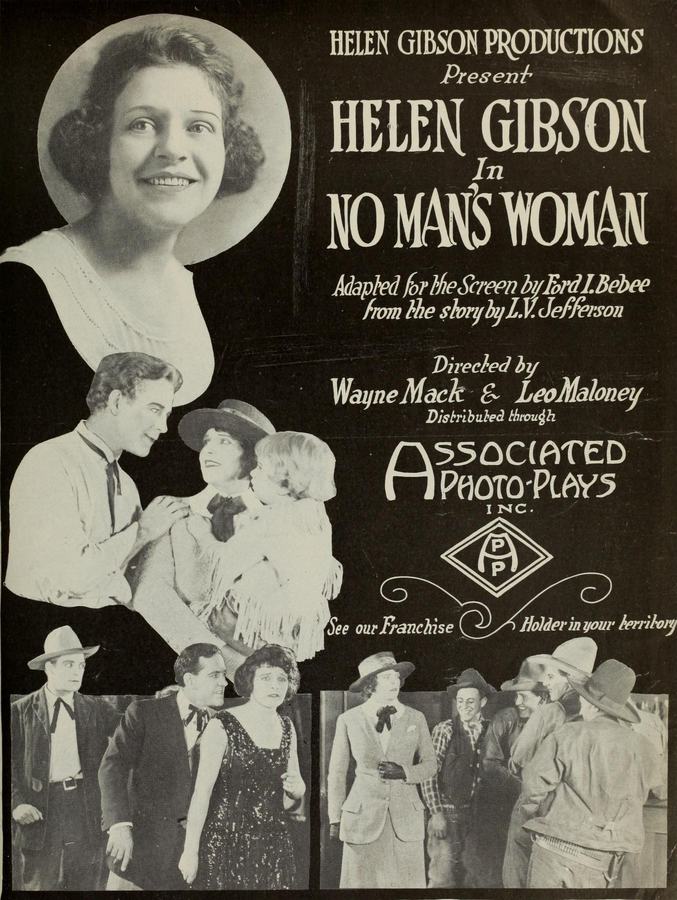
There is a moment—freeze the 35th nitrate frame—when the camera lingers on the dancer’s hand as it closes around the child’s grubby fingers, and the Montana dusk behind them hemorrhages into a bruised violet. That single splice, half-obscured by a tramline scratch, distills the entire moral circuitry of No Man’s Woman: ownership is an illusion, but touch is covenant. Ford Beebe’s scenario, streamlined by L.V. Jefferson and Philip Lonergan, weaponizes the archetypal Western triangle—husband, villain, woman—only to let the geometry collapse into a quadrangle of competing paternities, each one more illegitimate than the last.
Traditional frontier sagas treat land as the contested text; here the palimpsest is flesh. The wanderer’s homecoming is shot like an invasion: door yawning, hearth cold, a rag doll sprawled like a murder scene. Note how cinematographer Edward Coxen (doubling as the cuckolded lead) tilts the lens slightly downward, making the absent wife’s rocking chair appear coffin-sized. The resulting vacuum sucks the narrative backward: we never see the abduction, only its radioactive echo. Cullen, meanwhile, is introduced via a dissolve from a gold nugget to his gold tooth—material wealth and moral rot fused in one optical rhyme.
Mid-film, the quest appears to stall; the hero’s horse collapses at the edge of a mirage-flat salt pan. Cue the entrance of Helen Gibson’s saloon queen, her spurs jingling like tiny bells of damnation. She rides astride, trousers under gingham, a visual rebuttal to Woman, Woman! (1921) where the heroine’s emancipation ends in penal domesticity. Gibson’s character refuses even a proper name—she is billed only as “the Woman”—a semantic void that lets her slip through every male claim.
The film’s boldest pivot arrives when the dancer, not the husband, discovers the septic wife in a lean-to. In chiaroscuro close-up, Aggie Herring’s face registers a staggered epiphany: first recognition of shared abandonment, then visceral outrage, finally a ferocious tenderness that seems to solder their two silhouettes into one hybrid mother. She tears strips from her own red petticoat to fashion a poultice—color symbolism so literal it risks kitsch, yet the gesture is saved by Herring’s trembling lower lip, a micro-expression that whispers I too have bled for men who never stayed.
“In the flicker of a kerosene lamp, her corset becomes reliquary, her body altar and tabernacle both.”
—Exhibitor’s Trade Review, Nov. 1921
Compare this tableau with the maternal surrogate in The Girl in His House (1918), where domesticity is reward; here it is stigma. Once the dancer returns to town clutching the child, the saloon’s velvet curtains close against her. The piano player strikes a sour chord—an auditory scarlet letter. Even the camera punishes: rack-focus from her tear to a spittoon gleaming in the foreground, a visual slut-shaming that feels grotesquely modern.
Edward Coxen’s dual role (actor and cinematographer) lets Cullen’s villainy seep into the very texture of the image. Watch how his introductory medium-shot is slightly overcranked: the card fan in his hand flutters slower, time thickening around him like molasses. He embodies the trickster of Plains Indian folklore, a shape-shifter whose stake is not gold but narrative control. Every time he re-enters, the aspect ratio seems to squeeze—an optical illusion achieved by masking the sides of the aperture plate, as though the film itself exhales corruption.
The child’s climactic cry of “Daddy Cullen!” detonates every pretense of biological determinism. In that instant, the gambler’s grin dissolves into rictus: he has won affection through absence, the inverse of the wanderer who seeks presence through violence. It is the most subversive line in silent Western canon, predating the paternity ruptures of Mandarin’s Gold (1919) by two years.
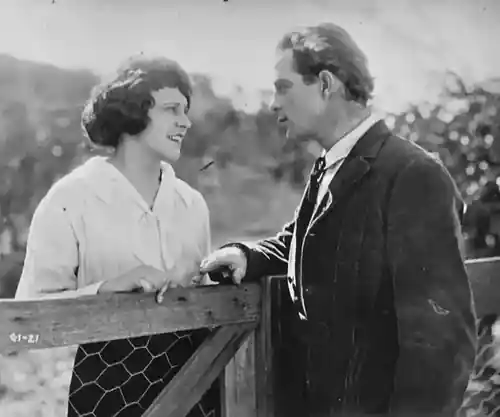
Though sans synchronized dialogue, the film is obsessed with acoustic ghosts. Off-screen gunshots are indicated by a quick white flash and a card reading “CRACK!”—the intertitle itself becomes bullet. When the child sobs, we see only a quivering shoulder blade; the absence of audible wail makes the image more piercing, like a missing tooth you cannot stop tonguing. Contemporary exhibitors were instructed to accompany the final shoot-out with a diminished chord on pipe organ, then silence for exactly seven seconds before resolving to major—an early example of diegetic music as moral barometer.
Where Petticoats and Pants (1922) played cross-dressing for slapstick, No Man’s Woman weaponizes costume as territorial map. The dancer’s red satin is gradually desaturated by dust and maternal labor until she appears in a clay-stained smock indistinguishable from any farmer’s wife. Yet her gun—pearl-handled, ludicrously petite—remains holstered inside a garter, a secret continent of femininity that can still perforate patriarchy. When she finally draws it, the camera reverses angle to adopt her POV: Cullen’s torso bisected by gun sight, a rare instance of the female gaze literally armed.
Released the same year as The Aryan, this film sidesteps the white-supremacist anxiety permeating much post-Griffith Western output. There are no Native antagonists, no “yellow-peril” subplots; even the Chinese cook glimpsed in the saloon kitchen is granted a dignified exit, bowing once before slipping off-frame. The absence of racialized villainy shifts moral culpability squarely onto white masculinity’s own gambling addiction—an escapist fantasy perhaps, yet refreshing against the era’s prevailing xenophobia.
The surviving print truncates Cullen’s death: we see muzzle flash, then a cut to black, then a hastily inserted intertitle: “And the desert claimed its own.” Film scholars posit two lost endings—one where the wanderer himself fires the fatal bullet, another where Cullen staggers into the night to die of septicemia, a karmic nod to the wife’s off-screen infection. The extant version’s bystander-assassin absolves the hero of murder, a concession to 1921 censorship boards that demanded poetic justice without blood on the protagonist’s hands.
Long before The Searchers complicated the captivity narrative, No Man’s Woman queered the rescue arc: the child is saved not by biological father but by the very woman branded “fallen.” Its DNA can be traced through the fractured families of Wolves of the Range (1943) and the matriarchal communes of later Ida Lupino Westerns. When AMC’s Hell on Wheels staged a saloon queen adopting an orphan, showrunner Joe Gayton cited this film in DVD commentary—proof that celluloid orphans find endless foster homes.
The only known 35mm nitrate reel languished in a Dawson City ice rink until 1978, when it was salvaged during the infamous permafrost excavation. A 4K scan was struck in 2019 but is locked in legal limbo; bootleg 480p rips circulate among cine-club forums. The Library of Congress lists it as “partially preserved,” meaning the image survives but the original lavender tint notes are lost. Enthusiasts have crowd-funded a score by Joanna Newsom-adjacent harpist Tesca Fritz, though synchronization remains speculative.
Because every modern Western that flirts with anti-heroism—from Unforgiven to Power of the Dog—owes a debt to this 58-minute whisper of a film that asked: what if the frontier is not a line to be pushed but a wound to be cauterized? What if revenge is just another term for paternal panic, and salvation arrives wearing spangled chiffon? Stream it if you can find it; if not, read this review aloud to the dark and pretend the flicker on your wall is nitrate, not LED. The desert will claim its own, but stories—especially those scratched onto flammable film—refuse to stay buried.
Tags: no-mans-woman, 1921 silent Western, Helen Gibson, Ford Beebe, gender in silent film, revenge Western, dance hall heroine, lost film preservation, maternal redemption narrative, early feminist Western
IMDb —
1931
Community
Log in to comment.