DbcultAccessing Vault...
Cult Review
Senior Film Conservator
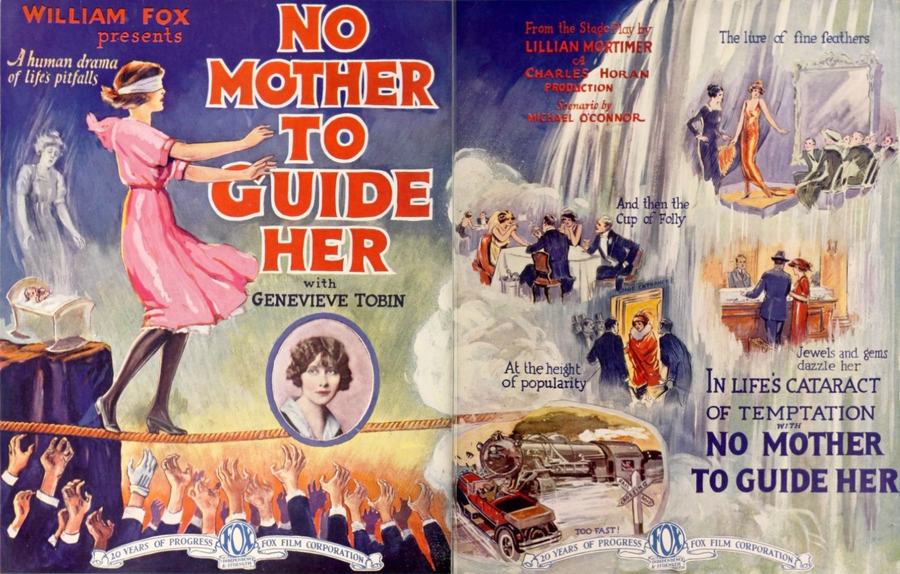
The silent drama No Mother to Guide Her unfolds as a study in contrast: the luminous privilege of Kathleen Pearson against the oppressive gloom surrounding Mary Boyd. From the opening frames, the director juxtaposes sumptuous interiors bathed in soft amber light with the stark, shadow‑laden chambers of Mary's home, underscoring a visual metaphor for their divergent fates. The narrative arc, while seemingly straightforward, weaves a labyrinth of deceit, loyalty, and societal expectations that echo the moral complexities found in contemporaneous works such as Pigtails and Peaches and Strictly Modern.
Ruth Sullivan, portraying Kathleen, delivers a nuanced performance that balances aristocratic poise with underlying vulnerability. Her eyes, often the only conduit for emotion in the silent medium, flicker with a mixture of fear and resolve when the fraudulent clergyman’s deception is revealed. Conversely, Lolita Robertson’s Mary is a masterclass in restrained anguish; her gestures are measured, each movement a silent protest against the patriarchal tyranny that defines her early life. The chemistry between Sullivan and Robertson feels authentic, a testament to the director’s keen eye for casting, reminiscent of the dynamic seen in Alias Jimmy Valentine (1920).
The revelation that Kathleen’s marriage to Donald Walling was officiated by a charlatan clergyman serves as the film’s pivotal twist. This plot device, while melodramatic, is executed with a deftness that avoids melodrama’s usual excesses. The subsequent legal scrutiny, depicted through a series of courtroom intercuts, offers a rare glimpse into early 20th‑century matrimonial law, adding a layer of historical authenticity. The screenplay, penned by Michael O'Connor and Lillian Mortimer, manages to keep the exposition brisk, ensuring the audience remains engaged without succumbing to expository overload.
The infant introduced upon the women’s return from Europe functions as more than a narrative catalyst; it embodies the fragile hope that can emerge from societal scandal. Mary’s decision to claim the child as her own is an act of sacrificial altruism, a motif that resonates with the self‑effacing heroines of His Last Dollar and The Target. This moment also foregrounds the film’s commentary on gendered expectations: a woman’s virtue is measured by her maternal status, a notion the director both utilizes and subverts.
Donald Walling’s untimely death in a motor‑car crash introduces a sudden, visceral shock that propels the narrative toward resolution. The crash scene, shot with kinetic camera movements and stark contrast lighting, mirrors the internal turbulence experienced by the protagonists. In the wake of the accident, the film meticulously reconstructs the legal proceedings that ultimately confirm Kathleen’s marriage as legitimate. This reversal not only restores Kathleen’s social standing but also serves as a narrative fulcrum that rebalances the power dynamics between the two women.
The denouement sees Mary’s reputation, once tarnished by rumors surrounding the child, reclaimed through the legal affirmation of Kathleen’s marriage. Freed from the shackles of suspicion, Mary is finally able to unite with the man she loves—a subplot that echoes the romantic closure found in Husband and Wife. The film concludes on a hopeful note, with both women achieving personal agency, a rare outcome for silent era dramas that often relegated female characters to perpetual victimhood.
Visually, the film employs a chiaroscuro aesthetic that accentuates emotional tension. The use of deep shadows in Mary’s domestic scenes contrasts sharply with the luminous, sun‑drenched exteriors of Kathleen’s world. This deliberate palette not only delineates class disparity but also underscores the thematic dichotomy of guidance versus abandonment. The cinematographer’s choice to frame Mary’s moments of despair through narrow, constricting doorways evokes a sense of entrapment, while Kathleen’s scenes are often shot from elevated angles, suggesting a broader, albeit fragile, horizon.
The musical accompaniment, though lost to time, is documented to have featured a somber piano motif interwoven with occasional brass flourishes during moments of revelation. Intertitles are sparingly employed, each crafted with a lyrical brevity that complements the visual storytelling. The phrasing—"Truth, though concealed, cannot be forever shrouded"—captures the film’s central tenet without resorting to heavy exposition.
When situated alongside contemporaneous works such as The Merry Jailbirds and The Dragon Painter, No Mother to Guide Her distinguishes itself through its intricate exploration of female solidarity. While many silent dramas of the 1920s foreground male heroics, this film places two women at the narrative core, allowing their agency to drive the plot forward.
The film’s enduring relevance lies in its subtle critique of patriarchal structures and its celebration of female resilience. Modern audiences, attuned to discussions of gender equity, will find resonance in Mary’s self‑sacrificial act and Kathleen’s quest for autonomy. Moreover, the film’s legal subplot anticipates later courtroom dramas, positioning it as a precursor to genre hybrids that blend personal melodrama with procedural intrigue.
In sum, No Mother to Guide Her is a masterfully crafted silent feature that marries compelling character studies with a meticulously constructed plot. Its visual composition, thematic depth, and strong performances render it a noteworthy entry in the silent canon, deserving of renewed scholarly attention and public exhibition. For aficionados of early cinema, the film offers a richly textured experience that transcends its era, inviting repeated viewings and sustained analysis.
IMDb —
1934
Community
Log in to comment.