DbcultAccessing Vault...
Cult Review
Senior Film Conservator
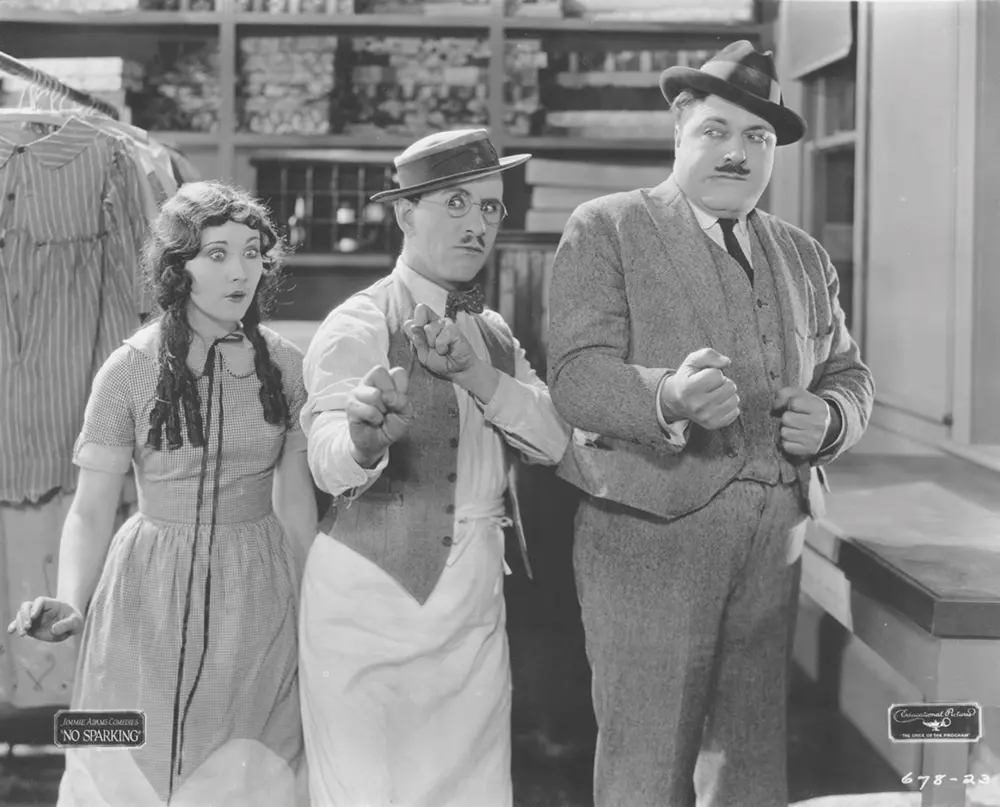
Is No Sparking worth watching today? Short answer: Yes, but primarily as a masterclass in the 'small man vs. big world' trope that defined the late silent era.
This film is for enthusiasts of physical comedy who find beauty in perfectly timed pratfalls and the mechanical precision of 1920s stunts. It is NOT for those who require complex narrative arcs or modern pacing; this is a film that breathes through its movement, not its dialogue.
1) This film works because the physical contrast between Jimmie Adams and William Blaisdell creates an immediate, visceral tension that requires zero exposition.
2) This film fails because the secondary characters, particularly the love interest played by Ann Christy, are relegated to mere trophies rather than active participants in the chaos.
3) You should watch it if you want to see how silent comedians utilized industrial environments—like a blacksmith’s shop—to heighten the stakes of a simple romantic rivalry.
Jimmie Adams is often overshadowed by the Keatons and Chaplins of his day, but in No Sparking, he proves why he was a staple of the Educational Pictures roster. His movement is frantic yet controlled. Unlike the stoic grace of Buster Keaton, Adams possesses a nervous energy that makes his encounters with William Blaisdell feel genuinely dangerous.
Consider the sequence where Blaisdell, acting as the 'bulldozer' of the plot, attempts to physically crowd Adams out of the frame. The camera placement is tight, emphasizing the claustrophobia of the blacksmith shop. Adams uses his slight frame to navigate the gaps in Blaisdell’s defense, a technique we see mirrored in other films of the era like Horse Shoes. It’s a rhythmic dance of avoidance.
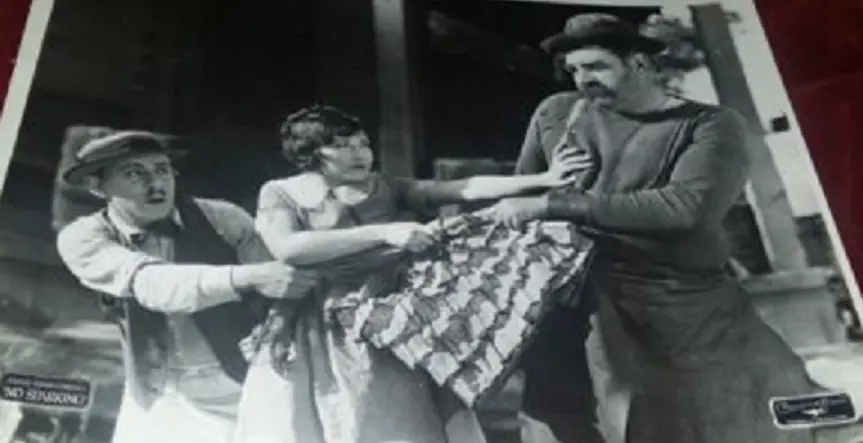
The film’s title is a clever pun on both the literal sparks of the forge and the romantic 'sparking' or courting of the era. This dual meaning is played for laughs throughout, particularly when the blacksmith’s tools become instruments of romantic sabotage. It’s simple. It’s effective. It works.
William Blaisdell is a mountain. In the 1920s, the blacksmith was the ultimate symbol of masculine power, and Blaisdell leans into this with a performance that borders on the monstrous. He doesn't just want to win the girl; he wants to flatten the competition. This isn't subtle acting, nor should it be. Slapstick requires clear, bold archetypes.
There is a specific moment where Blaisdell uses a heavy mallet to intimidate Adams. The way the light hits the metal—a credit to the uncredited but capable cinematography—highlights the sheer weight of the threat. Compared to the more domestic comedy found in Pajamas, No Sparking feels heavy and metallic.
Tiny Sandford also appears, bringing his trademark girth to the supporting cast. Sandford was the ultimate 'heavy' of the silent era, and his presence here adds a layer of professional polish to the ensemble. When these large men congregate, Adams looks like a leaf in a storm.
Yes, No Sparking is worth watching because it captures the pure, unadulterated spirit of 1920s short-form comedy before the arrival of sound complicated the genre's mechanics. It is a lean, 20-minute explosion of physical timing that serves as a perfect entry point for those curious about the 'Educational Pictures' style of comedy.
Hal Conklin, the writer and director, understands the economy of the short film. There is no wasted space in No Sparking. Every shot is designed to set up a punchline or resolve one. The pacing is relentless. Once the blacksmith’s jealousy is ignited, the film accelerates toward a chaotic climax that involves literal machinery being used as weapons of courtship.
In comparison to more avant-garde works of the time, such as Return to Reason, No Sparking is unapologetically populist. It doesn't want to challenge your perception of reality; it wants to see a man fall into a water trough. There is a brutal honesty in that goal. Conklin’s direction ensures that the camera is always in the right place to capture the impact of a fall or the absurdity of a chase.
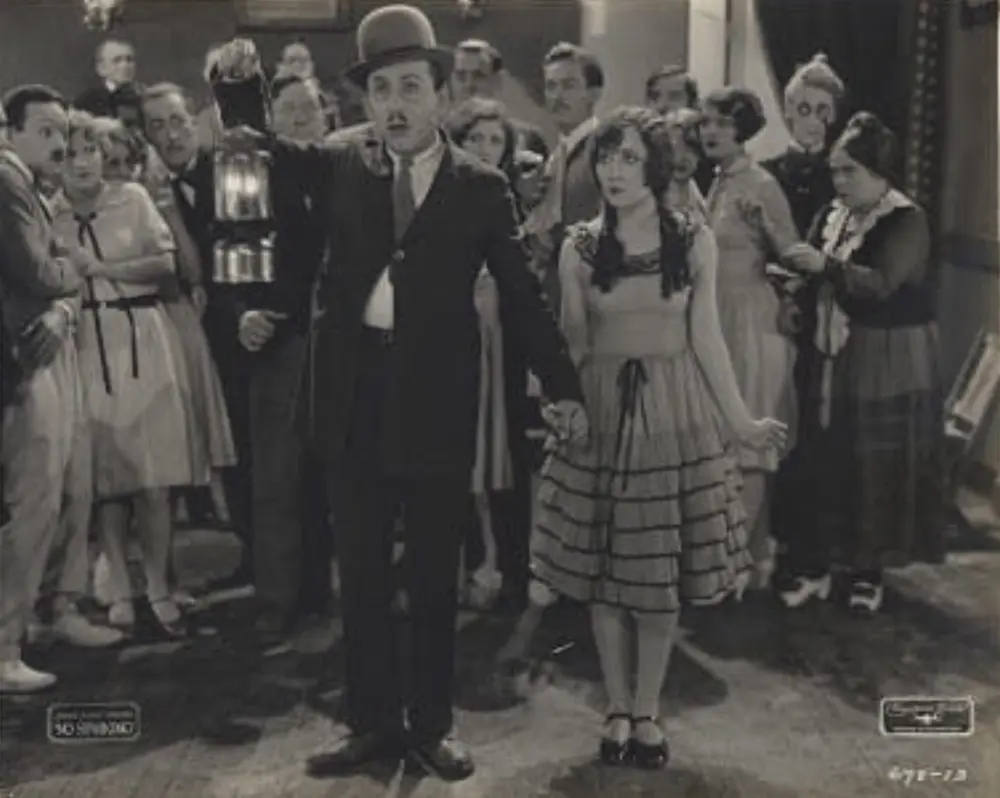
The film shares a certain DNA with Holy Smoke, another short that relies on environmental hazards for its humor. However, the blacksmith setting here provides a unique texture—the soot, the heat, and the heavy iron tools add a layer of 'blue-collar' comedy that feels distinct from the more middle-class settings of other shorts.
Here is a debatable stance: Blaisdell’s blacksmith is actually the most interesting character in the film. While Jimmie Adams is the 'hero' by default of his romantic intent, Blaisdell represents the struggle of the skilled laborer against the encroaching modernity represented by Adams’ more refined, city-adjacent character. Blaisdell’s anger feels earned. He is a man of the forge being mocked by a man of the air.
This subtext might be unintentional, but it adds a layer of socio-economic tension that makes the slapstick feel more grounded. When Adams finally outsmarts him, it doesn't feel like a victory of character, but a victory of luck. It’s an unconventional observation, but it changes how one views the 'happy' ending.
"A relic of a time when comedy was measured in bruises and broken props."
The tone of No Sparking is one of controlled anarchy. It begins in a relatively grounded reality and slowly descends into a world where physics are merely suggestions. The cinematography, though standard for the time, excels in its outdoor sequences. The natural light of the California sun (where most of these were shot) provides a crispness that helps the audience track the complex movements of the chase.
One surprising observation is the lack of sentimentality. Unlike Chaplin’s films, which often paused for a moment of pathos, No Sparking is a machine. It is designed to produce laughs per minute. This makes it feel more modern in some ways than its more famous contemporaries. It doesn't ask for your pity; it only asks for your attention.
The editing is sharp. The cuts between the blacksmith’s looming presence and Adams’ panicked reactions create a rhythmic pulse. It’s the same kind of editing precision found in Perils of the Rail, where timing is everything. If a cut is a second off, the joke dies. Here, the jokes live.
No Sparking is a minor masterpiece of the two-reel comedy format. It doesn't reinvent the wheel, but it polishes the spokes until they shine. Jimmie Adams delivers a performance that is both exhausting to watch and exhilarating to witness. While the film lacks the emotional depth of the era's greatest features, it compensates with sheer, unadulterated energy.
It is a loud film in a silent medium. It is a violent film in a romantic genre. It is, ultimately, a testament to the power of the underdog. If you have twenty minutes and a love for the history of the laugh, No Sparking is a spark worth catching.
IMDb —
1922
Community
Log in to comment.