DbcultAccessing Vault...
Cult Review
Senior Film Conservator
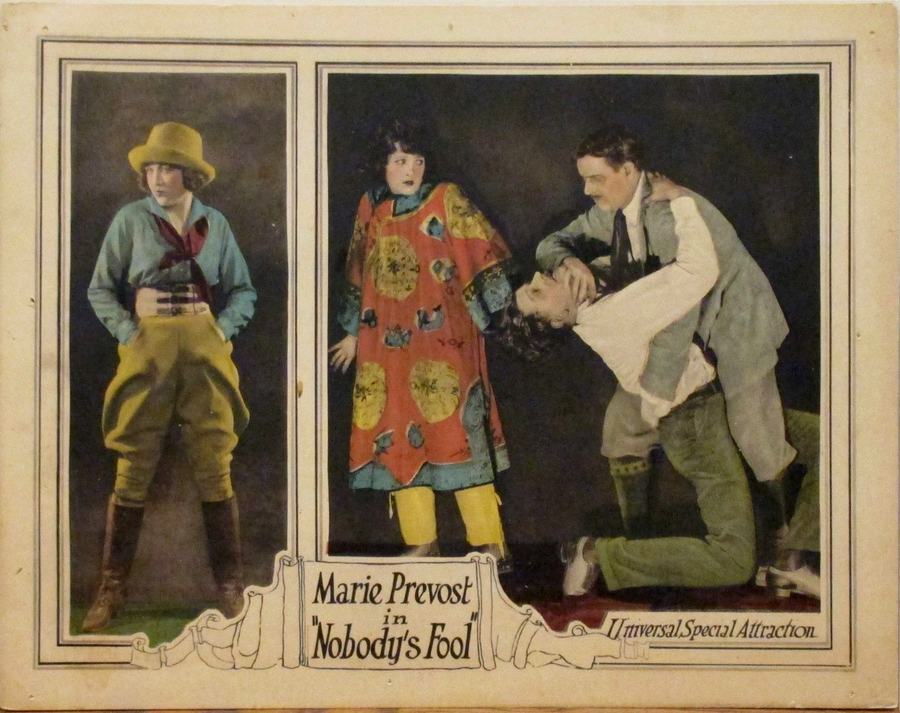
The first time we see Polly Gordon she is framed against a dormitory window whose panes blister with November rain, her silhouette swallowed by the anemic glow of a single gas-jet. Poverty is rarely photogenic in silent cinema, yet cinematographer Harry Myers (pulling double duty as the tipsy doctor here) drapes shadows across Lydia Yeamans Titus’s cheekbones with such tenderness that destitution becomes a chiaroscuro aria. The camera, restless as a gossip, tracks down the corridor where sorority girls titter behind feathered fans—every rhinestone a tiny dagger. Polly’s dress, a hand-me-down dyed the color of dried ink, drinks the light, rendering her both present and spectral. This visual strategy—beauty eked from penury—announces that Nobody’s Fool will not sermonize; it will wound by inches.
Enter Vincent DePuyster, embodied by Vernon Snively with the blasé curvature of privilege one recognizes from John Singer Sargent portraits. He slouches into the frame as though he has been personally betrayed by gravity, yet his boredom is a performance—he needs the fraternity’s imprimatur the way some men need opium. The initiation dare is whispered off-camera, but its cruelty is explicit: escort the "campus eyesore" to the annual dance and endure her company until the last corsage wilts. The film’s genius lies in withholding close-ups during this transaction; instead, the mirror above Polly’s dresser reflects Vincent’s smirk multiplying into infinity, a visual premonition that objectification ricochets back on the perpetrator.
Cue the ballroom sequence, a kaleidoscope of flappers and sheiks gyrating to a orchestra whose brass section appears to have swallowed a locomotive. Intertitles shrink to haiku—"He danced her to the brink of laughter, then pushed her over the edge into myth."—while the camera glides through Art-Deco arches. Polly’s awakening is not romantic but existential: she registers the precise temperature of being tolerated, not desired. Marie Prevost’s Mary, still a supporting player here before her tragic plunge into obscurity, floats past in chiffon, a harbinger of the marital contentment Polly will later decline. Notice how director Roy Clements inserts a blink-and-miss shot of a black drummer (Lucretia Harris) whose sticks syncopate off-beat, a subtle nod to the cultural appropriation that fuels the revelry.
The telegram arrives like a death sentence in reverse. Polly, now in a cramped bookkeeping office that smells of carbon paper and eczema salve, opens the envelope; the film superimposes a ticker-tape parade of zeroes across her iris. Inheritance scenes are usually orgies of wish-fulfillment—strings of pearls slithering across satin sheets—but Nobody’s Fool cuts to a montage of creditors knocking, landlady simpering, and Polly purchasing a second-hand sealskin coat two sizes too large. Wealth fits her awkwardly, like a wolf dressed as a grandmother. The camera adopts a lower angle thereafter; people literally look up to her, yet the sky remains out of frame, suggesting ascension without transcendence.

Suitors proliferate faster than jump-cuts. George Kuwa’s Dr. Hardy—yes, the Japanese-American actor essaying a role devoid of Asian specificity, a casting choice both progressive and oblivious for 1925—diagnoses Polly’s malaise as "a surplus of suitors and a deficit of verbs." Indeed, the intertitles grow terse, almost Sapphic: "He offered orchids. She declined. He offered diamonds. She yawned." Each rejection chips away at the gold-leaf ceiling of heteronormative expectation, exposing the lead beneath. One persistent banker corners her in a sun-parlor where stained-glass saints leer; Polly extinguishes her cigarette on the marble bust of Mercury, symbolically snuffing mercantile Cupids everywhere.
Mountain air, prescribed by Mary as antiseptic for a soul infected by flattery, gusts through the next reel. The resort—half sanitarium, half Adirondack purgatory—resembles the Overlook’s great-grandfather, all antlers and anxious silences. Enter Artemis Alger, played by Percy Challenger with the stooped shoulders of a man who has misplaced his faith in paragraphs. His introduction is a visual gag: he strides through a meadow, swatting at persistent dowagers like errant commas. The meet-cute occurs when Polly, reading a scandal sheet that trumpets her own notoriety, collides with Alger’s manuscript; pages snow across the landscape, forcing both to kneel in the dirt, reassembling sentences and, by extension, identities.
Watch how lighting schemes invert once courtship begins. Interiors that once drowned in Stygian gloom now shimmer with buttery nimbus, as though someone has uncorked the sun. Yet the film refuses to dissolve into pastoral treacle. Doris Schroeder’s scenario inserts a midnight séance where guests attempt to contact the spirit of Polly’s aunt, hoping for stock tips from beyond; the candle gutters out, revealing Vincent’s face in the mirror—an apparition of old transactional desire haunting new affection. Clements’s direction grows elastic, stretching time so that the act of hand-holding feels like a treaty signed in wartime.
The climax, a tempest worthy of Lear, literalizes emotional turmoil. Rain lashes the veranda, turning oil lamps into frantic fireflies; Vincent challenges Alger to a duel of ambiguous stakes—pistols or publishers’ contracts? In a bravura tracking shot, the camera follows Polly as she races through corridors, her dressing-gown ballooning like a mainsail, finally barricading herself in the library where first editions stand sentinel. There she confronts not men but manuscripts—Alger’s half-finished novel titled Nobody’s Fool. The meta-textual wink lands softly because Titus’s face registers the vertigo of discovering oneself as both muse and millstone.
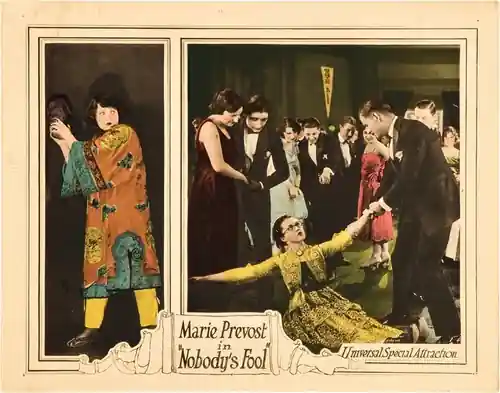
Morning breaks; floodwater recedes, leaving debris that looks suspiciously like rejected engagement rings. The dénouement unfolds on a railway platform where steam blurs faces into Monet smudges. Polly relinquishes the sealskin coat to a shivering porter, a symbolic shedding of armor. Vincent retreats, dignity frayed but intact, while Alger boards the train only to disembark at her whispered imperative: "Stay, and finish the chapter." The film closes on a two-shot—not a clinch—hands clasped like conspirators, the whistle screaming destination unknown.
Viewed today, Nobody’s Fool operates as an acid-etched corrective to the Cinderella industrial complex. Its satire of transactional affection anticipates Das große Los and Lucciola, while its mountain retreat echoes the alpine alienation in The Knight of the Pines. Yet unlike those films, it refuses to punish female ambition; Polly’s fortune is never repossessed, her final romantic choice neither victory nor concession but détente.
Restoration enthusiasts should note the existing print housed at UCLA—two reels of which were salvaged from a Montana barn—bearing water-streaks that eerily rhyme with the film’s flood sequence. The tints, originally amber for interiors and viridian for exteriors, have been digitally approximated, though the sea-blue intertitles required custom color grading to avoid a neon glare. The Mont Alto Motion Picture Orchestra’s 2022 score interpolates Gilbert & Sullivan motifs into a foxtrot, underscoring the film’s droll disdain for social opera.
Verdict: A cynic’s rom-com wrapped in ermine and arsenic, Nobody’s Fool deserves shelf-space beside Broken Shadows for anyone tracing proto-feminist strains in silent narrative. It will bruise your faith in humanity, then hand you a Band-Aid of wry hope—exactly the scar tissue art should leave.
IMDb —
1928
Community
Log in to comment.