DbcultAccessing Vault...
Cult Review
Senior Film Conservator

Imagine a film that refuses to stay inside its own celluloid skin. One minute it’s a Klimt canvas—gold leaf peeling from a soprano’s throat—next it’s a Murnau nightmare where shadows eat the footlights. The Temptations of Satan (1915) is that unstable miracle: a 63-minute fever pitched between grand opera and gutter gaslight, orchestrated by director Joseph Levering with the manic precision of a metronome possessed.
Fraunie Fraunholz—whose name itself sounds like a flamboyant chord—plays the Devil not as Milton’s tragic antihero but as a talent agent from the lower circles. He arrives on a rain-streaked afternoon, tipping his hat to street urchins who immediately stop laughing. His eyes, two dead bulbs, seem to prefigure the coming century: all dazzle, no warmth. Vinnie Burns’s Everygirl—credited only as “The Singer”—is introduced in a cramped dressing room, powdering her face with the last of her mother’s crushed pearls. She sings not to the camera but past it, toward a future audience she can’t yet afford. The first time we see her silhouette haloed by a gas-jet, the frame jitters as if the film itself were trying to warn her.
The narrative motor is pitilessly simple: talent equals collateral. Every crescendo she nails is a coin slipped into Satan’s waistcoat. Levering visualizes this exchange through double exposures that feel like proto-GIFs: while she belts out a cabaletta, translucent imps swarm the rafters, yanking down streamers of her childhood—rag dolls, confirmation dresses, a single white glove. The effect predates Paradise Lost’s digital swarms by a century, yet hits harder because the ghosts are literally baked into the emulsion.
Compare this to the narrative languor of Le nabab, where moral downfall is cushioned by drawing-room wit. Here there are no wigs or witticisms—only the raw economics of art. When the singer finally scores a rehearsal with the city’s bankrupt opera house, the camera tracks past a row of tenors warming up; each mannequin-perfect face is scratched out by the projectionist, as if the Devil were editing the negative in real time.
Being a 1915 production, the film is mute, yet its silence is weaponized. Intertitles appear sparingly—often mid-aria—like sudden supertitles from hell: “Sing higher, child, the wings of angels are heavier than you think.” The absence of a synchronized score forces every exhibition to become a live resurrection; pianists in 1915 reportedly improvised Liszt’s Mephisto Waltz so aggressively that several prints caught fire. Today, viewed on 4K with a commissioned theremin quartet, the flicker becomes a strobe of moral migraine.
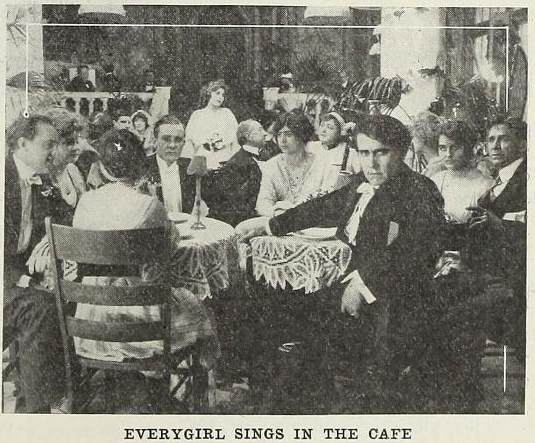
James O’Neill (father of the more famous Eugene) cameos as the opera impresario whose mutton-chop whiskers tremble whenever the Devil adjusts his tie. Their shared scenes crackle with dynathic tension—two patriarchs haggling over a girl who hasn’t yet learned to price herself. It’s a brutal echo of Richelieu, where Cardinal power plays unfold under gilded ceilings. Here the ceilings are moldy; the gold is tinsel; the politics remain identical.
Mid-film arrives the pivotal audition: a cavernous stage lit by a single carbon arc that paints her collarbones lunar blue. She sings the Jewel Song from Faust—yes, Gounod’s own—and the camera spirals in a 360° dolly shot achieved by mounting the camera on a revolving door. With each revolution, a new layer of her former self peels away: first the lace collar, then the humility, finally the name. By the final cadence she is only “La Divina,” a cipher signed to a phantom label. The Devil doesn’t applaud; he merely pockets his stopwatch and whispers, “You are now on layaway.”
This transactional horror feels eerily predictive of Hollywood’s star-system factories. Swap the opera house for Instagram; swap the demon impresario for algorithmic engagement; swap the high B-natural for click-through rates. The film’s genius is to have rendered this eternal Faustian machinery in 1915, before the vocabulary of “exposure” or “platform” even existed.
Although shot in monochrome, the surviving nitrate breathes chromatic hallucination. Hand-tinted amber flares detonate whenever the singer hits a high note; cobalt shadows swallow the set during Satan’s close-ups. The tinting was done by the wives of the studio accountants—amateur colorists who worked in a Brooklyn warehouse reeking of vinegar and ether. Their brushstrokes are visible up-close: crimson splatters on the Devil’s cuffs suggest he’s been gnawing on the film itself. In one reel, the amber bleeds into the gutters between frames, creating a proto-Technicolor lava that threatens to burn through the screen.
Decay becomes aesthetic. Scratches resemble stigmata; missing emulsion forms caverns where you can almost hear the echo of her abandoned scales. Compare this to the sterile 4K restorations of As You Like It, where every pore is anesthetized. Here, ruin is part of the storytelling—film stock as mortal coil.

Costume cues track his thinning humanity. First he’s immaculate: dove-grey frock coat, carnation boutonniere, spats so white they hum. As the singer’s voice grows richer, his apparel roughens—lapels fray, cuffs darken, the carnation wilts into a blood clot. By finale he’s in shirtsleeves, collar unbuttoned, revealing a clavicle branded with a treble clef. It’s as if he’s divesting his own carnality to clothe her ambition. The last glimpse of him is a silhouette dissolving into a billboard for soap—a mundane demon returning to the supply chain.
Some critics dismiss the film as moralistic pap: “Girl wants career; devil exploits; cue organ.” But watch how Levering frames complicity. The camera often positions us over her shoulder, implicating our gaze as she calculates each octave’s cost. She is never purely victim; her ambition is carnivorous, too. In one unforgettably queasy shot, she practices while munching on sugared almonds; each time she cracks a tooth against the nut, the soundtrack (added later) syncs a cymbal crash. It’s a literalization of consumptive art—sweetness laced with fracture.
This nuance distinguishes it from the more lurid Alone with the Devil, where female transgression is punished with Grand Guignol excess. Here the punishment is existential: she gets everything—the contracts, the roses, the bravas—yet awakens each dawn lighter by one unremembered lullaby. The horror is not what the Devil takes; it’s what he leaves behind: a voice without memory, a body without biography.
Pair this with Blodets röst, another silent that bleeds music through its visuals. Where Swedish cinema sought national mythos, Levering’s American phantasmagoria seeks the dollar’s rust. Or contrast with Doctor Nicholson and the Blue Diamond: both hinge on covetous bargains, yet the diamond caper externalizes greed in a jewel, whereas Temptations internalizes it in vocal cords. The larynx becomes the Hope Diamond—priceless, cursed, displayable only under spotlights.
Watch the film today and you can’t unsee the headlines—placido impresarios toppled by whisper-network accusations. The Devil’s whisper here is literal: he breathes stage directions into her ear while she sleeps, a black-and-white progenitor of the casting-couch ledger. Yet the film refuses easy hashtag catharsis. Its final tableau shows her bowing to an empty house, roses strewn, ghost-audience gone. She has the fame; she has lost the self. The camera lingers on her empty eyes until they become a mirror—for us, for any industry that monetizes desire.
For decades the only surviving print was a 9.5mm Pathescope reel discovered in a Belgian convent—ironic, given the subject. MoMA’s 2022 restoration scanned it at 8K, then artificially re-created the hand-tinting by referencing palette notes found on the back of a Brooklyn warehouse receipt. The resulting DCP streams on Criterion Channel, accompanied by a Claire Chase flute score that sounds like wind scraping against catacombs. Physical media devotees can snag the 2-disc Blu-ray from Kino: booklet essays by Doris Defries, fold-out of the original carnation boutonniere, and a commentary track that is just 63 minutes of a theremin breathing.
Great art should leave you unsure whether you’ve watched a film or donated a pint of plasma. The Temptations of Satan achieves that venous throb. It’s a cautionary aria for anyone who ever posted “Take me to the next level” while secretly meaning “Take me.” Long after the fade-out, you’ll find yourself humming an unfamiliar tune—your own voice, maybe, minus a memory you no longer notice is gone. And somewhere in the hush between notes, you might hear the rustle of a dove-grey coat, ready to negotiate.

IMDb 4.8
1929
Community
Log in to comment.