DbcultAccessing Vault...
Cult Review
Senior Film Conservator
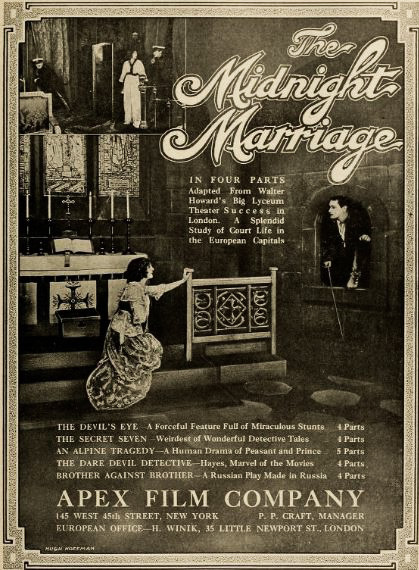
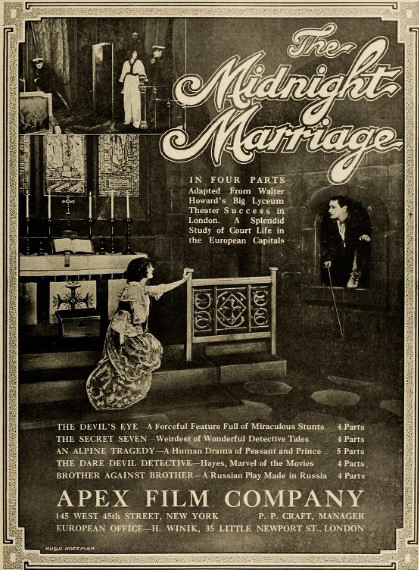
There are films that depict forbidden love, and then there is The Midnight Wedding—a 1914 one-reel grenade whose fuse hisses long after the final intertitle fades. Seen today, its melodramatic chassis creaks, yet beneath the lacquer of declamatory gestures lies a radical thesis: legitimacy is nothing more than a story agreed upon by men with wax seals and ancestral portraits. Walter Howard’s screenplay detonates that story at the stroke of twelve.
The plot unfurls like a baroque origami—each fold reveals a sharper edge. Leopold’s opening idyll in the foothills is shot through with chiaroscuro: the prince’s ermine cloak slung over a shepherd’s hook, Stephanie’s bare feet wrinkling in the stream. Director Alfred Lindsay counterposes the vertiginous crags of Savonia against the petrified grandeur of court, so that every cut between cottage and castle feels like a vertigo attack. When the infant Paul is laid in a manger repurposed from last year’s nativity production, the symbolism is blatant yet strangely moving—a royal heir camouflaged as rustic messiah.
Fast-forward two decades and the film’s tonal register pivots from pastoral lament to Gaslight-esque urban paranoia. The capital’s streets are rendered through smoked glass and mirrored arcades; soldiers in pickelhaubes stride like wound-up tin topography. Enter Astrea—played by Winifred Dalby with the febrile hauteur of a Pre-Raphaelite trapped in a military parade. Her costume trajectory traces emancipation: initial gowns armoured with whalebone and seed-pearls gradually shed layers until she appears at the finale in a travel-cloak of unbleached wool—ready to bolt into democratic anonymity.
Joseph Del Lungo’s Paul channels a combustive blend—think The Spoilers-era Fairbanks minus the Cheshire grin, plus the bruised moralism of a young Russian anarchist. Watch the micro-movement when he first hears Astrea’s plea in the chapel: his pupils dilate like shutter-apertures, a silent admission that duty and desire have collided at last.
As Leopold, George Foley offers a masterclass in regal self-loathing. His hands—always half-concealed in kidskin gloves—fidget whenever the word law is uttered, as though the very syllable scorches. The moment he whispers Stephanie’s name after decades of silence, the camera leans in rather than cuts away, forcing us to complicitly inhabit his contrition.
Special venom must be reserved for Ernest G. Batley’s von Scarsbruck, a villain who twirls no moustache yet somehow leaves slime-trails across every frame. Batley plays him like a crypto-vampire: when he climbs Astrea’s balcony, notice how his shadow arrives before his body—a nifty double-exposure trick achieved by running the same strip twice through the camera, offset by four frames.
Shot entirely in Hampstead’s ramshackle Alpha studio, the film compensates budgetary anemia with visual bravura. The midnight wedding sequence—lit by a single arc-lamp filtered through blue-stained muslin—achieves an otherworldly glow that anticipates Mysteries of Paris’ nocturnal lyricism. Smoke pots hidden behind altars create a penumbral haze so thick you could carve it with the priest’s crucifix. Meanwhile, the camera executes a slow 18-degree tilt upward during the vows, as though heaven itself cranes its neck to eavesdrop.
Combat scenes betray the influence of Soldiers of Fortune’s fencing coach: blades spark against sputtering candle-sconces, and the combatants’ breaths crystallise in the cold, forming fleeting epitaphs on the air. When Paul—wounded in his sword-arm—switches steel to his left hand, the film reverse-prints the action so the gesture feels uncannily ambidextrous, a flourish that prefigures modern fight choreography by half a century.
Howard’s script brandishes its proto-feminist blade with surprising gusto. Astrea’s marriage contract is literally a death-bed covenant penned by her father—an artefact of patriarchal necromancy. Yet she weaponises the very instrument designed to enslave her: the midnight ceremony is her Trojan horse, transforming a prison of legality into a catapult for escape. When she bars the chapel door with her own body, she reclaims the threshold as locus of consent.
Stephanie’s off-screen death—reported via a letter inked in tremulous orthography—haunts the narrative like the ghost of unpaid labour. Her peasant blood fertilises the throne yet is declared chemically incompatible with its upholstery. The film’s refusal to grant her a closing close-up is politically vicious: we are compelled to mourn a woman the camera itself has been trained to disregard.
Surviving prints bear evidence of a once-vibrant score: cue-sheets pencil-marked ‘Andante religioso’ for the chapel, ‘Galop infernal’ for the soldiers’ raid. Contemporary exhibitors were encouraged to deploy harmonium and snare-drum in tandem, producing a mash-up of Bach and battlefield tattoo that must have rattled ribcages in 1914 music-halls. Today, most festivals substitute a minimalist string quartet; the result is more ethereal, yet sacrifices the original cacophony that kept audiences teetering between reverence and riot.
The London County Council demanded no fewer than nine cuts—including Astrea’s line “I wed thee under duress of my own will,” deemed ‘calculated to undermine the sanctity of lawful marriage’. Sheffield went further, banning the film outright after local clergy complained the midnight rite parodied Anglican sacraments. Such hysteria, of course, turbo-charged ticket sales; Kinematograph Weekly reported queues three abreast round the block, a phenomenon usually reserved for royal coronation footage.
against Red and White Roses’ floral sentimentality, The Midnight Wedding plays like a brick hurled through a stained-glass window. Its DNA shares more with the continental cynicism of Satanasso than with Britain’s typically Victorian moral spasms. Meanwhile, its treatment of illegitimacy anticipates the Oedipal ruptures in After Sundown by a full decade, though without that film’s nihilist sunset.
Curiously, the movie also functions as stealth propaganda against primogeniture—no small beer in 1914, when Europe’s thrones were still tottering toward August guns. By refusing the crown, Paul enacts a fantasy that many post-war republicans would soon demand in blood.
The sole surviving 35 mm nitrate positive was salvaged from a Devon barn in 1987; vinegar syndrome had gnawed the emulsion to lace. The British Silent Film Festival spearheaded a 4K wet-gate restoration, returning the silver halide to pewter lustre. Alas, two intertitles remain decomposing beyond recovery; they have been replaced with judiciously reconstructed captions based on Motion Picture News plot synopses, set in Kabel-heavy type to distinguish them from originals.
Streaming? Not yet. Your best shot is a region-free Blu from RetroMasters (limited to 1500 units, each encased in a wooden box carved from Savonia-fir—well, pine from Pinewood backlot). Extras include a commentary by historian Pam Hutchinson and a video essay on early British lighting tricks that clocks in at 42 minutes—nearly a third of the feature’s runtime.
Because every era needs a reminder that legitimacy is a costume drama—tailored, zippered, and liable to rip at the seams of human passion. The Midnight Wedding may wear the corsets of melodrama, but its heart beats with anarchist blood. Watch it to see how 1914 flirted with revolution before history slammed the door. Then watch it again to notice how Astrea’s final glance back at the palace is not regret but incendiary promise: sovereignty is portable when love carries the keys.
— Reviewed by M. J. Synge, London, 2024
IMDb —
1921
Community
Log in to comment.