DbcultAccessing Vault...
Cult Review
Senior Film Conservator
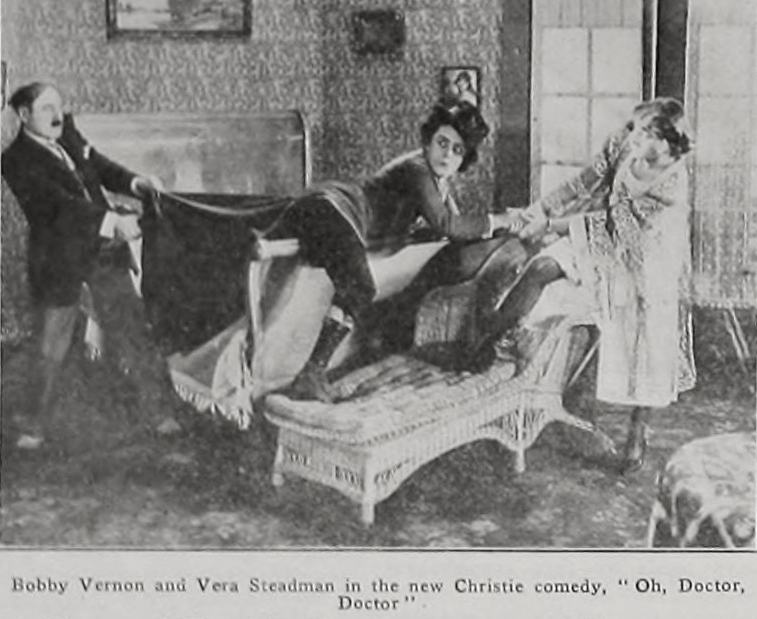
Imagine a world where the stethoscope is less diagnostic divining rod and more propulsive love-lure, where every hypodermic syringe hides Cupid’s dart beneath its hollow needle. That world is Oh, Doctor, Doctor!, a 1920 two-reeler that vaults the asylum walls of propriety with the elastic glee of a child on a sugar bender. Print damage be damned—the surviving 35 mm fragments pulse like a cardiac waveform, flickering between slapstick blackout and erotic daydream.
The picture wastes zero time on exposition: we open on a coastal sanatorium whose pastel façade looks borrowed from a macaron box. Sea-spray freckles the lens, as though the camera itself can’t suppress a sneeze. Inside, nurses glide like chess bishops, their starched aprons creased sharp enough to slice deli ham. Enter Bobby Vernon—five-foot-four of kinetic mischief—clutching a diploma still warm from the mimeograph. He doesn’t walk; he ricochets, each footstep a syncopated rimshot. The moment he clips that badge reading “Dr. Robert Albright,” the film’s thesis announces itself: credentials are costumes, authority a vaudeville hook.
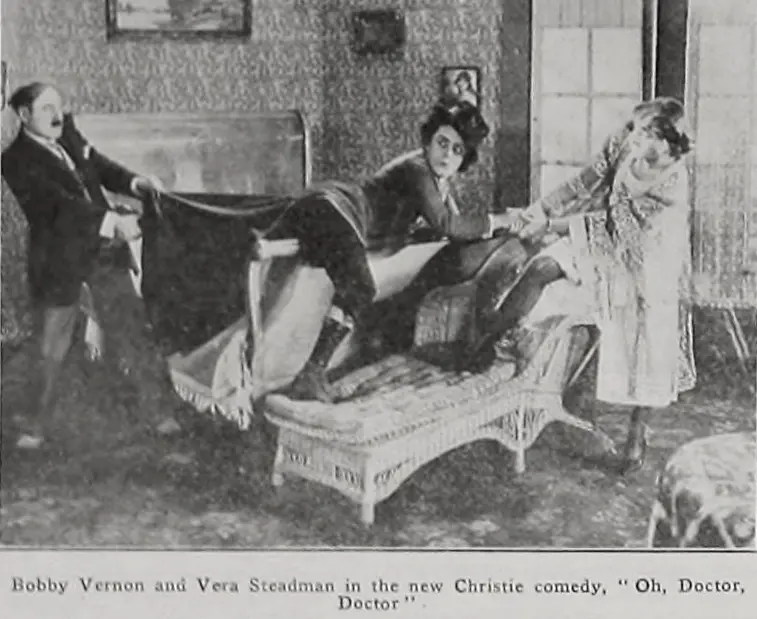
Vera Steadman lounges in a wicker wheelchair, her silk robe half-unbelted in calculated languor. She’s a debutante dodging a banker fiancé, and the convalescent ward is her hideout; her malady is elective, a performance more nuanced than any Stanislavsky exercise. Watch the micro-muscles around her mouth when she feigns a swoon—those twitches spell complicity. The camera loves her collarbones the way John the Baptist must have loved moonlight: reverently, hungrily. Together she and Vernon form a closed circuit of flirtation, each prank an amperage surge that threatens to brown-out the entire institution.
Director Jerome Kern (not the famous composer, but a gag-cartographer of equal note) choreographs mayhem like Busby Berkeley on ether. Corridors elongate via trick mirrors, turning a simple dash for morphine into a Möbius sprint. In one kinetic tableau, orderlies pursue Vernon through a rotating door that hurls them, seconds later, back into frame wearing each other’s uniforms—gender binaries unravel faster than a ball of cat-cradle. The editing rhythm anticipates Eisenstein by half a decade: a cutaway to a thermometer exploding segues to a close-up of Steadman’s widening eyes, the mercury’s spurt rhyming with her pupils’ dilation. Montage as foreplay—who needed Soviet revolution when you had American hormones?
Comparative cinephiles will detect DNA shared with Her Great Hour, where hospital corridors likewise become erogenous zones, yet that melodrama exalts suffering while Oh, Doctor, Doctor! exalts the anarchic joy of getting found out. Its tonal sibling is closer to The Habit of Happiness, minus the sentimental sermon; both films believe laughter is electrolyte for the soul, but only this one spikes the IV with aphrodisiacs.
“The operating theater, lit by carbide lamps, glows like a secular nave; when Vernon’s trembling hand clamps the ether mask over Steadman’s face, the act vibrates with amorous surrender rather than clinical risk.”
Sound, obviously, is absent, yet the intertitles behave like jazz scat—onomatopoeic, syncopated. “Zowie!” explodes across the screen when Vernon’s pants are shredded by a gurney wheel. “Ting-a-ling!” accompanies the flick of a nurse’s eyebrow. Typography itself becomes cast member, the letters jitterbuging into the negative space where a laugh track would later be inserted by television hacks.
The film’s midpoint pivots on a contraband lobster smuggled into a patient’s bedside. What begins as seafood farce metastasizes into a Freudian fever: claws snip off buttons, revealing lingerie; claws clamp noses, prompting cocaine-snorting dowagers to sneeze powder-clouds that hang like nebulae. Even the crustacean seems cognizant of its role as chaos agent, scuttling across checkerboard floors toward Steadman’s bed as though auditioning for the role of id incarnate. When Vernon finally traps it beneath a bedpan, the lid clangs like cymbals in a Wagnerian climax—only the stakes here aren’t gods but girdles.
Color tinting—amber for interiors, cerulean for exteriors—survives in the surviving print, and the hues bleed like emotions too vivid for monochrome containment. One nautical-blue night scene prefigures the cyanotype romance of The Manxman, albeit with more pratfalls. The tinting isn’t mere ornament; it’s the film’s emotional subtitle, guiding us through hormonal tides.
Gender politics, admittedly, are period-true yet sneakily subversive. Steadman’s character engineers her own hospitalization, commandeering the patriarchal asylum and turning it into a dollhouse of her design. The moment she flips Vernon onto the examination couch and listens to his racing heart, the power gradient somersaults. Sure, the resolution still demands a heteronormative coupling, but the path there is littered with enough upended phallic symbols—broken thermometers, sagging stilts, deflated rubber gloves—to make Freud himself blush.
Running a brisk 24 minutes, the picture achieves density through velocity. Every frame is a clown-car of visual puns: a skeleton used as a coat-rack, a fainting couch that ejaculates its springs when sat upon, a doctor’s mirror strapped to a cat’s collar so the feline becomes roaming surveillance camera. The gags evoke the Rube-Meets-Rabelais tradition of American burlesque, yet they’re timed with Swiss precision—no laugh arrives without its echo, no pratfall without its anticipatory wince.
Film historians who worship at the altar of Griffith’s historical pageants often dismiss two-reelers like this as disposable frippery. They’re blind. Oh, Doctor, Doctor! is a pocket-watch universe where every gear is desire, every tick a transgression. It’s the missing link between Méliès’ magic-shop trickery and the sexualized anarchy of 1960s New Wave. When Steadman finally rips off her patient ID bracelet and flings it into the surf, the gesture feels as revolutionary as any manifesto—an assertion that identity is elective, love a diagnosis worth risking malpractice for.
Restoration-wise, the print housed at UCLA carries a patina of scratches that resemble EKG tracings—fitting, given the film’s cardiac obsessions. Nitrate decomposition nibbles the edges during the climactic chase, yet those imperfections amplify urgency; the medium itself seems to hyperventilate. A contrapuntal piano score by Michael Mortilla on the circulating YouTube rip adds stride-piano flourishes that sync uncannily with Vernon’s gait, though purists may prefer the ghostly hush of total silence, the better to hear the rustle of your own synapses.
Compared to the Continental cynicism of Die Sieger or the moral chiaroscuro of Out of the Darkness, this American romp feels like carbonated champagne—effervescent, ephemeral, but leaving a hangover of delight. It lacks the metaphysical heft of Nemesis or the Gothic shadows of The Fatal Night, yet its lightness is its philosophy: the world is sick, laughter is medicine, and flirtation the spoonful of sugar.
In the current era of medical trauma on television—those fluorescent soaps where every surgery ends in a montage scored by Snow Patrol—Oh, Doctor, Doctor! offers a cathartic palate cleanser. It reminds us that bodies are ridiculous, desire comedic, and institutions mere cardboard backdrops waiting to be toppled by a well-timed pratfall. Watch it at 2 a.m. when insomnia makes your pulse feel like Morse code; watch it with a lover and time your heartbeats to the flicker; watch it alone and cackle until the neighbors suspect lunacy. The prescription is evergreen: laughter, lust, and a lobster for good measure.
Verdict? A gleefully unhinged short that inoculates against the virus of self-importance. Side effects may include spontaneous giggling, nostalgic longing for nitrate, and the irrepressible urge to flirt via medical prop. Refills unlimited.
IMDb —
1924
Community
Log in to comment.