DbcultAccessing Vault...
Cult Review
Senior Film Conservator
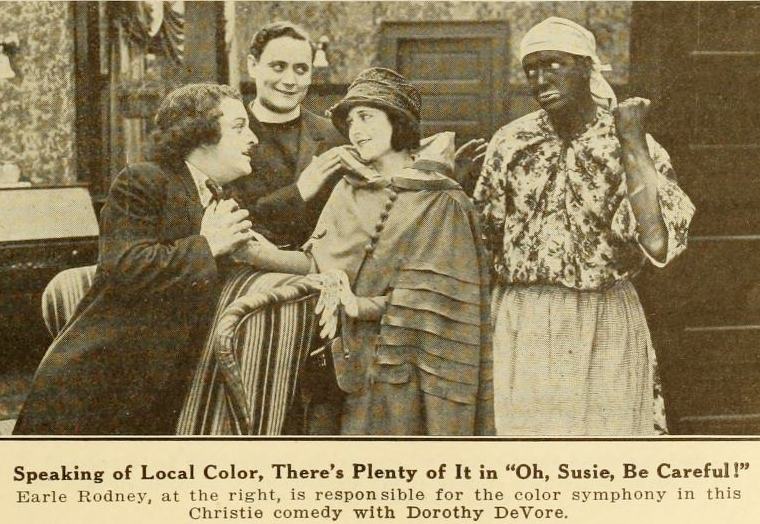
Stepping back into the nascent years of cinematic storytelling, we encounter 'Oh, Susie, Be Careful', a 1917 offering from the prolific Al Christie, a name synonymous with early American comedy shorts. This particular silent film, co-written by Christie himself alongside Scott Darling, serves as more than just a fleeting glimpse into the comedic sensibilities of over a century ago; it's a fascinating, if at times unsettling, cultural artifact. It presents a seemingly straightforward romantic comedy premise, yet beneath its surface of lighthearted hijinks and mistaken affections lies a narrative fraught with the complexities of identity, perception, and a deeply problematic comedic device that demands our contemporary scrutiny.
At its heart, the film orbits around Dorothy Devore's character, a young woman whose romantic ideals are seemingly swept away by the intellectual veneer of a long-haired professor. This infatuation, perhaps born more of idealized fantasy than genuine connection, culminates in an impulsive elopement. Such a premise was a common trope in early cinema, often exploring the societal pressures and personal whims that guided young women's choices in love. However, the narrative's true dramatic tension, and indeed its historical weight, emerges with the character of Earle, portrayed by Earle Rodney. Rodney, often cast as the earnest, slightly bumbling suitor, embodies 'the other fellow' – the one whose genuine affection is overshadowed by a rival's more flamboyant or perhaps simply more immediately appealing persona.
The central conflict, beyond the initial elopement, pivots on Earle's desperate attempt to win Dorothy back. The plot description hints at a 'critical situation' where Earle's use of blackface makeup almost costs him the girl of his choice. This is where the film transcends simple comedic analysis and delves into a much broader, more uncomfortable discussion about the history of entertainment. For modern viewers, the inclusion of blackface is an immediate and jarring reminder of a deeply racist practice prevalent in American minstrel shows and early cinema. It was a form of entertainment built on grotesque caricatures and dehumanization, perpetuating harmful stereotypes against Black people. While the film likely intended this as a mere comedic disguise, a narrative device for Earle to either infiltrate a situation or simply hide his identity, its historical context cannot be ignored. The fact that it almost 'loses him the girl' in the narrative suggests that even within the film's own moral framework, there was an acknowledgment of its potential to offend or alienate, albeit likely framed as a social faux pas rather than a racial transgression.
From a purely narrative perspective, Al Christie and Scott Darling, as writers, leverage this 'disguise' for dramatic effect. It creates a moment of high stakes for Earle, forcing Dorothy to confront something unexpected and potentially repellent in her suitor. The film, therefore, inadvertently offers a fascinating, if disturbing, lens through which to examine the evolving boundaries of comedic acceptability and the impact of visual identity. How did audiences of 1917 react to this scene? Was it seen purely as a gag, or did it carry a broader social commentary, even an unconscious one, about the masks people wear, literally and figuratively, in pursuit of love or status? These are questions that echo through the decades, complicating any simple appreciation of the film's comedic merits.
Dorothy Devore, as Susie, navigates the emotional landscape of a young woman torn between an idealized romantic notion and the reality of her suitors. Silent film acting demanded a particular kind of physicality and expressiveness, and Devore, like many of her contemporaries, likely employed exaggerated gestures and facial expressions to convey her character's internal state. Her portrayal would have been crucial in selling the initial infatuation with the professor and the subsequent disillusionment or confusion brought on by Earle's antics. Earle Rodney, in his role as the earnest, albeit misguided, lover, would have relied on physical comedy and a pathos-laden earnestness to endear himself to the audience, even as his character makes a spectacularly bad choice with the blackface. His ability to convey regret or desperation through pantomime would have been paramount in ensuring the audience still rooted for him, despite the misstep.
Roscoe Karns and Thornton Edwards, though perhaps in supporting roles, would have contributed to the film's texture, providing additional comedic relief or dramatic foil. In the fast-paced world of early film shorts, every character, no matter how minor, played a vital role in propelling the narrative forward and amplifying the central conflict. Al Christie's direction, typical of the era, would have emphasized clear visual storytelling, relying heavily on intertitles to convey dialogue and crucial plot points. The pacing would have been brisk, designed to entertain and amuse in a relatively short runtime, a stark contrast to the epic features that would soon dominate the cinematic landscape.
Al Christie was a pioneer in film comedy, known for his efficient production methods and his knack for identifying comedic talent. His studio, Christie Film Company, was a veritable factory of laughter, churning out hundreds of shorts during the silent era. His style often leaned into slapstick, farcical situations, and character-driven humor. 'Oh, Susie, Be Careful' fits squarely within this tradition, even with its more problematic elements. The film's structure, moving from initial romantic entanglement to a comedic crisis and eventual resolution (implied, though the plot summary leaves us hanging on the outcome of the blackface incident), is characteristic of Christie's approach to narrative. He understood the rhythm of silent comedy, the need for clear visual gags, and the power of a well-timed intertitle.
When considering other films of the era, one might draw parallels to the early works of figures like Charlie Chaplin or Buster Keaton, though Christie's films often had a slightly more grounded, less overtly surreal quality than some of their masterpieces. For instance, the physical comedy and situational misunderstandings found here might remind one of the chaotic energy in a film like Bumping Into Broadway, where the protagonist navigates a series of escalating predicaments through sheer physical presence and quick thinking. However, 'Oh, Susie, Be Careful' distinguishes itself by introducing a layer of social commentary, however unintentional, through its controversial plot point.
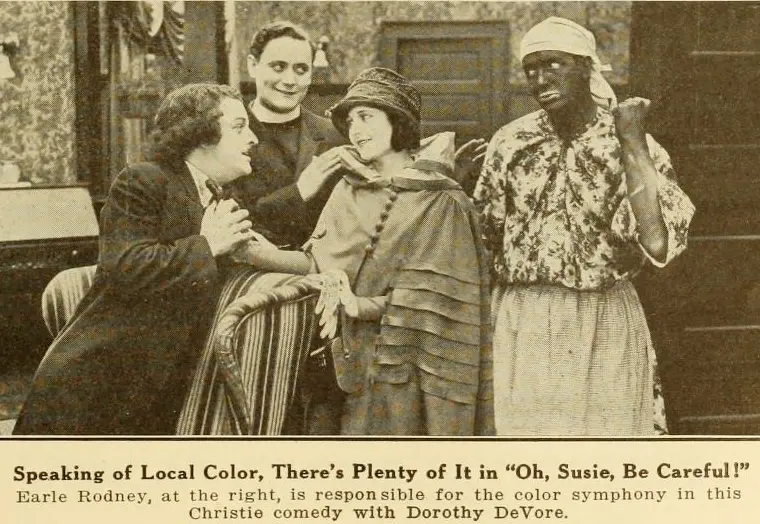
It's impossible to discuss 'Oh, Susie, Be Careful' without directly confronting the inclusion of blackface. This practice, rooted in minstrelsy, was a pervasive and deplorable aspect of American entertainment for over a century. Performers, usually white, would darken their skin with greasepaint, exaggerate their lips, and don caricatured costumes to portray Black individuals as lazy, ignorant, superstitious, hypersexual, or buffoonish. These portrayals were deeply damaging, contributing to and reinforcing racist stereotypes that had profound real-world consequences.
In the context of 'Oh, Susie, Be Careful,' the blackface appears to function as a narrative device – a disguise that Earle uses. The plot's implication that this act 'almost loses him the girl' suggests a comedic failure, a miscalculation on Earle's part within the film's internal logic. It's crucial to understand that while the film itself might not have been conceived with malicious racial intent (it was a common, accepted, albeit racist, comedic trope of the time), its impact and historical significance are undeniable. Modern viewers must grapple with this element, not to dismiss the film entirely, but to understand it as a product of its time, reflecting deeply ingrained societal prejudices.
This scene forces us to consider the ethical responsibilities of historical preservation and critical analysis. How do we engage with works that contain elements that are now universally condemned? The answer lies in contextualization and critical discourse. We acknowledge its presence, understand its historical prevalence, and simultaneously condemn its racist implications. It serves as a stark reminder of how far society, and indeed entertainment, has evolved, and how much further there is to go in ensuring truly equitable representation.
Beyond the controversy, the film, like many silent comedies, grapples with universal themes. Dorothy's initial attraction to the professor speaks to the allure of superficial charm or perceived intellect, a common pitfall in romantic pursuits. Earle's desperation to win her back, even resorting to such a misguided disguise, highlights the lengths to which individuals will go for love. This theme of appearance versus reality is central. The professor's 'long hair' might signify a bohemian, intellectual image that Dorothy finds appealing, while Earle's blackface is a literal mask, designed to deceive but ultimately revealing a deeper truth about his character (or at least his poor judgment). This echoes dramatic conflicts found in other films of the period where mistaken identity or hidden truths drive the plot, such as in the melodramatic twists of The House Built Upon Sand, where deceit underpins the entire narrative, or the complex emotional stakes of films like As Men Love, which explores the profound consequences of personal choices and societal pressures on relationships.
The film's title itself, 'Oh, Susie, Be Careful', suggests a cautionary tale, perhaps warning against hasty decisions in love or falling for superficial charms. The narrative structure, with its focus on Dorothy's romantic predicament and Earle's desperate attempts, aligns with the romantic comedies and melodramas of the era. The contrast between Dorothy's initial choice and Earle's earnest pursuit, complicated by his ill-fated disguise, creates a compelling, if historically challenging, examination of what truly constitutes a worthy partner. It’s a narrative device that could be seen in other contemporary works exploring romantic folly or the consequences of impetuous decisions, much like the intricate relationship dynamics in Upstairs and Down, which also delves into social expectations and romantic misadventures.
The sheer volume of films produced during this period, including other Christie comedies like Ring Up the Curtain, demonstrates the public's insatiable appetite for cinematic entertainment. These shorts, often playing before longer features, were designed to deliver quick bursts of laughter and lighthearted drama. 'Oh, Susie, Be Careful' undoubtedly fulfilled this role for its original audience, providing a diverting story of love, rivalry, and a spectacularly misguided attempt at winning back affection. It stands as a testament to the era's storytelling conventions, where broad humor and clear character motivations were paramount, even if some of the methods employed are deeply uncomfortable by today's standards.
Today, 'Oh, Susie, Be Careful' is more than just an obscure silent film; it's a critical touchstone for understanding the evolution of cinema and society. Its existence compels us to engage with the uncomfortable truths of our past. While its comedic intentions might have been innocent in its original context, the use of blackface irrevocably taints its legacy for modern audiences. It forces us to confront how cultural norms change, how entertainment reflects and shapes societal biases, and the importance of continuous critical re-evaluation of historical works.
The film's survival and its availability for contemporary viewing offer a unique opportunity for dialogue about race, representation, and the ethical responsibilities of artists and audiences. It's a reminder that even seemingly innocuous comedies can carry profound historical weight. For film historians and enthusiasts, it provides invaluable insight into the working methods of pioneers like Al Christie and the performance styles of actors like Dorothy Devore and Earle Rodney. It encapsulates a moment in time when cinema was rapidly evolving, experimenting with narrative forms and comedic devices, some of which would endure, and others, thankfully, would be relegated to the regrettable chapters of history.
Ultimately, 'Oh, Susie, Be Careful' is a film that demands careful consideration. It is a product of its time, offering glimpses into the romantic foibles and comedic tastes of a bygone era, yet it also carries a burden of historical insensitivity that cannot be overlooked. Its viewing today is less about unadulterated enjoyment and more about a critical engagement with cinematic history, prompting us to reflect on the complex interplay between art, entertainment, and societal values. It serves as a powerful, albeit challenging, document of early 20th-century American culture, proving that even seemingly simple comedies can spark profound and necessary conversations about our collective past and present.
IMDb 6.8
1931
Community
Log in to comment.