DbcultAccessing Vault...
Cult Review
Senior Film Conservator
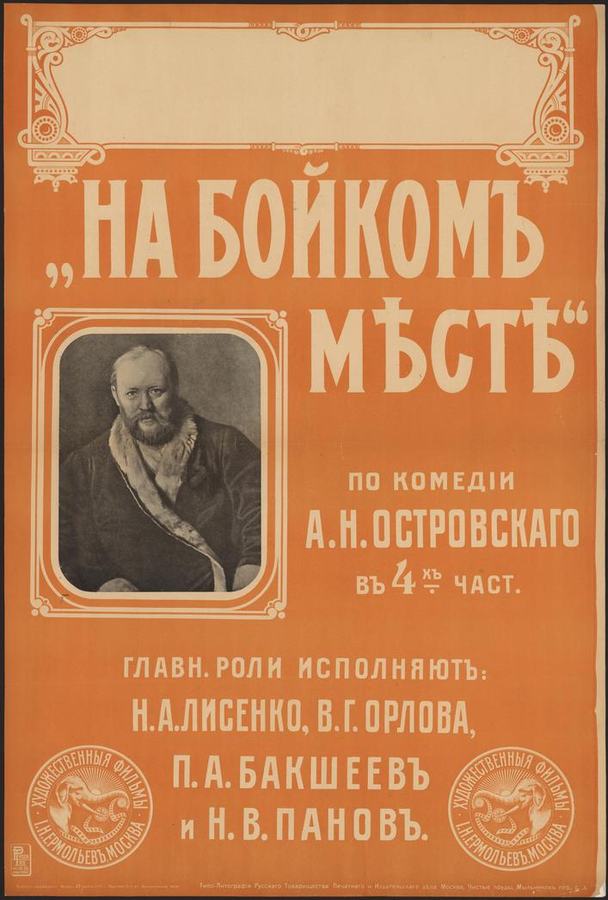
In the annals of early 20th-century Russian cinema, where flickering images often spoke volumes more than any dialogue ever could, The Busy Inn emerges as a compelling, if somewhat overlooked, testament to the era's dramatic prowess. Directed with a keen eye for human frailty and moral decay, this 1917 production, penned by the collaborative genius of Aleksandr Ostrovskiy and Cheslav Sabinsky, plunges viewers into a world where the lines between hospitality and exploitation blur irrevocably. It's a narrative that, even today, resonates with an unsettling familiarity, exploring the corrosive effects of greed and the perilous dance of manipulation that often underpins human relationships.
The film, at its heart, is an intricate character study wrapped in a melodramatic package, a common but often effective trope of the silent era. We are introduced to Bessyne, portrayed with a brooding intensity by Nikolai Panov, the proprietor of the titular Busy Inn. Far from being a mere innkeeper, Bessyne is a man perpetually dissatisfied with the modest returns of his gambling establishment. His ambition, or perhaps his desperation, drives him to darker avenues: nocturnal robberies, a stark contrast to the veneer of respectability his business attempts to maintain. This internal conflict, though often understated in silent film acting, is palpable in Panov’s nuanced expressions, a silent battle waged across his features.
Complementing Bessyne's illicit ventures is his wife, Eugenia, brought to life with captivating cunning by Vera Orlova. Orlova’s portrayal is a masterclass in silent film villainy, a woman whose charm is merely a prelude to her predatory instincts. Eugenia is no passive accomplice; she actively participates in extorting money from the Inn’s unsuspecting visitors, her very presence a silent threat, her smiles a deceptive mask. Her influence over Bessyne is considerable, a testament to the power dynamics at play within their unholy alliance. It’s a relationship built on mutual gain and moral compromise, a toxic synergy that poisons everyone it touches.
The true catalyst for the unfolding tragedy, however, arrives in the form of Anna, Bessyne’s sister, played with a delicate yet resolute vulnerability by Nathalie Lissenko. Anna represents a vestige of purity in this den of iniquity, a character whose inherent goodness stands in stark contrast to the moral decay surrounding her. Eugenia, sensing Anna’s reluctance to partake in their criminal schemes, becomes the architect of her downfall, persuading Bessyne to coerce his sister into their illicit activities. This pivotal moment is where the film transcends a simple crime narrative, delving into the psychological torment of forced complicity and the erosion of innocence. Lissenko’s performance here is particularly poignant, her wide, expressive eyes conveying a profound sense of anguish and betrayal.
Anna's unwilling participation in the Inn’s dark dealings inadvertently introduces her to Prince Myloff, a frequent patron, whose noble bearing and unsuspecting nature make him a compelling figure in this morally ambiguous landscape. Pyotr Baksheyev, as Prince Myloff, embodies the aristocratic ideal, a stark contrast to the base motivations of the Inn’s proprietors. The burgeoning romance between Anna and Myloff is the film’s emotional core, a fragile bloom struggling to survive in a hostile environment. It is a classic silent film romance, reliant on longing glances, subtle gestures, and the powerful suggestion of unspoken affection. This dynamic reminds one of the innocent, often doomed, love affairs depicted in other melodramas of the era, where societal constraints or nefarious plots often conspire against true love.
However, this nascent love story is not without its formidable adversary. Eugenia, whose manipulative tendencies know no bounds, becomes instantly fascinated by Prince Myloff. Her fascination quickly morphs into a possessive jealousy when she observes the genuine connection between Myloff and Anna. This shift in Eugenia's character from mere accomplice to vengeful rival adds another layer of complexity to Orlova’s already formidable performance. Her actions become driven by a potent cocktail of lust and envy, a destructive force that threatens to consume everyone in its path. In a truly Machiavellian move, Eugenia sets about poisoning the Prince’s mind against Anna, weaving a web of lies and insinuations designed to shatter their burgeoning relationship. The subtlety with which Orlova conveys this insidious manipulation, often through a mere shift in her gaze or a slight curl of her lip, is a testament to the power of silent acting.
Disheartened and utterly crushed by what she perceives as Myloff’s rejection, Anna reaches a breaking point. In a moment of profound despair, she consumes what she believes to be poison. This dramatic act of self-destruction, a common trope in melodramatic narratives, is rendered with a raw emotional intensity by Lissenko. The scene is imbued with a palpable sense of tragedy, as Anna, feeling life ebb away, summons the Prince, who, by a twist of fate, has called at the Inn once more. In a desperate, final confession, she assures him of her unwavering love, her words unspoken but conveyed through every trembling gesture and tearful gaze. This powerful moment of vulnerability finally breaks through Myloff’s prejudiced perceptions, instilled by Eugenia’s lies.
Convinced of her sincerity and overcome with remorse, the Prince acts swiftly, having Anna taken to his home for immediate treatment. In a declaration that promises a hopeful future, he announces their imminent betrothal, a testament to the power of truth, even when revealed on the precipice of death. This dramatic turn of events, however, is merely a prelude to the film’s ultimate, and perhaps most cynical, revelation. Bessyne, ever the pragmatist and perhaps a reluctant participant in the emotional fallout, relieves the excruciating tension by revealing that Anna’s supposed poison was, in fact, nothing more than a potent sleeping potion. This final twist, a classic example of dramatic irony, recontextualizes the entire preceding sequence, transforming a tragic suicide attempt into a darkly comedic, almost farcical, misunderstanding.
The ensemble cast of The Busy Inn delivers performances that are deeply characteristic of the silent film era, relying heavily on exaggerated gestures, expressive facial movements, and a profound understanding of body language to convey complex emotions. Nikolai Panov, as Bessyne, manages to imbue his character with a certain weary cynicism, a man trapped by his own greed yet not entirely devoid of a conscience, as evidenced by his final revelation. Vera Orlova's Eugenia is a standout, a truly memorable antagonist whose machinations drive much of the plot's dramatic momentum. Her ability to switch from seductive charm to venomous spite with a mere flicker of her eyes is truly remarkable. Nathalie Lissenko's Anna is the film's emotional compass, her suffering and eventual redemption forming the core of the audience's empathy. Her performance of despair, particularly in the 'poison' scene, is heart-wrenching and believable, making the subsequent revelation all the more impactful.
Supporting roles by Polycarpe Pavloff and Vladimir Kvanin, though less central, contribute to the overall atmosphere of the Inn, painting a picture of its denizens and the shadowy world they inhabit. The direction, while adhering to the conventions of the time, demonstrates a solid grasp of narrative pacing and visual storytelling. The use of close-ups to emphasize emotional states, the staging of dramatic confrontations, and the overall composition of shots all serve to draw the audience into the film's tense narrative. One can see echoes of the dramatic intensity found in films like The Crimson Stain Mystery, where intricate plots and heightened emotions are paramount, or the atmospheric tension of Mysteries of the Grand Hotel, which similarly leverages its setting to amplify suspense.
The Busy Inn is a rich tapestry of themes that remain relevant even today. At its core, it is a critique of unchecked greed and the moral compromises individuals are willing to make for financial gain. Bessyne's transformation from innkeeper to robber, and Eugenia's active role in extorting guests, paint a bleak picture of societal decay. The film also delves into the destructive nature of jealousy and manipulation, particularly through Eugenia's relentless efforts to sabotage Anna's happiness. Her character embodies the dark side of human desire, a cautionary tale about the lengths to which envy can drive an individual.
Furthermore, the film explores the resilience of love and the possibility of redemption, however fleeting. Anna’s love for Myloff, despite the obstacles and deceptions, shines through as a beacon of hope, even if her dramatic 'suicide' is ultimately revealed to be a mere misunderstanding. The final revelation, while providing a measure of relief, also leaves a lingering question about the ethical boundaries of such a deception. Was Bessyne's act one of mercy or simply a theatrical flourish to conclude a turbulent period? This ambiguity adds depth to the narrative, preventing it from devolving into a simplistic morality play. In this sense, it shares a thematic complexity with films like Out of the Darkness, which also explored moral dilemmas and the grey areas of human behavior.
The film's exploration of forced complicity, particularly Anna’s unwilling involvement in the Inn’s criminal activities, is also a powerful commentary on individual agency versus external pressure. It examines how easily an innocent individual can be drawn into a world of corruption, highlighting the vulnerability of those without power or influence. This struggle for moral integrity in a corrupt environment is a timeless theme, expertly conveyed through Lissenko’s performance.
As a product of early Russian cinema, The Busy Inn offers valuable insight into the stylistic and thematic preoccupations of the era. The influence of literary giants like Aleksandr Ostrovskiy (one of the film's writers) is evident in the film's strong dramatic structure and its focus on character-driven conflict. Russian silent cinema, often overshadowed by its European and American counterparts, nevertheless produced a wealth of compelling narratives and innovative techniques. This film, with its intricate plot and nuanced characterizations, stands as a strong example of the dramatic capabilities of the period. It demonstrates a sophisticated understanding of how to build suspense and elicit emotional responses from an audience without relying on spoken dialogue.
While not as widely known as some of its contemporaries, The Busy Inn deserves recognition for its compelling storytelling and strong performances. It's a film that, despite its age, manages to captivate with its exploration of universal human flaws and desires. The dramatic pacing, the visual storytelling, and the emotional performances all contribute to a viewing experience that transcends the limitations of its silent format. It is a work that, like One Wonderful Night or Den farlige Haand, relies on unfolding events and character reactions to build its narrative, proving the enduring power of visual drama.
In essence, The Busy Inn is more than a mere silent melodrama; it is a fascinating psychological drama wrapped in the guise of a crime thriller and a romance. The film's strength lies in its ability to delve into the darker aspects of human nature – greed, jealousy, and manipulation – while simultaneously exploring themes of love, despair, and the enduring hope for redemption. The performances by Nikolai Panov, Vera Orlova, Pyotr Baksheyev, and Nathalie Lissenko are particularly noteworthy, bringing a depth and complexity to their characters that defies the limitations of silent film acting. The final twist, while perhaps a touch too convenient for some modern sensibilities, nonetheless provides a memorable conclusion to a tale that keeps the audience engaged from its shadowy opening to its surprising denouement.
For enthusiasts of classic cinema and those eager to explore the rich tapestry of early Russian film, The Busy Inn offers a valuable and entertaining experience. It’s a testament to the timeless appeal of well-crafted stories, regardless of the technological advancements that have since transformed the medium. Its narrative intricacies and powerful emotional beats ensure its place as a compelling artifact of cinematic history, inviting viewers to ponder the moral quandaries presented within its flickering frames. The film acts as a stark reminder that the human condition, with all its virtues and vices, remains a perennial source of dramatic inspiration, a truth as evident in 1917 as it is today. It’s a compelling journey into a bygone era, yet its core themes echo with contemporary relevance, proving that the silent screen was far from voiceless.
IMDb —
1929
Community
Log in to comment.