DbcultAccessing Vault...
6.7/10
Senior Film Conservator
A definitive 6.7/10 rating for a film that redefined the boundaries of cult cinema. Old Brandis' Eyes remains a cornerstone of transgressive art.
In the annals of early cinematic storytelling, few films dared to probe the psychological depths of human existence with the audacious precision found in "Old Brandis' Eyes." This silent era masterpiece, far from being a mere relic, remains a potent exploration of perception, truth, and the often-unsettling chasm between outward facade and inner reality. It's a film that doesn't just tell a story; it invites its audience into a profound philosophical inquiry, a journey into the very fabric of human deception and self-delusion, setting a remarkably high bar for psychological drama in its nascent period.
The early 20th century, particularly in Germany, was a crucible for artistic experimentation, and cinema, still finding its voice, became a potent medium for exploring themes previously confined to literature or theatre. "Old Brandis' Eyes" emerges from this fertile ground, a work that captures the anxieties and intellectual curiosities of its age while simultaneously transcending them to speak to universal human experiences. It showcases the remarkable capacity of silent film to convey complex emotional and intellectual narratives without the crutch of spoken dialogue, relying instead on a sophisticated interplay of visual metaphor, nuanced performance, and evocative mood.
At its core, "Old Brandis' Eyes" presents a premise both tantalizing and terrifying: a young artist, imbued by the enigmatic Brandis with the extraordinary faculty to discern the authentic essence of individuals, to peer directly into their souls. This isn't a superpower in the conventional sense, but rather a relentless, unblinking clarity that strips away all pretense, revealing the raw, often unpalatable truths that lie beneath the polished exteriors of polite society. Imagine living in a world where every smile, every gesture, every spoken word is instantly juxtaposed against the raw, unfiltered truth of the heart from which it springs. This is the burden, or perhaps the ultimate enlightenment, bestowed upon our protagonist, transforming his very perception of reality.
The film masterfully depicts the artist's initial bewilderment, transitioning swiftly into a profound disquiet. The mundane interactions of daily life, once navigable through socially accepted conventions, become a relentless barrage of discordant revelations. The benevolent elder is revealed as a schemer, the devoted lover harbors secret resentments, the virtuous friend conceals avarice. This constant stream of unfiltered honesty, rather than empowering him, isolates him. The world, once a stage of carefully constructed performances, transforms into a grotesque tableau of unvarnished human frailty and duplicity. It's a striking commentary on the necessity of social fictions, suggesting that perhaps a certain degree of self-deception, or at least mutual blindness, is crucial for societal cohesion. The weight of this revelation is palpable, conveyed through the artist's increasingly haunted expressions and withdrawn demeanor, a visual diary of a soul under siege. His artistic sensibilities, once a source of joy and expression, are now tainted by this pervasive cynicism, rendering the beauty of the world hollow.
In the silent era, the onus of conveying complex internal states fell squarely upon the actors' physical prowess and expressive faces. "Old Brandis' Eyes" is a testament to this art form, featuring compelling performances from its lead ensemble. Alexander Moissi, as the young artist, delivers a portrayal that is both nuanced and deeply affecting. His transformation from an earnest observer to a man tormented by his own extraordinary perception is utterly convincing. Moissi doesn't merely react; he embodies the psychological toll of his gift, his eyes, ironically, becoming the primary conduit for the audience to witness his internal turmoil. One can almost feel the weight of every hidden truth pressing down upon him, manifesting in subtle shifts of posture, the slight tremor in a hand, or the profound sorrow etched onto his countenance. This physical embodiment of existential anguish is a masterclass in silent acting.
Grete Berger, a stalwart of early German cinema, brings a formidable presence to her role, even if it's not the central figure. Her ability to project character and intention without a single spoken word is remarkable, showcasing the depth of talent prevalent in this formative period of film. Similarly, Lothar Körner and Jean Ducret contribute significantly to the film's atmospheric density, each portraying characters whose surface pleasantries belie deeper, more complex motivations. The film thrives on this visual dichotomy, where the actors' overt actions are constantly being recontextualized by the audience's understanding of the artist's unique perspective. This dynamic makes every interaction fraught with subtle tension and dramatic irony, a sophisticated narrative technique for its time, demanding an active, interpretive engagement from the viewer. The subtlety with which these performers navigate their roles, often hinting at hidden depths with a glance or a restrained gesture, is truly remarkable and speaks to the sophistication of early cinematic acting.
The film’s profound thematic underpinnings are largely attributable to the fertile imagination of its writer, Hanns Heinz Ewers. Known for his contributions to fantastic and occult literature, Ewers was a master of the macabre and the psychologically unsettling. His screenplay for "Old Brandis' Eyes" transcends simple melodrama, delving into existential questions about identity, authenticity, and the very nature of human connection. Ewers understood that true horror often resides not in external monsters, but in the internal landscapes of the human psyche, and in the uncomfortable truths that lie just beneath the surface of polite society. His narrative choices imbue the film with a dark, almost gothic sensibility, a pervasive sense of dread that stems from understanding rather than fear of the unknown. This intellectual rigor elevates the film beyond mere entertainment, cementing its place as a significant work of early psychological cinema, showcasing a writer unafraid to confront the more disquieting aspects of human nature.
Ewers' writing style, often characterized by its exploration of the uncanny and the grotesque, found a perfect medium in silent film, where visual symbolism could amplify the unspoken terrors of the mind. He crafted a narrative that is less about external conflict and more about internal disintegration, a slow-burning psychological unraveling that resonates deeply with audiences even today. His ability to craft a compelling story around such an abstract concept as "seeing into hearts" is a testament to his unique literary genius and his foresight in understanding the expressive potential of the burgeoning film medium.
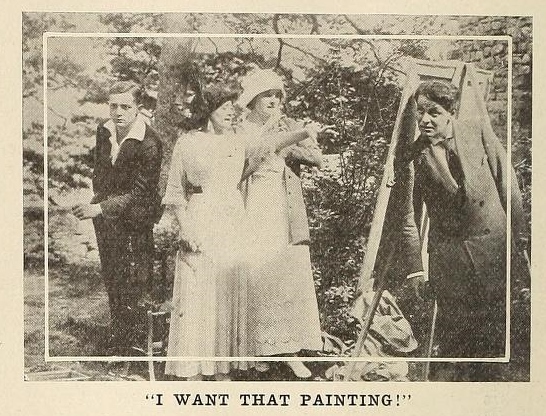
Beyond the stellar performances, the film's visual language is instrumental in translating the artist's subjective experience to the audience. While specific details on the director are not provided, the execution clearly demonstrates a thoughtful approach to visual storytelling. Cinematography and lighting are employed not just to illuminate scenes, but to articulate mood and the protagonist's altered perception. Close-ups on the artist's face, for instance, become potent windows into his inner turmoil, emphasizing the isolation brought by his unique vision. The interplay of shadows and light might subtly shift when he perceives a character's true nature, perhaps lending a sinister cast to an otherwise innocuous figure, or revealing a hidden vulnerability. This visual grammar, though rudimentary by modern standards, is incredibly effective in its psychological impact.
The mise-en-scène, too, plays a crucial role. One can imagine sets that initially appear grand and inviting slowly taking on a suffocating quality as the artist's disillusionment grows. The film, in its silent eloquence, must rely heavily on these visual cues to communicate the profound psychological shift occurring within its central figure. This reliance on visual metaphor and symbolic imagery is a hallmark of the silent era, and "Old Brandis' Eyes" utilizes it to its fullest potential, creating an immersive, if unsettling, experience for the viewer. It's a masterclass in how to show, rather than tell, the unraveling of a mind burdened by unwanted truth, making the internal external through ingenious cinematic techniques. The camera becomes an extension of the artist's own haunted gaze, forcing the audience to experience his newfound, agonizing clarity.
"Old Brandis' Eyes" stands as a significant precursor to later psychological dramas and films that delve into the uncanny. Its thematic audacity resonates with other works of its period and beyond that explore the darker recesses of human nature or extraordinary sensory perceptions. For instance, the existential angst and the burden of a supernatural pact in The Student of Prague (1913) share a certain spiritual kinship with the artist's plight here, both protagonists grappling with gifts that ultimately become curses, their lives irrevocably altered by forces beyond their control. Similarly, films like The Mysteries of Souls (1912) from the same era, though perhaps less focused on a singular character's internal journey, hint at the societal fascination with hidden motives and the complexities of the human spirit, showcasing a burgeoning interest in the unseen forces governing human behavior.
The exploration of dual identities and psychological torment found in Der Andere (1913) also finds a compelling parallel, albeit through different narrative mechanisms. Where "Der Andere" delves into the fractured self, "Old Brandis' Eyes" focuses on the fractured perception of others, both leading to profound personal crises. The film also foreshadows the later expressionistic movement in German cinema, which would frequently employ distorted realities and heightened emotional states to reflect internal psychological turmoil. One can draw a clear line from this film's thematic boldness to the visual and narrative daring of classics like The Cabinet of Dr. Caligari (1920), which similarly plunged into subjective, unsettling realities, using exaggerated sets and chiaroscuro lighting to mirror a disturbed mind. The influence of Ewers' unique blend of the fantastic and the philosophical can be seen reverberating through the genre, pushing boundaries of what cinema could explore beyond simple adventure or romance.
Furthermore, other films of the period, while perhaps not directly psychological, shared a common thread of exploring the unseen or the morally ambiguous. Consider the darker, more mystical undertones found in Vampyrdanserinden (1911), which, through its exploration of seduction and hidden dangers, touches upon the idea of concealed identities and intentions. Even the intense personal drama of Der Eid des Stephan Huller (1912), with its focus on a man caught in a web of circumstance and moral choices, echoes the profound personal struggle at the heart of "Old Brandis' Eyes." These comparisons underscore how early cinema was not merely a spectacle, but a burgeoning art form capable of deep introspection and complex thematic engagement, often laying the groundwork for genres that would flourish decades later.
What truly elevates "Old Brandis' Eyes" beyond a mere curiosity is its timeless relevance. The questions it poses about authenticity, trust, and the masks we wear in society remain as pertinent today as they were a century ago. In an age saturated with curated online personas and carefully constructed public images, the film serves as a chilling reminder of the potential dissonance between projected self and true self. It forces us to ponder: would we truly want to see into the hearts of others, and more disturbingly, would we want them to see into ours? The film doesn't offer easy answers, instead opting for a potent, unsettling meditation on the nature of human interaction, a disquieting mirror held up to our own tendencies toward artifice and self-preservation.
The film’s power lies in its ability to disturb the comfortable assumptions we make about the people around us. It's a profound psychological thriller, not in the sense of jump scares or overt violence, but in the relentless dismantling of innocence and the crushing weight of knowledge. The artist's journey is a tragic one, an ascent to a higher, more painful plane of understanding, from which there is no return to blissful ignorance. This narrative arc, combined with the period's unique approach to visual storytelling, creates a cinematic experience that is both intellectually stimulating and emotionally resonant, leaving an indelible imprint on the viewer's psyche long after the credits have rolled. It challenges us to reconsider the very foundations of our social contracts and personal relationships.
In conclusion, "Old Brandis' Eyes" is far more than a historical artifact; it is a vibrant, thought-provoking piece of cinema that continues to challenge and captivate. It's a testament to the fact that even in its nascent stages, film possessed the capacity to explore the most intricate and disquieting aspects of the human condition. For anyone interested in the evolution of psychological drama, the capabilities of silent film acting, or simply a deep dive into what it means to truly "see," this film is an indispensable viewing experience. It leaves an indelible mark, urging us to look a little closer, and perhaps, to be a little more honest, not just with others, but with ourselves, in a world where true perception can be both a blessing and an unbearable curse.
IMDb 6.7
1927
Community
Log in to comment.