DbcultAccessing Vault...
Cult Review
Senior Film Conservator
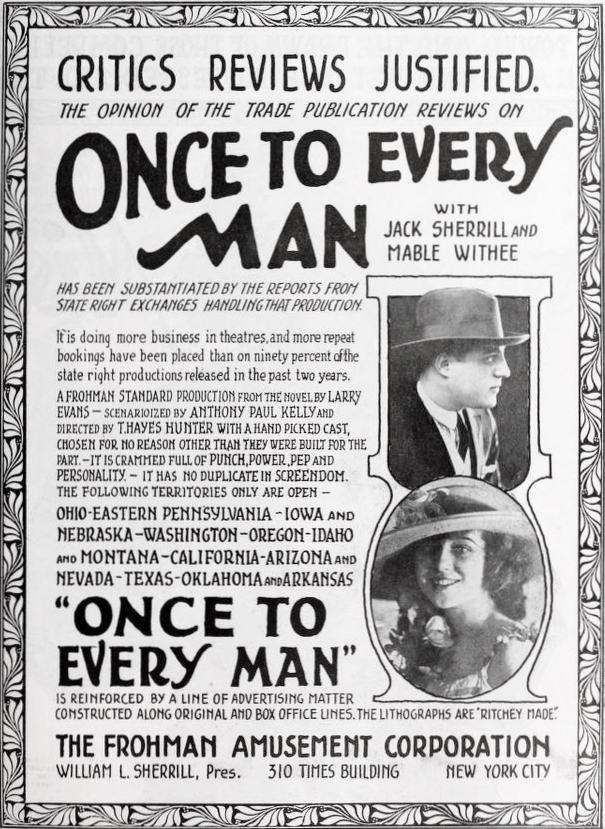
In the annals of early American cinema, few narratives capture the suffocating weight of social expectation and biological destiny as poignantly as Once to Every Man (1918). This is not merely a film about boxing; it is a cinematic treatise on the concept of the 'sins of the father.' Jack Sherrill portrays Denny Bolton with a nuanced fragility that belies the physical demands of his eventual transformation. The film opens in a landscape that feels less like a rural haven and more like a panopticon of Puritanical judgment. The inhabitants of his upstate New York home are not neighbors; they are wardens of a reputation he did not build. This thematic preoccupation with the inevitability of moral decay echoes the somber tones found in The Silence of Dean Maitland, where the past acts as a relentless predator.
The pivotal moment of the horse kick is a masterpiece of silent era melodrama, executed with a jarring physicality. It serves as the narrative fulcrum upon which Denny’s life pivots. When Dryad Anderson, played with a luminous but eventually faltering resolve by Mable Withee, discovers him prone, the film brilliantly illustrates the fragility of trust. The audience witnesses the tragic irony of a man suffering a physical trauma being branded with a moral failure. This sequence mirrors the emotional volatility seen in Dzieje grzechu, where the protagonist is similarly buffeted by the cruel winds of circumstance and social perception. The visual grammar here relies heavily on the close-up, capturing the flicker of doubt in Dryad’s eyes—a doubt that proves more damaging than the horse's hoof.
As Denny migrates to New York City, the film shifts its aesthetic from the soft, ominous shadows of the countryside to the stark, gritty textures of the city. Flash Hogarty’s gymnasium is depicted not as a place of leisure, but as a factory for the reconstruction of the male ego. Here, the film aligns itself with the industrial grit found in The Soul Market. Boxing becomes a metaphor for Denny’s internal struggle; every punch thrown at his opponent is a strike against the ghost of his grandfather’s alcoholism. The training montages, while primitive by modern standards, possess a rhythmic intensity that underscores the character's desperation to outrun his DNA. The introduction of the fighter Sutton provides a necessary foil, a physical manifestation of the obstacles Denny has faced his entire life.
The final bout against Jed the Red is a sequence of remarkable kinetic energy. The direction manages to convey the claustrophobia of the ring and the roar of the invisible crowd. It is during this crescendo of violence that the film introduces its most potent emotional device: the note from Dryad. This letter is not merely a romantic gesture; it is a restoration of Denny’s humanity. It validates his struggle in a way that the championship belt never could. This intersection of the domestic and the violent is a hallmark of the era’s storytelling, reminiscent of the high-stakes moral dilemmas in The Woman and the Law. The victory is not just over an opponent, but over the very concept of the 'branded soul,' a theme explored with similar intensity in A Branded Soul.
The collaborative efforts of writers Larry Evans, Anthony Paul Kelly, and Joseph Farnham result in a script that avoids the mawkish sentimentality often associated with 1910s drama. They understand that for Denny’s redemption to feel earned, his isolation must be absolute. The dialogue cards are sparse but impactful, emphasizing the internal monologue of a man who has been told since birth that he is a failure. This narrative economy is something that contemporary filmmakers could learn from. The film’s pacing, while deliberate in its first act, accelerates with a terrifying momentum once Denny enters the urban sphere, much like the frantic energy of Atop of the World in Motion.
Once to Every Man stands as a testament to the enduring power of the underdog story. It navigates the treacherous waters of temperance-era moralizing without becoming a dry sermon. By grounding the conflict in the physical reality of boxing and the emotional reality of betrayal, the film achieves a universal resonance. It shares a certain DNA with Denny from Ireland in its exploration of identity and heritage, yet it remains distinct in its focus on the psychological trauma of community-wide stigmatization. The film’s conclusion, while ostensibly a 'happy ending,' carries the weight of the scars Denny has accumulated. He returns home not to apologize for who he was, but to demonstrate who he has forced himself to become.
In comparison to other works of the period, such as Blackbirds or Patria, Once to Every Man feels remarkably modern in its focus on trauma and self-actualization. It eschews the grand political conspiracies of Patria for a more intimate, visceral combat. It is a film that recognizes that the hardest fights are not those fought in the spotlight, but those fought in the silence of one's own conscience. The cinematography, though limited by the technology of 1918, uses light and shadow to articulate Denny's isolation, a technique that would later be perfected in the film noir era. The starkness of the gym, contrasted with the idealized, if judgmental, beauty of the upstate landscapes, creates a visual dichotomy that mirrors Denny's fractured psyche.
To watch Once to Every Man today is to witness the birth of the modern sports drama. It possesses the DNA of every 'Rocky' or 'Raging Bull' that followed, yet it is imbued with a unique, silent-era grace. The performances, particularly from Sherrill and Withee, bridge the gap between stage-bound pantomime and modern naturalism. It is a vital piece of cinematic history that demands a reappraisal, not just as a relic of the past, but as a living, breathing story of human resilience. Whether compared to the social critiques of The Turn of the Wheel or the domestic dramas of Whoso Findeth a Wife, Denny Bolton's journey remains a singular achievement in early narrative filmmaking. It reminds us that while we cannot choose our ancestors, we can certainly choose which of their battles we continue to fight. The film is a masterclass in tension, release, and the ultimate triumph of the individual over the collective's low expectations. It is, quite simply, essential viewing for anyone interested in the evolution of the American hero.
Furthermore, the film's exploration of the female perspective through Dryad Anderson, though secondary, offers a glimpse into the limited agency of women in this era. Her abandonment of Denny is not an act of malice, but a survival mechanism in a world where a husband's alcoholism meant certain destitution, a theme touched upon in Giving Becky a Chance and Pauline. Her eventual reconciliation with him represents a mutual liberation from the town's toxic narrative. In the end, Once to Every Man is a film about the courage to be wrong, the strength to change, and the power of a single moment to redefine a lifetime.
IMDb —
1919
Community
Log in to comment.