DbcultAccessing Vault...
Cult Review
Senior Film Conservator
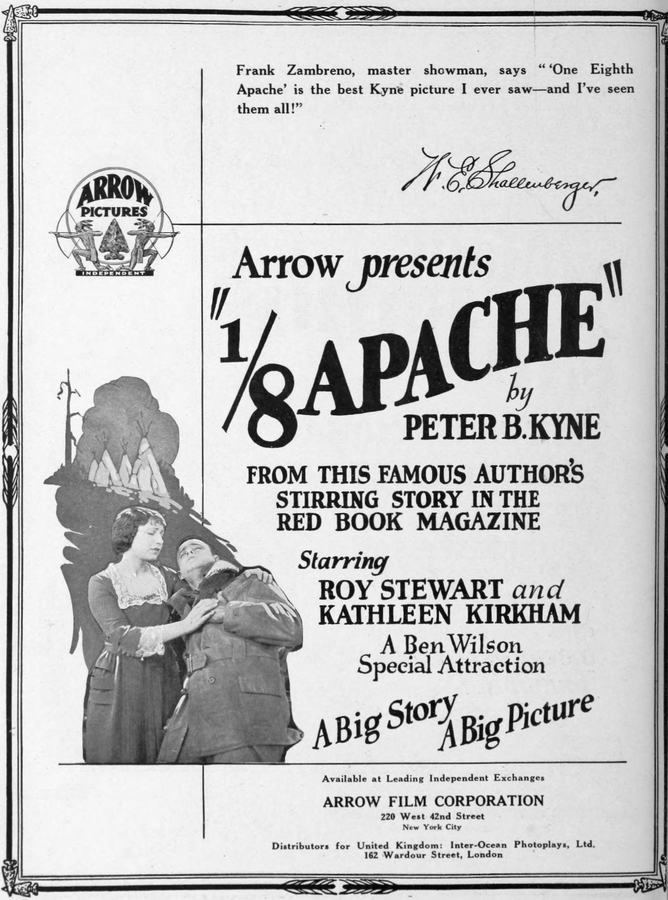
The cinematic landscape of 1922 was a fertile ground for the exploration of the American mythos, a time when the frontier was transitioning from a lawless expanse into a structured society defined by industrial wealth. One Eighth Apache, directed with a keen eye for the shifting tides of social status, presents a narrative that is far more than a mere Western. It is a psychological drama that interrogates the fragility of the American dream when it is built upon the shifting sands of reputation and racial purity. Unlike the more straightforward heroics found in Just Tony, this film delves into the darker recesses of human motivation, where the villain is not a masked bandit, but a social climber with a lethal tongue.
At the heart of this tragedy is Tyler Burgess, portrayed with a chilling sense of entitlement by the cast. Burgess represents the modern interloper, a man who views the West not as a place for labor, but as a chessboard for his own advancement. His target is Brant, the son of a cattle and oil baron—a character who embodies the synthesis of old-world land ownership and new-world resource extraction. The conflict here is not over territory in the physical sense, but over the legitimacy of the individuals who inhabit it. The film’s screenplay, penned by J. Grubb Alexander and Peter B. Kyne, masterfully weaves a tapestry of resentment that feels surprisingly contemporary in its examination of identity politics.
The pivot point of the entire film is the accusation of Brant's 'tainted' blood. In the early 20th century, the concept of blood quantum was a powerful tool of exclusion. By alleging that Brant is one-eighth Apache, Burgess isn't just attacking a man's character; he is dismantling his legal and social standing. This thematic preoccupation with mixed-race identity echoes the sentiments found in The Goddess of Lost Lake, though here it is used with a more malicious, strategic intent. The renegade Indian character, often a trope of the genre, is utilized here as a tragic instrument of Burgess’s machinations, highlighting the exploitation of indigenous figures in the broader narrative of white expansion.
The wedding sequence stands as a masterclass in silent film tension. The visual storytelling captures the transition from celebratory opulence to visceral horror with a fluidity that few films of the era achieved. When Burgess casts his aspersions, the camera lingers on the faces of the high-society guests, capturing the immediate, reflexive recoil of a class that values provenance above all else. This moment of social death is followed by actual death, as the confrontation turns physical, leading to the murder of Brant’s father. It is a sequence that rivals the dramatic weight of The Masqueraders in its focus on the collapse of public personas.
George M. Daniel and Kathleen Kirkham deliver performances that transcend the often-exaggerated pantomime of the silent era. Kirkham, as Norma, portrays a woman caught in a gravitational pull between duty and desire, and later, between realization and regret. Her portrayal of the 'unhappy' marriage to Burgess is etched in the weary lines of her posture and the haunting stillness of her gaze. It is a nuanced performance that suggests a depth of inner life rarely afforded to female leads in Westerns of this period. One might compare her emotional range here to the protagonists in What Money Can't Buy, where the hollowness of material gain is laid bare.
The cinematography utilizes the vast, open spaces of the West to mirror the isolation of the characters. While many films of the era, such as Cupid's Hold-Up, used the landscape as a backdrop for adventure, One Eighth Apache uses it as a psychological landscape. The shadows in the Burgess household are long and oppressive, contrasting sharply with the sun-drenched oil fields that represent Brant’s lost heritage. This visual dichotomy reinforces the film’s central theme: that wealth and status are easily stolen, but peace of mind is a far more elusive commodity.
When examining One Eighth Apache alongside Boomerang Bill, one sees a fascinating contrast in how crime and consequence are handled. While the latter focuses on the gritty reality of the underworld, the former explores the 'polite' crimes of the upper class—slander, emotional manipulation, and the subversion of law through social influence. The film also shares a DNA with Who Is to Blame?, as it forces the audience to question the collective guilt of a society that allows such racialized lies to take root and flourish.
The inclusion of the renegade Indian as the eventual executioner of Burgess provides a poetic, if violent, resolution. It suggests a world where the marginalized eventually reclaim their agency, albeit through the only means left to them by a system that has used them as pawns. This resolution is far more complex than the traditional 'happy ending' found in I Will Repay. It is a conclusion steeped in blood and the realization that while Norma and Brant are reunited, the world they inhabit has been irrevocably stained by the events Burgess set in motion.
To watch One Eighth Apache today is to witness a cultural artifact grappling with the anxieties of its time. The film was released in a post-war America that was increasingly obsessed with 'nativism' and the preservation of a specific social order. By using the 'one-eighth' motif, the filmmakers were tapping into a very real legal and social obsession with genealogy. This same obsession can be seen through a different lens in The Rose of Rhodesia, which dealt with colonial anxieties in a different hemisphere. The brilliance of this film lies in its ability to take these macro-social fears and distill them into a micro-drama of three individuals.
Furthermore, the film’s depiction of the oil industry serves as a precursor to the great oil epics of later decades. The cattle and oil baron is a figure of transition, representing the end of the agrarian West and the birth of the industrial titan. This shift in economic power creates the vacuum that Burgess attempts to fill. It is a thematic thread that connects this film to the social hierarchies explored in The Heiress at Coffee Dan's, where the source of one's wealth determines their moral and social standing.
The eventual exposure of the frame-up is handled with a relentless narrative drive. The film does not shy away from the ugliness of Burgess’s defeat. Unlike the redemptive arcs seen in The Desire of the Moth, there is no salvation for Tyler Burgess. He is a character defined by his lack of a moral core, and his end is as hollow as his life. The way the truth comes to light—through the very people he thought he had successfully exploited—serves as a powerful commentary on the inherent instability of lies.
The final reunion between Brant and Norma is bittersweet. While the film satisfies the generic requirements of a romance, the audience is left with the knowledge of the trauma they have endured. This complexity is what elevates One Eighth Apache above its contemporaries. It shares a certain gravitas with The Bishop's Emeralds, another film where the past refuses to stay buried and where the consequences of one's lineage are inescapable. The film ends not with a celebration, but with a sense of quiet exhaustion, a fitting conclusion to a story that began with such violent disruption.
In the grand canon of silent Westerns, One Eighth Apache deserves a more prominent place. It anticipates the psychological depth of the 1950s 'adult Western' and the revisionist critiques of the 1970s. Its exploration of race, class, and the corrupting influence of ambition is handled with a sophistication that belies the era's reputation for simple morality plays. It is a film that, like Kindling or The Married Flapper, captures a specific moment in American social history while speaking to universal human failings.
The film’s legacy is one of technical proficiency and narrative courage. It dared to ask uncomfortable questions about the nature of American identity at a time when the country was still trying to define itself. For the modern viewer, it remains a compelling, if harrowing, journey into the heart of the frontier—a place where the greatest dangers were not the elements or the 'outlaws,' but the prejudices and ambitions of one's own neighbors. It is a stark reminder that the history of the West was written not just in ink and blood, but in the whispers and lies that could destroy a man's life with a single word.
IMDb 7.2
1927
Community
Log in to comment.