DbcultAccessing Vault...
2.2/10
Senior Film Conservator
A definitive 2.2/10 rating for a film that redefined the boundaries of cult cinema. One Hundred Years Ago remains a cornerstone of transgressive art.
Unearthing 'One Hundred Years Ago': A Glimpse into Australia's Cinematic Dawn
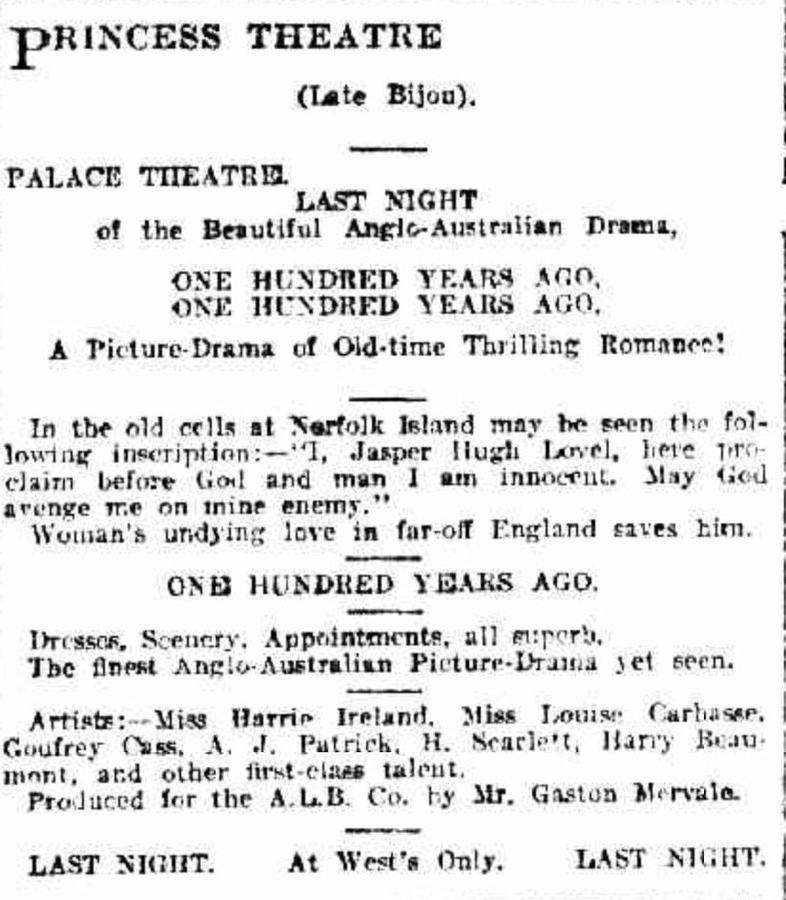
Stepping back into the annals of early cinema is often akin to a journey through a dimly lit archive, where each reel promises a glimpse into a world long vanished. 'One Hundred Years Ago,' a film from the nascent days of Australian filmmaking, directed by P.W. Marony and featuring the incandescent Louise Lovely, along with A.J. Patrick, Godfrey Cass, and Harrie Ireland, is precisely such a treasure. Released in an era when cinema was still finding its voice, this particular feature offers not just a story, but a profound reflection on the very foundations of a nation, viewed through the lens of individual struggle and grand ambition. It's a testament to the pioneering spirit not only of its characters but of the filmmakers themselves, daring to weave complex narratives in a medium still considered a novelty.
The film plunges us into the rugged, unforgiving landscape of New South Wales, circa 1815, a century before its likely production date. This temporal distance allows for a fascinating interplay between the historical setting and the contemporary anxieties of its original audience. The sprawling, untamed Australian bush becomes more than just a backdrop; it is a formidable character, shaping destinies and mirroring the internal turmoil of its human inhabitants. Marony's direction, though constrained by the technical limitations of the time, demonstrates an intuitive understanding of visual storytelling, using the vastness of the environment to underscore the isolation and resilience required of early settlers. The narrative's strength lies in its ability to humanize the often-mythologized colonial experience, presenting it not as a monolithic historical event, but as a series of deeply personal battles for survival, love, and self-determination.
The Heart of the Colony: Louise Lovely's Elara
At the narrative's core is Elara, brought to life with remarkable grace and conviction by Louise Lovely. Lovely, already a burgeoning star, imbues Elara with a compelling blend of fragility and steeliness. Her performance is a masterclass in silent film acting, where every gesture, every flicker of the eye, conveys volumes of unspoken emotion. Elara is not merely a damsel in distress; she is a woman grappling with the suffocating expectations of a patriarchal society, epitomized by her father, Silas Thorne. Her yearning for a life beyond the confines of duty and the pursuit of material wealth resonates deeply, making her a proto-feminist figure in an era where such portrayals were rare. One can draw parallels to other early narratives that attempted to give women agency, though often within the framework of romantic melodrama, such as the heroines in films like The Wayward Daughter or Only a Factory Girl, yet Lovely's Elara feels particularly robust, her inner conflict palpable even without dialogue.
Elara's internal struggle is the emotional compass of the film. She represents the nascent Australian identity, torn between the Old World's rigid class structures and the New World's promise of freedom and self-invention. Her dreams are not of grand ballrooms but of a life connected to the land, a vision that starkly contrasts with her father's rapacious ambition. Lovely's portrayal captures this tension beautifully, her expressive face a canvas for Elara's hopes and fears. The subtle nuances in her performance elevate Elara beyond a simple romantic lead, transforming her into a symbol of burgeoning independence in a landscape that demands both submission and defiance. This nuanced characterization is a highlight, demonstrating the often-underestimated depth achievable in early silent cinema through skilled acting.
The Clash of Ideologies: Silas Thorne and Daniel
Godfrey Cass, as the formidable Silas Thorne, delivers a performance that is both menacing and tragically human. Silas is not a cartoon villain; he is a man forged by the harsh realities of colonial life, believing that strength and acquisition are the only paths to survival and prosperity. His relentless pursuit of land, particularly Daniel's vital parcel, stems from a deep-seated fear of scarcity and a desire to impose order on a chaotic world. Cass masterfully conveys this blend of ruthlessness and a warped sense of paternal duty, making Silas a complex antagonist rather than a mere obstacle. His presence looms large, a tangible representation of the societal pressures and economic realities that defined the era. The film skillfully uses his character to explore the darker side of the pioneering spirit – the drive for control that often trampled over more harmonious approaches to settlement.
Opposing Silas is Daniel, portrayed by A.J. Patrick. Patrick brings a quiet dignity and an understated strength to Daniel, making him a compelling romantic lead. Daniel's vision for the land is one of respect and sustainability, a philosophy that places him at odds with the prevailing ethos of exploitation. He represents a different kind of pioneer, one who seeks to understand and integrate with the environment rather than simply subdue it. His love for Elara is not merely a romantic subplot; it is intertwined with his reverence for the land, symbolizing a hopeful alternative to Silas's destructive path. The dynamic between Patrick and Lovely is understated but potent, relying on glances and shared moments of quiet understanding to convey their deep connection. This contrast between the two male leads forms the central ideological conflict, allowing the film to comment on the differing pathways of colonial development.
The Supporting Tapestry: Harrie Ireland's Maeve
Harrie Ireland, as Elara's friend Maeve, provides an essential grounding presence. Maeve is the voice of practicality, warning Elara of the dangers inherent in defying social norms and challenging her father's authority. Her character serves as a realistic counterpoint to Elara's more idealistic leanings, highlighting the very real risks faced by women who dared to stray from prescribed paths in that era. Ireland's performance, while perhaps less outwardly dramatic than Lovely's or Cass's, is crucial in establishing the social fabric against which Elara's rebellion plays out. She represents the cautious wisdom of those who have learned to navigate, rather than confront, the rigid structures of their world, adding a layer of authenticity to the community depicted. Her loyalty and concern for Elara are evident, making her a sympathetic figure despite her conservative advice.
P.W. Marony's Direction and the Art of Early Visual Storytelling
P.W. Marony's direction, though lacking the sophisticated techniques of later eras, is remarkably effective in 'One Hundred Years Ago.' He understands the power of the landscape, often framing his characters against the vast, indifferent bush, emphasizing their smallness yet also their resilience. The cinematography, rudimentary by today's standards, nonetheless captures the raw beauty and harshness of the Australian environment, making it an active participant in the drama. Marony employs long shots to establish the isolation of the colonial settlements and close-ups to convey the intense emotions of his cast, a technique that was still evolving in early narrative cinema. His pacing, while deliberate, builds tension effectively, particularly in the escalating conflict over Daniel's land and the film's climactic natural disaster.
Compared to the 'actualités' and event films that dominated early cinema, such as The Corbett-Fitzsimmons Fight or Saída dos Operários do Arsenal da Marinha, 'One Hundred Years Ago' represents a significant stride towards complex narrative filmmaking. While those films captured slices of reality, Marony's work constructs a fully imagined world, populated by characters with motivations and conflicts that resonate beyond mere documentation. This shift from 'showing' to 'telling' was a crucial evolutionary step for cinema, and 'One Hundred Years Ago' stands as a compelling example of this transition in an Australian context. The editing, though perhaps not as fluid as in contemporary films, serves the story, guiding the audience through the emotional beats and plot developments without losing clarity.
Themes: Land, Love, and Liberty in a Young Nation
The central themes of 'One Hundred Years Ago' are as relevant today as they were over a century ago. The film explores the profound relationship between humanity and the land, a recurrent motif in Australian art. Silas Thorne's desire to dominate and exploit the land contrasts sharply with Daniel's philosophy of coexistence, reflecting an ongoing debate about environmental stewardship. This ecological consciousness, even in its nascent form, is remarkably forward-thinking for a film of this period. Furthermore, the film delves into the perennial conflict between individual liberty and societal expectations. Elara's struggle to forge her own path, independent of her father's will and the restrictive norms of her community, speaks to universal desires for self-determination. Her choices, whether for love or for a different way of life, are presented with a gravity that elevates the melodrama into something more substantial.
The colonial setting, while specific, allows for broader commentary on the formation of identity in a new world. The characters are not merely settlers; they are pioneers, grappling with what it means to build a society from scratch, often at great personal cost. The film implicitly asks: what kind of nation are we building? One founded on greed and control, or one built on respect and shared values? This interrogation of national character, even if unintentional, lends the film a layer of historical significance that transcends its immediate plot. It's a foundational narrative, much like The Story of the Kelly Gang, which also explored the tensions of Australian identity and lawlessness, albeit through a different lens. Both films, in their own ways, contribute to the nascent mythology of the Australian bush and its inhabitants.
The Climax: Nature's Reckoning
The film's climax, involving a dramatic confrontation over land rights intertwined with a natural peril, is a masterstroke of early cinematic tension. Whether it's a raging bushfire, a devastating flood, or a relentless drought, the specific nature of the environmental threat is less important than its symbolic power. It represents the ultimate, indifferent force that humbles human ambition and forces a reckoning. In these moments of crisis, characters are stripped bare, their true natures revealed. Elara's pivotal choice, caught between the two men and their opposing philosophies, becomes a microcosm of the larger struggle for the soul of the young colony. The visual spectacle of the natural disaster, even with the special effects limitations of the era, would have been impactful, serving as a powerful reminder of humanity's place within the grander scheme of nature. This dramatic use of environmental elements to shape narrative and character fate is a recurring strength in early Australian cinema, where the landscape often dictates the terms of human existence.
The resolution, while perhaps leaning towards the melodramatic conventions of the period, feels earned. It underscores the film's message that true progress lies not in domination, but in understanding and collaboration. The choices made by Elara, Daniel, and even the eventual fate of Silas, contribute to a narrative arc that speaks to the possibility of growth and change, even in the most rigid of environments. The film manages to convey a sense of hope, suggesting that the harshness of the past can give way to a more equitable future, provided humanity learns to respect both the land and each other. This optimistic undertone, despite the preceding struggles, leaves a lasting impression, resonating with the aspirations of a young nation still defining itself.
Legacy and Rediscovery
'One Hundred Years Ago' stands as a significant, if often overlooked, piece of Australian cinematic history. Its rediscovery and preservation are vital for understanding the evolution of narrative film and the unique cultural narratives that emerged from different parts of the world. The performances by Louise Lovely, A.J. Patrick, Godfrey Cass, and Harrie Ireland offer invaluable insights into the acting styles and conventions of the silent era, showcasing their ability to convey complex emotions and character arcs without the aid of spoken dialogue. P.W. Marony's direction, while perhaps not as widely known as some of his European or American contemporaries, demonstrates a clear vision and a knack for crafting compelling drama within the constraints of early filmmaking technology. This film, alongside others of its time, such as Robbery Under Arms or The Squatter's Daughter, forms a crucial part of Australia's cinematic heritage, illustrating the foundational stories that helped shape a national identity on screen.
For modern audiences, 'One Hundred Years Ago' offers more than just historical curiosity. It is a window into the past, a powerful reminder of the struggles and triumphs that forged a nation. Its themes of environmental responsibility, individual freedom, and the clash between progress and tradition remain acutely relevant. The film’s artistic merit lies in its audacious attempt to tell a grand story with limited means, relying on strong performances, evocative imagery, and a compelling narrative to captivate its audience. It serves as a potent reminder that even in cinema's infancy, filmmakers were grappling with profound questions, using the new medium to reflect on human nature and the world around them. Its continued study enriches our understanding of global film history and the diverse voices that contributed to its early development.
A Timeless Narrative in a Nascent Medium
In conclusion, 'One Hundred Years Ago' transcends its status as a historical artifact to stand as a compelling piece of narrative cinema. Its intricate plot, driven by well-defined characters and universal themes, showcases the burgeoning artistry of P.W. Marony and the expressive talents of its cast. Louise Lovely's Elara, in particular, emerges as a memorable figure, embodying the spirit of resilience and aspiration against a backdrop of colonial challenge. The film’s ability to weave together personal drama with broader societal and environmental concerns speaks volumes about its enduring relevance. It is a film that demands to be seen, studied, and appreciated not just for its place in history, but for its inherent power to tell a timeless story of human struggle and the quest for self-determination in an untamed world. It highlights how early cinema, far from being simplistic, was often deeply ambitious, tackling complex ideas with ingenuity and passion. The film's legacy is a testament to the fact that compelling storytelling, regardless of technological advancement, has always been at the heart of the cinematic experience, connecting us to the past and illuminating the human condition with remarkable clarity and emotional depth.
IMDb —
1919
Community
Log in to comment.