DbcultAccessing Vault...
Cult Review
Senior Film Conservator
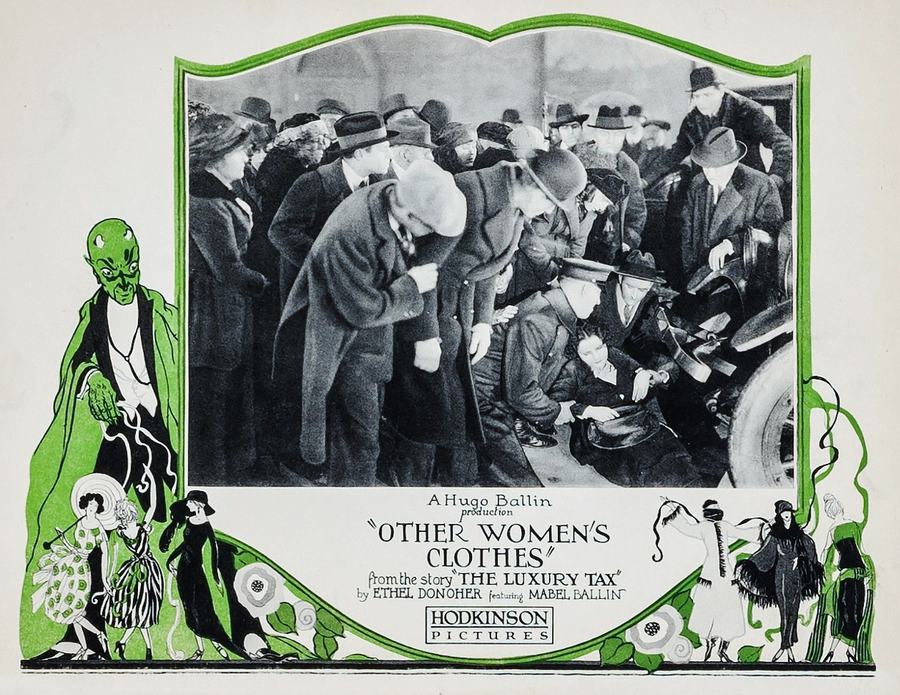
Hugo Ballin’s Other Women’s Clothes arrives like a lacquered cigarette case snapped open in a velvet booth—its glamour exhales acetone and orchids, its morality coughs up blood. The film, now nearing a century of neglect, deserves rescue from the vault’s vinegar breath, for it is a Rosetta Stone of jazz-age cynicism: a parable about forgery that is itself forged from pure celluloid illusion.
The plot, deceptively frothy, is stitched from predator silk. Barker Garrison—played by Raymond Bloomer with the blasé decadence of a man who’s never heard the word no—decides that love is easiest when gift-wrapped in someone else’s future. He invents an ailing dowager in Rio, endows her with emerald mines that exist only in stock-photo atlases, and dangles the forthcoming bequest before Jacqueline Lee, a model whose cheekbones could slice invoices. The ruse is couture: measured, draped, and accessorized until Jacqueline drapes herself in the expectation of wealth like a mink that still breathes.
Notice how Ballin photographs Jacqueline’s first entrance: a slow tilt from her T-strap heels to the tiara of studio kliegs, the camera essentially unwrapping her for consumption. It is the film’s thesis in miniature—woman as gift, fortune as wrapping paper.
Rupert Lewis—Crauford Kent prowls through the role with a drunkard’s rubber-legged elegance—arrives at Jacqueline’s self-thrown birthday masque like a cracked gramophone. In top-tailored stupor he hoists champagne and toasts “the old lady in Rio de Janeiro… Barker Garrison!” The sentence ricochets across crystal, silvers, and pretense; the orchestra’s pizzicato hiccups; Jacqueline’s smile calcifies. Ballin holds the reaction shot of Aggie La Field for a near-sadistic fourteen seconds—her pupils dilate from starlight to sinkholes. The frame freezes on that vertiginous instant when gift horse becomes Trojan.
From here the film fractures into two mirrored odysseys: Jacqueline’s flight and Garrison’s penitent pilgrimage. She evaporates from Paris to Bruges to Vienna, changing names like lipsticks—each alias a rebuke to the man who tried to trademark her destiny. He pursues not out of entitlement now, but out of the dawning nausea that the world’s easiest mark was himself.
The continental mid-section is a visual aria. Cinematographer J. Roy Hunt lenses Europe like a fever dream: canals ripple with black mercury snow; cathedral spires skewer pewter skies; locomotive steam writes cursive regrets across the Danube. Intertitles, lettered in wrought-iron font, inform us She wandered cities whose names she forgot to pronounce. It is exile rendered as baroque poetry, and it is here that the film escapes its potboiler chassis and becomes Klimt-like parable—woman re-creating herself with every station stamp on a forged passport.
Ballin cross-cuts between Garrison’s obsessive quest and Jacqueline’s metamorphosis into an actress of “burnished renown” (the film’s own florid intertitle). The irony scalds: the swindler who fabricated an heiress now chases a genuine star who wears her own invented name like a diadem.
Act III detonates in Manhattan. A yellow Duesenberg screams down Fifth Avenue; Jacqueline—now billed as Carlotta Vale—stumbles from the curb, her silhouette folding beneath the chassis like a love letter crushed into a pocket. Garrison, idling at the light, recognizes the curve of that clavicle before he recognizes the woman. He carries her limp form into twilight, and the film trades its European chiaroscuro for hospital whites that buzz like neon halos.
Recovery unfolds in a loft paneled with Broadway posters—each play title a breadcrumb of her ascent. Mabel Ballin, the real-life actress portraying Jacqueline/Carlotta, modulates between anesthesia and spotlight: half-lidded vulnerability giving way to command presence when she announces, “I will never again be anyone’s unsigned canvas.”
Bloomer’s Garrison matures from lounge-lizard smugness to gaunt repentance; his cheekbones sharpen with every mile of track he chases. La Field’s Jacqueline carries the film’s emotional stethoscope—listen to the micro-tremor in her gloved fingers when she first feels the velvet of the imaginary fortune, then compare it to the iron-steady handshake she offers Garrison in the hospital. The contrast is a masterclass in silent-film physiognomy.
Supporting players sparkle like errant diamonds. May Kitson’s acid-tongued socialite fires off fan-cooled barbs; Rose Burdick’s lady’s maid supplies Chaplinesque side-eye that could wither orchids. William H. Strauss, as the family attorney who smells something sulfurous in the Rio narrative, exudes the weary rectitude of a man who’s seen every con twice.
Art direction by Hugo Ballin himself—he was a salon painter before turning lens—imbues sets with Gustav Klimt’s gilt mosaics and Otto Dix’s razor angles. Notice the party scene: mirrors multiplied into infinity, each reflection slightly mis-timed, so that Jacqueline confronts an army of selves she can no longer vouch for. The motif anticipates Orson Welles’s Lady from Shanghai hall of mirrors by two decades, though here the fragmentation is emotional, not merely stylistic.
The tinting strategy is equally eloquent. Night sequences bathe in uric amber; scenes of deception flicker sickly green; the hospital coda warms to peach—like dawn filtering through gauze. Modern viewers accustomed to monochrome silents will be startled by how chromatic the 1926 experience was.
Beneath its love story, Other Women’s Clothes is a treatise on gendered liquidity. Men trade futures; women wear them. Jacqueline’s body is the promissory note upon which Garrison writes a fantasy estate. When she learns the forgery, she reclaims authorship by turning her own corpus into a publicly traded commodity on the stage. The final vow—never to leave him—is less sentimental surrender than capitalist merger: two brands pooling risk after due diligence.
Viewed alongside contemporaries like The Hungry Heart (which treats female appetite as pathology) or Armstrong’s Wife (where marriage equals colonial conquest), Ballin’s film is startlingly progressive: the woman ends upright, solvent, and on her own corporate letterhead.
Cinephiles will detect DNA strands that slither into later eras. Jacqueline’s self-reinvention prefigures Kieslowski’s Blind Chance: both narratives pivot on a single revelatory instant that sends life cartwheeling into alternate orbits. The Rio dowager hovers like a proto–rosebud, an absent lynchpin whose non-existence still dictates destinies.
Meanwhile the cross-continental chase rhymes with The Border Legion’s fugitive arcs, though Ballin substitutes Western mesas for café-society decadence. Where Nancy Comes Home domesticates redemption inside small-town porches, Other Women’s Clothes insists on metropolitan neon as the only baptismal font vast enough to scrub away original sin.
No original score survives, but cue sheets suggest a collage: Saint-Saëns’ Introduction and Rondo Capriccioso for Jacqueline’s catwalk reveries; a foxtrot record reversed for the party meltdown; solo celesta during hospital scenes to lend recovery the tint of toy-box innocence. Modern programmers should lean into anachronism—sampled typewriter pings, Rio carnival field recordings filtered through static—to evoke the film’s central tension between authenticity and artifice.
Like many independents of the mid-20s, Other Women’s Clothes slipped through the cracks of corporate archives; only a 35mm nitrate positive and a 28mm show-at-home print survive, both housed in a Bologna vault awaiting 4K love. Rumor persists that a Czech collector holds an amber-tinted 16mm—but rumor is the film’s native currency, after all.
What endures is attitude: the film’s conviction that identity is a gown one may doff or don, that love is only as honorable as the contract underwriting it, and that redemption—if it exists—must be negotiated under harsh marquee light, not in the forgiving shadows of a confessional.
For viewers fatigued by superhero third acts that mistake volume for stakes, Other Women’s Clothes offers a quieter but sharper pleasure: the spectacle of human beings weaponizing imagination against one another, then discovering the cost is their own marrow. It is a film that predates our influencer era yet anticipates its hustle: curate the fantasy, sell the lifestyle, pray the seams never show.
Seek it out if you crave jazz-age poison served in a golden spoon. Just remember: every gown onscreen is borrowed, every title deed written in smoke. And when the projector’s last flicker dies, you may find yourself patting your own pockets, wondering which of your stories were bought with real currency, and which with the counterfeit coin of wishing.
—a love letter and a warning, both written on watermarked paper that dissolves at the first drop of champagne.
IMDb 6.3
1925
Community
Log in to comment.