DbcultAccessing Vault...
Cult Review
Senior Film Conservator
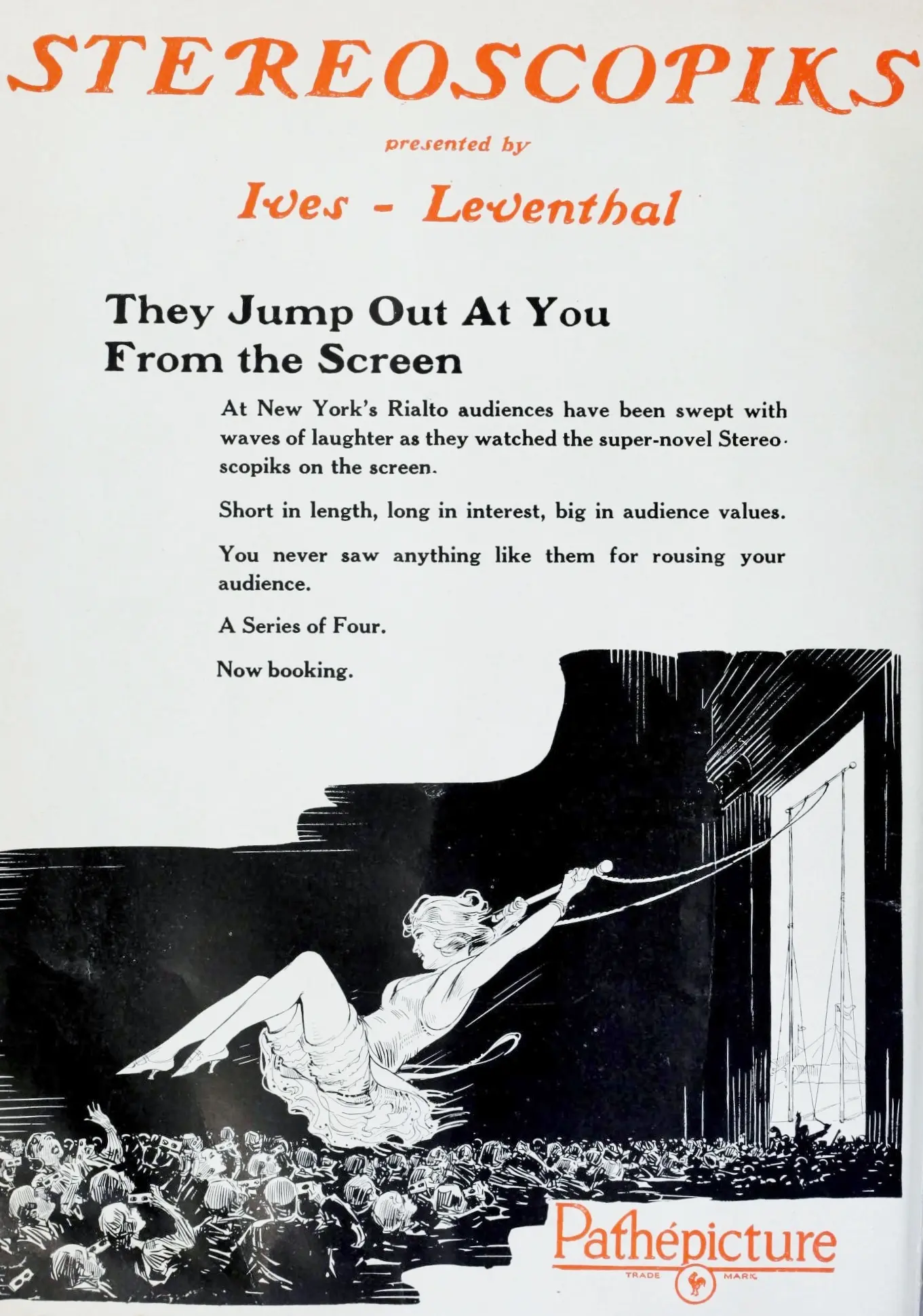
Is 'Ouch!' a film worth seeking out today? Short answer: yes, but with significant caveats. This isn't a film you watch for character development or a compelling plot; it's a historical artifact, a pure, unadulterated jolt from the dawn of 3D cinema. It’s a vital piece of cinematic archaeology, offering a window into the industry's relentless pursuit of novelty and immersion.
This film is unequivocally for film historians, technology enthusiasts, and those fascinated by the evolution of visual storytelling. It is emphatically NOT for viewers seeking a conventional narrative, deep thematic exploration, or a feature-length experience. If your expectation is anything beyond a brief, impactful demonstration of early Stereoscopik, you will likely be disappointed.
The early 20th century was a crucible of cinematic innovation, a period where the very language of film was being invented and reinvented with astonishing speed. Amidst this ferment, "Ouch!" emerges not as a story, but as a bold declaration: cinema could do more than simply show; it could truly immerse. Its entire premise revolves around the new Stereoscopik process, a technological marvel intended to shatter the two-dimensional barrier of the screen and bring the action directly into the audience's lap. This wasn’t about telling a tale; it was about delivering a sensation.
Frederick Eugene Ives and Jacob Leventhal, the figures credited with bringing this experience to life, were less traditional filmmakers and more cinematic engineers. Their goal was to prove the viability and visceral appeal of 3D, and to do so, they stripped away all pretense of plot. What remained was pure effect, a series of carefully orchestrated visual assaults designed to elicit a primal, physical reaction from the viewer. It's a testament to the era's boundless ambition, where the medium itself was the star.
"Ouch!" is a film that demands to be understood not as a story, but as a proof-of-concept, a thrilling, if brief, glimpse into a future where films would literally reach out and grab you. Its audacity, even today, is palpable.
Absolutely, if you approach it with the right mindset. "Ouch!" isn't entertainment in the modern sense; it's an educational experience, a historical document of a pivotal moment in film technology. For those who appreciate the 'how' and 'why' of cinema's development, it offers invaluable insights.
This film works because it unapologetically embraces its core purpose: to showcase Stereoscopik. Its brief runtime ensures that the novelty doesn't wear thin, delivering a concentrated burst of what was, at the time, an utterly revolutionary experience. It succeeds by being direct, impactful, and innovative.
This film fails because it offers almost no narrative content, which for many, is the fundamental expectation of cinema. Its brevity and singular focus, while its strength as a demonstration, make it a difficult recommendation for casual viewing or for those seeking a traditional movie experience. It's a technical marvel, not a storytelling one.
You should watch it if you are a student of film history, an enthusiast of early cinematic techniques, or simply curious about the origins of 3D. It’s a foundational piece that helps contextualize every subsequent attempt at immersive filmmaking, from the 'golden age' of 3D in the 1950s to modern blockbusters.
The plot, or rather, the experiential blueprint, of "Ouch!" is deceptively simple: "Lariats are thrown, guns are fired and swords are slashed at the audience through the medium of the new Stereoscopik process." This isn't a narrative; it's a list of effects. The genius here lies in the understanding that, for early 3D, the 'what' was less important than the 'how.'
The cinematography, under the direction of Ives and Leventhal, was entirely geared towards maximizing the illusion of depth and projection. Imagine the staging: performers likely positioned at varying distances from the camera, with key objects – the lariat, the pistol, the sword – brought aggressively into the foreground. The camera work would have been static, precise, and calculated to maintain the stereoscopic effect without causing viewer discomfort, a common pitfall of early 3D.
The choice of objects is crucial. A lariat, by its very nature, suggests movement and extension. A gun firing implies a flash, a sudden burst of energy directed outwards. A slashing sword provides a sharp, linear motion, cutting through the perceived space between screen and viewer. Each element was chosen for its potential to exploit the nascent 3D technology, transforming passive observation into an almost tactile encounter.
It's a brutalist approach to filmmaking, stripping away all non-essential elements to highlight a single, groundbreaking feature. In this regard, it shares a philosophical lineage with other early cinematic experiments like The Pousse Cafe, which focused on a single visual gag, or even the abstract visual rhythms of films like Frenzied Film, albeit with a distinctly different technological thrust.
Given the film's nature, one might question the role of "acting." Frederick Eugene Ives and Jacob Leventhal, the credited cast members, weren't delivering dramatic monologues or complex emotional arcs. Their 'performance' was one of precise execution and convincing presence. They were, in essence, the conduits for the Stereoscopik experience.
Their task was to embody the threat or spectacle that the 3D process was designed to highlight. This meant perfectly timed lariat throws, convincingly aimed pistol shots, and swift, menacing sword slashes, all choreographed to maximize the illusion of depth and proximity. The success of "Ouch!" hinged on their ability to make the audience believe, for a fleeting moment, that these objects were truly emerging from the screen.
It’s a different kind of performance, one rooted in technical precision and physical presence rather than emotional depth. They are performers in a magic trick, and their skill lies in selling the illusion. It’s a fascinating precursor to how actors would later be directed in 3D blockbusters, where spatial awareness and interaction with the depth plane become paramount.
The pacing of "Ouch!" would have been swift, almost relentless. The description implies a rapid succession of these 'attacks,' each designed to startle and engage. There's no time for contemplation; the film's intent is immediate, visceral reaction. This rapid-fire assault ensures that the audience remains on edge, constantly anticipating the next object to burst forth.
The tone is one of exhilarating novelty and playful aggression. It's designed to be thrilling, perhaps even a little frightening, but ultimately a fun experience. The title itself, "Ouch!", suggests a lighthearted acknowledgment of the film's intended effect – a harmless, yet impactful, physical jolt. This isn't a horror film, but a cinematic carnival ride, exploiting a new technology for pure sensation.
Imagine the audience in the early 1920s: gasps, shrieks, laughter, perhaps even ducking in their seats. This was interactive cinema before the term existed, a direct challenge to the passive viewing experience. It set a precedent for films that prioritize spectacle over story, a lineage that continues to this day in various forms, from theme park rides to IMAX experiences.
My unconventional observation is this: "Ouch!" isn't just a technical demo; it's a meta-commentary on the very nature of cinematic illusion. By overtly breaking the fourth wall with its aggressive 3D effects, it forces the audience to confront the artifice of film, even as it immerses them in it. It’s a paradox of early cinema that remains compelling.
"Ouch!" is more than just a forgotten curio; it's a foundational text in the history of immersive cinema. Its bold use of Stereoscopik laid groundwork, even if the technology itself would undergo many iterations and periods of dormancy before finding more widespread acceptance. It proved that audiences craved more than just stories; they craved experiences.
While films like Number 17 or Rumpelstiltskin from the same era explored narrative depth or traditional storytelling, "Ouch!" was busy pushing the boundaries of perception. It’s a stark reminder that innovation in film is not solely about narrative complexity, but often about technological leaps that redefine what a movie can be.
It works. But it’s flawed. Its legacy is not in its artistic merit as a narrative, but in its audacious vision for what cinema could become: a medium that not only tells stories but also creates worlds that physically engage the viewer. It's a testament to the fact that sometimes, a simple 'ouch' is more impactful than a thousand words.
"Ouch!" is a fascinating, essential fragment of film history. It's a bold, almost confrontational piece of early cinema that prioritizes technological spectacle over traditional storytelling. While it won't be topping anyone's list for narrative brilliance, its significance in the lineage of immersive filmmaking is undeniable. It's a loud, clear signal from the past, reminding us that from its very inception, cinema has always strived to break free from the confines of the screen. Watch it, not as a film to be enjoyed, but as a historical moment to be understood and appreciated for its audacious vision. It’s a landmark. A brief, sharp, unforgettable landmark.
IMDb 6.9
1934
Community
Log in to comment.