DbcultAccessing Vault...
Cult Review
Senior Film Conservator
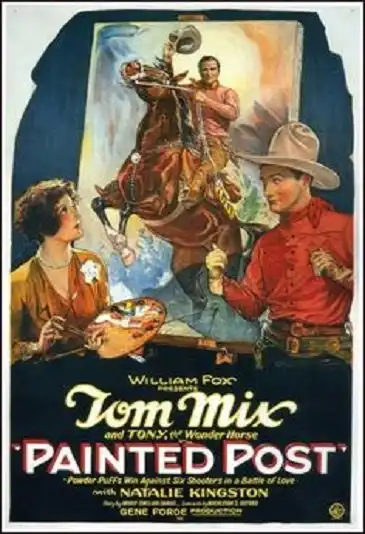
If you are the kind of person who needs a Western to feel gritty, sweaty, and spiritually heavy, you should probably stay away from Painted Post. This is not that kind of movie. This is a Tom Mix movie, which means it is essentially a circus performance that happens to take place near some cacti. But if you have a soft spot for 1920s showmanship and horses that seem significantly more intelligent than the people riding them, it is worth an hour of your time.
Tom Mix is an interesting figure to watch now because he feels so disconnected from what we think a cowboy is. He’s too clean. His hat is too white. In Painted Post, he plays a guy named Tom Warren, but he’s really just playing 'Tom Mix.' There is a scene early on where he’s leaning against a fence, and you can tell he’s very aware of how the fringe on his sleeves is hanging. It’s not 'bad' acting, exactly, but it is very performative. He’s a star, and he knows it.
The plot involves a gang and some undercover work, but honestly, the story is just a clothesline to hang stunts on. The town of Painted Post itself has that strangely empty, hollow feeling you get in late silent Westerns. There are moments where the camera pans across the street and you only see about three people, making the 'dangerous' frontier feel more like a quiet Sunday afternoon in the suburbs. It’s a bit like The Canyon of Light in that sense—the landscape is the only thing that feels truly big.
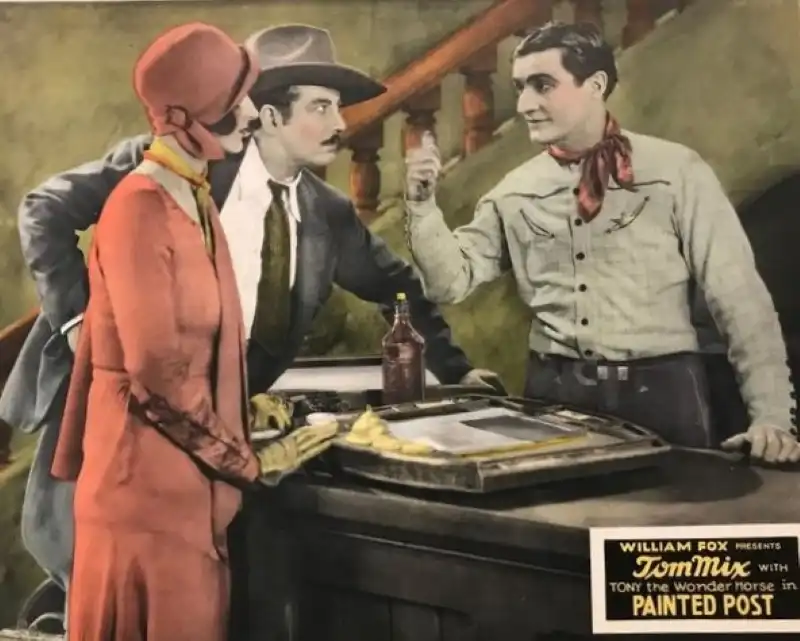
The real star, as is often the case, is Tony the Horse. There is a bit where Tony has to help Tom escape, and the horse’s timing is better than most of the human cast. There’s a specific close-up of Tony’s face where he looks almost bored by the humans' incompetence. I found myself watching the horse’s ears more than the actors' expressions. Tony has this way of nudging Mix that feels completely unscripted, like the horse was actually trying to get the scene over with so he could go eat.
Al St. John shows up for some comic relief, and your mileage will vary depending on how much you like watching a grown man fall over for no reason. He has this elastic way of moving that feels like it belongs in a different movie—maybe a cartoon. When he’s on screen with Philo McCullough, who plays the villain with a very stiff, almost aggressive mustache, the tonal shift is jarring. McCullough is acting in a melodrama; St. John is acting in a slapstick short; Mix is acting in a fashion show. It shouldn't work. It barely does.
There is one stunt involving a jump that made me lean forward. You can tell it’s actually Mix (or at least someone very close to the camera) and the lack of safety equipment is palpable. Modern movies have so much digital padding that you forget what it looks like when a human being actually risks a broken ankle for a medium shot. The frame wobbles slightly, the dust kicks up, and for three seconds, the movie feels dangerous.

Natalie Kingston is there as the love interest, but the movie doesn't seem to know what to do with her. She has one scene where she’s looking out a window, and the lighting is suddenly very soft and beautiful, like the cinematographer forgot they were shooting a Western and thought they were making Sealed Lips. Then the scene cuts back to a dusty trail and the spell is broken. Her chemistry with Mix is... polite. They stand near each other. They look at each other. But Mix seems much more affectionate toward his horse.
The editing gets a little frantic toward the end. There’s a chase sequence where the geography makes absolutely no sense. They’ll be riding through a narrow pass, and in the next shot, they are in a wide-open field, then back in the pass again. It’s the kind of thing that probably didn't matter on a grainy screen in 1928, but now it makes the whole climax feel a bit like a fever dream. You just have to accept that they are 'somewhere outdoors' and moving fast.
One thing I noticed was the background extras. In the saloon scene, there is a guy in the far left of the frame who is just aggressively cleaning a glass for about three minutes straight. He never stops. He doesn't look at the main action. He is the most dedicated dishwasher in the Old West. I ended up watching him more than the dialogue titles. It’s those little moments—the accidental life in the corners of the frame—that make these old silents feel human.
It’s a short film, and it moves quickly, but there are still parts that drag. Any time the characters have to sit down and explain the 'plan,' the energy just evaporates. The title cards are wordy and try to make the stakes feel higher than they are. You find yourself waiting for someone to get back on a horse. The movie knows its strengths, but it still feels obligated to pretend it has a complicated mystery to solve.
If you’ve seen things like Stage Struck, you know how these mid-20s productions can sometimes feel a bit factory-made. Painted Post has that vibe, but Tom Mix’s sheer charisma (and his absurdly large hats) keeps it from being totally forgettable. It’s a glimpse into a very specific kind of stardom that doesn't exist anymore—one based on physical stunts, a very clean horse, and the ability to look good while riding into a very fake-looking sunset.
IMDb —
1925
Community
Log in to comment.