
DbcultAccessing Vault...
Cult Review
Senior Film Conservator
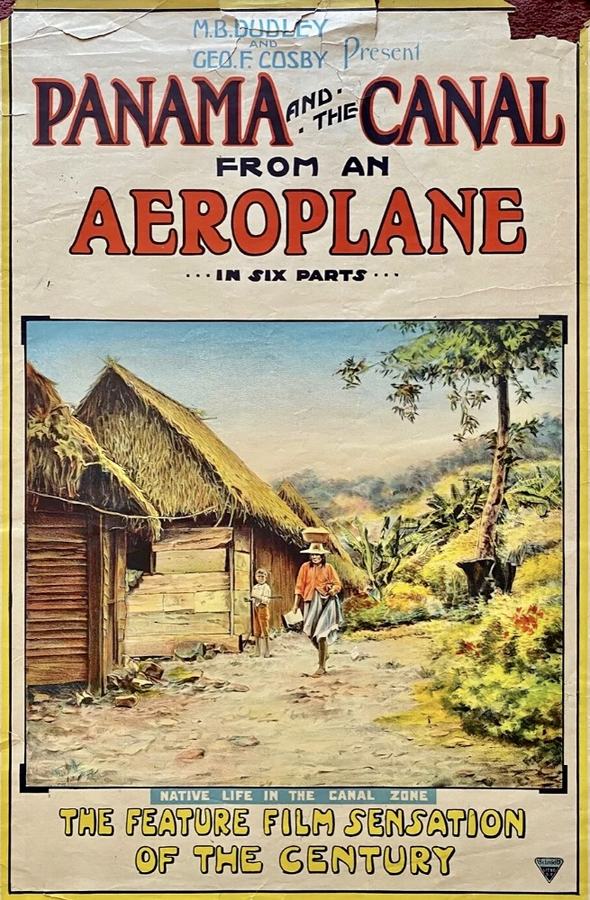
Imagine stumbling upon a sun-scorched map that folds open into moving air—that is the jolt delivered by Panama and the Canal from an Aeroplane, a 1913 one-reel whisper now preserved on the ether of digital archives. Shot by aviation daredevil Robert G. Fowler during the canal’s blood-rush adolescence, the footage predates Hollywood’s grammar, yet it crackles with proto-cinematic audacity: no intertitles, no star close-ups, just the raw intoxication of flight colliding with industrial sublime.
A Camera Learning to Fly
Technically, the film is a vestige of the phantom ride tradition—cameras bolted to the fronts of trains, boats, and, here, the fragile skeleton of a Wright-style pusher biplane. But Fowler, already famous for his coast-to-coast aerial odysseys, refuses mere sightseeing. He banks, climbs, and dives, turning the apparatus into an acolyte of perspective. The result feels uncannily contemporary: a vertiginous Steadicam avant la lettre. Grain swims like plankton; the heat shimmer above the Gatun locks morphs into liquid mercury. When the aircraft skims the treetops, orchids and bromeliads smear across the lens like paint on a dragged canvas. You taste aviation fuel and humidity in equal measure.
Geopolitical Dreamwork in Monochrome
Context matters. In 1913 the canal’s concrete was still damp; the Culebra Cut was hemorrhaging landslides; the U.S. had recently wrested control from a bankrupt French syndicate and a newborn Panama still trembling after secession from Colombia. Fowler’s camera, consciously or not, becomes an imperial retina. It ogles the spoil piles, the rail-mounted cranes, the segregated labor camps—yet does so from Olympian remove. Indigenous workers appear as specks, their bodies abstracted into vectors of shovel and pick. The film thus stages a dialectic: human ants carving a maritime super-highway while the airplane—symbol of twentieth-century omniscience—hovers above, exempt from sweat and muck.
“The lens does not discriminate between bedrock and bone; both are merely obstacles to the coming cargo leviathan.”
Temporal Vertigo: Silent Era Meets Anthropocene
Watch the short twice and you’ll feel chronology shear. First screening: a quaint relic, sepia ghosts sweating under Rooseveltian ambition. Second screening: a premonition of drones, of planetary engineering, of humanity’s itch to terraform. The canal, after all, was the opening stanza in a century of mega-projects that now culminate in island-cities sculpted for billionaires. Fowler’s prop-wash becomes the ancestor of rocket exhaust.
Comparative sparks fly if you pair this with Wildflower (1914), whose pastoral melodrama mourns vanishing Eden, or the expressionist doom of The Leap of Despair (1916). Where those narratives moralize through character, Panama moralizes through scale: the Earth itself is protagonist, antagonist, and collateral damage.
Editing as Tectonics
There are perhaps sixty shots in the nine-minute runtime, stitched without fades. The rhythm mimics excavation: languid panoramas suddenly ruptured by a dive toward lock gates. Spatio-temporal continuity is irrelevant; what links the shots is the kinesthetic throb of empire. Close your eyes and the film becomes a drum suite—bass thuds of explosions, hi-hat clatter of rails, the whine of wires in wind. Fowler inverts the classic travelogue formula: instead of reassuring the viewer with mapped coherence, he fractures space until the isthmus feels like a living fracture zone.
Eco-Gothic Undertow
Modern eco-critics will squirm at the canal’s eco-cidal backstory—entire forests drowned, mosquito-borne hellscapes, species extinctions. Fowler’s footage, though mute, anticipates this guilt. In one breathtaking passage, the biplane ascends above a mahogany canopy only to reveal a bruise-colored landslide where the cut has slumped. The camera lingers as if mourning. Then, without sentiment, it pivots to a steam-shovel taking a carnivorous bite from the slope. The montage is an ecological haiku: beauty, rupture, appetite.
Sound of Silence, Echo of Empire
Archival presentations often accompany this short with period marches or ragtime. Resist. The true soundtrack is the hollow whir of projector gears and the occasional gasp from modern viewers realizing that every cubic yard of earth moved pre-dated the EPA by six decades. Silence amplifies the imperial hush—the sense that history’s most audacious re-landscaping was once just wind, sweat, and dynamite.
Gendered Gaze from 800 Feet
Gender politics surface obliquely. No women appear; the canal zone was a testosterone crucible. Yet the airplane itself is coded feminine in period aviation journals—“the fair bird,” “the winged lady.” Fowler’s courtship is rough: he yanks her into steep banks, pushes her into power dives. The courtship yields a masculine progeny: the canal, a watery birth-canal for cargo. Feminist film theorists could have a field day unpacking this aerial phallocracy, and they should.
Restoration Revelations
Recent 4K scans by the University of Panama reveal hieroglyphs invisible in 1913: a worker chalking tally marks on a boulder; a foreman’s bowler hat sailing off in prop-wash; a stray dog trotting along the lock lip like a medieval jester. These micro-episodes restore agency to the anonymous laborers, puncturing the aerial omniscience. They remind us that history’s grand narratives are lint-specked with trivial, breathing lives.
Cine-Poetic Legacy
Fowler’s little short anticipates the geo-political montage of The Napoleonic Epics (1927), the topographic fever of In the Stretch (1916), even the Expressionist vertigo of The Leap of Despair. Yet it remains sui generis: no later film captured Earth’s reshaping from such naked altitude with such primitive technology. In the age of satellite cartography, the short feels like a handmade love letter to a planet we no longer recognize.
Digital Resurrection & Viewing Strategy
Stream it on a wall-sized screen, lights off, volume zero. Let the pixels glow like embers. Then replay Ten Nights in a Barroom (1911) or the lurid The Monster and the Girl (1913) to calibrate how rapidly American cinema pivoted from social sermon to sensationalist noir. Fowler’s short sits between those impulses: a documentary that dreams like fiction, a fiction that bleeds fact.
Final Aileron Twist
The film’s coda—an iris-out on the distant Pacific—works like a magician’s cloth flip: the century-old illusion becomes tomorrow’s climate-justice parable. As sea-levels rise, the locks may one day drown beneath their own ambition. Fowler’s biplane, long since rotted into spruce splinters, still hovers in the collective retina, urging us to ask: who gets to redraw maps, and who gets erased? No intertitle answers. Only the hush of moving air and the flicker of nitrate ghosts remind us that every vision of the future is already a tombstone for some possible world.