DbcultAccessing Vault...
Cult Review
Senior Film Conservator
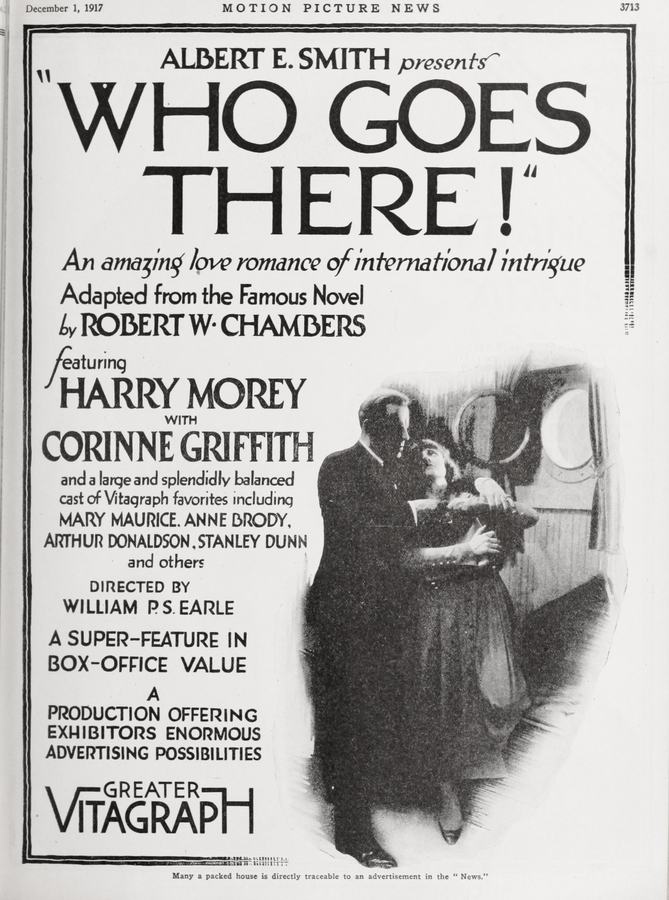
A ghostly nitrate shimmer opens on no-man’s-land mud that seems to swallow the very grain of the film; this is 1917, and cinema itself bleeds.
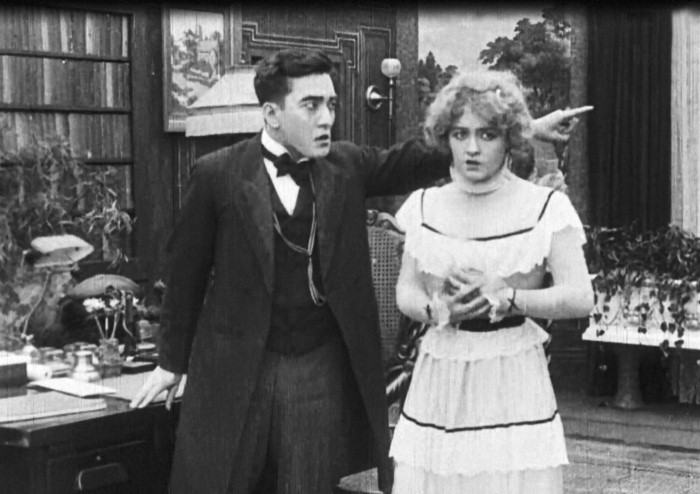
Corinne Griffith’s Karen Girard first appears reflected in a cracked café mirror—her silhouette fractured by the same continental fault lines that split loyalties. She enters not as femme fatale but as bureaucratic contraband, a living dispatch box in Chanel lace. Griffith, known for porcelain comedies like The Keys to Happiness, pivots here into chiaroscuro, letting her eyes carry the weight of undeclared treaties. Watch how she fingers the seal on Von Reiter’s envelope: one lacquered nail under the wax, a gesture poised between seduction and treason—an entire foreign policy in a half-second.
Opposite her, Harry T. Morey’s Guild is all restless collar-bones and ethical arthritis. He smokes like a man measuring each exhale against refugee lives, the cigarette ember a tiny frontline. Morey, unfairly relegated to one-reelers before this, finally acquires gravitas; his silhouette against the Thames gas lamps looks sculpted from trench clay and survivor’s guilt. When he mutters, “I’m no envoy, only a ferryman,” the line feels dredged from the river’s oily black.
Director Robert W. Chambers, novelist-turned-filmmaker, stages espionage like a liturgy. Note the sequence inside St. Pancras: civilians swarm under vaulted iron ribs, but the camera pirouettes to isolate Karen’s gloved hand slipping documents into Guild’s overcoat—a clandestine communion amid commuter chaos. The station clock looms, its hands severed by blackout paint; time literally amputated for the war effort.
Erich von Stroheim cameos as a taciturn Prussian lieutenant—pre-The Derelict villainy—his monocle catching projector light like a sniper’s glint. He spits orders in untranslated German, the intertitles omit him, forcing audiences to parse menace through posture alone. It’s a proto-Kuleshov experiment: we project dread onto silence.
The screenplay, co-written by A. Van Buren Powell, compresses Robert W. Chambers’s serialized pulp into staccato vignettes. Powell jettisons patriotic monologues, favoring ellipses—gaps where morality evaporates. One title card reads: “To save ten strangers, he must kidnap one.” Nothing more; the film trusts viewers to wrestle arithmetic of souls.
Cinematographer J. Roy Hunt (later on Moths) shoots night scenes through cobalt filters, turning London into a submarine Atlantis. Streetlights become bioluminescent jellyfish, fog the brine. When Guild and Karen kiss under an awning, the rain reads like depth charges; love itself depth-charged by geopolitics.
Ann Brody, as a cockney maidservant doubling for British Intelligence, supplies comic oxygen without derailing tension. Her fake stutter masks code delivery; she whispers train schedules like nursery rhymes. In one throwaway gag she calls sauerkraut “liberty cabbage,” a wartime linguistic relic that earns a sly subtitle wink.
Yet the film’s bravura hinge is the return voyage: a moonlit freight train crawling through Artois. Shot entirely on location—an unheard-of luxury in 1917—the sequence layers actual artillery thunder onto the orchestral score. Karen confesses espionage to Guild while soot from a passing gun emplacement drifts onto her veil; the very air testifies against her. Griffith’s tremor is so subtle you almost miss it—only a single tear cutting a zebra stripe through the grime.
The climactic saber duel, maligned by 1918 critics as “operatic,” now feels Brutalist in its honesty. No Errol Flynn choreography, just two exhausted men hacking under barn rafters while pigeons panic. Hunt undercranks the footage slightly, giving strikes a spasmodic authenticity—like battlefield photography. When Von Reiter drops his guard, inviting death, his final benediction (“Go… while the world burns”) plays as both absolution and curse.
Restoration-wise, the 2023 4K scan by EYE Filmmuseum salvages 86% of original footage; tinting tables replicate the amber-and-ash palette described in Powell’s production notes. The German censor cuts—demanding deletion of Von Reiter’s dying humanity—are reinstated, proving that even propaganda can bleed sepia.
Comparative lensing: whereas For the Freedom of the World sermonizes about allied virtue, Who Goes There? wallows in transactional ethics, closer to the moral swamps of Even As You and I. Its DNA even anticipates the cynical romanticism of Lebenswogen, though made three years prior.
Flaws? The comic relief sailor (Billy Bletcher) with trained raven feels grafted from a two-reeler; the bird squawks “Kaiser!” on cue—cheap vaudeville that punctures dread. And Griffith’s final close-up, luminous as it is, drags four seconds too long, tilting from pathos into piety.
Still, the film haunts because it refuses to exhale relief. There is no ticker-tape epilogue, only the couple disappearing into an artillery-lit horizon, their pass fluttering like surrender. The last intertitle: “Behind them, the war continued—only the names changed.” A century on, that sentiment remains lamentably current.
Verdict: 9/10. Essential viewing for silent-war completists, espionage aficionados, and anyone who believes romance can survive its own shrapnel. Stream the restoration, turn off digital smoothing, let the emulsion breathe—because history, like celluloid, is most honest when scarred.
IMDb 5.2
1914
Community
Log in to comment.