DbcultAccessing Vault...
Cult Review
Senior Film Conservator
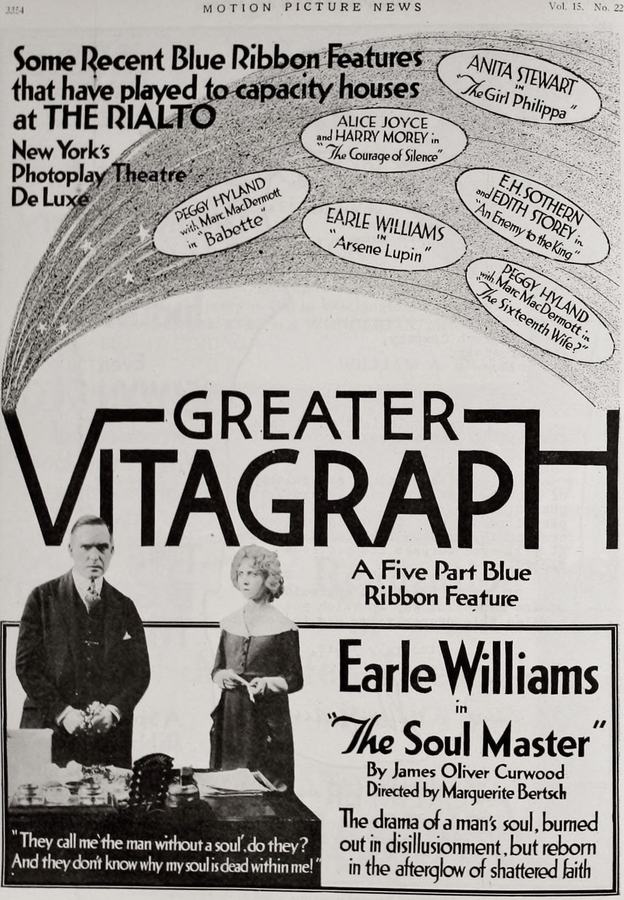
In the pantheon of early American cinema, few narratives capture the chilling transformation of the human spirit as poignantly as the 1917 Vitagraph production, The Soul Master. Directed with a keen eye for social hierarchy and psychological depth, the film serves as a testament to the era's ability to blend high melodrama with searing social commentary. At its core, the film is an interrogation of trauma—specifically, how a single act of betrayal can ripple through decades, turning a man of passion into a monolithic figure of industry, devoid of empathy. This 'man without a soul,' Robert Travers, portrayed with a brooding, statuesque intensity by Earle Williams, represents the prototypical industrialist of the Gilded Age: successful, wealthy, yet spiritually bankrupt.
The narrative architecture, crafted by the formidable duo of James Oliver Curwood and Marguerite Bertsch, eschews the typical wilderness tropes often associated with Curwood. Instead, it leans into the claustrophobic urban landscapes of department stores and high-society parlors. This transition from the 'wild' to the 'civilized' reflects a broader cinematic shift seen in contemporaries like The Law of Compensation, where moral choices are weighed against the backdrop of modern temptation and economic disparity.
The film’s middle act is dominated by the sprawling mechanism of Travers’ department store. Here, the cinematography emphasizes the vastness of the enterprise, making the individual workers appear as mere cogs in a massive machine. It is within this sterile environment that we find Ruth Carroll, played by Mildred May with a luminosity that pierces through the grainy black-and-white film stock. As a ribbon clerk, Ruth occupies the lowest rung of the social ladder, a position that mirrors the struggles of the working class often depicted in Midinettes.
Travers’ attraction to Ruth is handled with a delicate ambiguity. For much of the film, the audience is left to wonder if his interest is predatory or protective. This tension is central to the film’s power; it forces the viewer to confront Travers’ reputation as a soul-less man. When he moves her from the ribbon counter to his private office, it is not merely a promotion—it is a disruption of the social order. This act of kindness, however unconscious, signals the first crack in his icy exterior. It is a thematic resonance found in Pay Dirt, where the accumulation of wealth is contrasted against the inherent value of human connection.
No silent era drama is complete without its antagonists, and Julia Swayne Gordon’s Laura Wilson is a masterclass in sophisticated malice. Wilson represents the parasitic elements of the upper class—those who view marriage and social status as a blood sport. Her jealousy of Ruth is not merely personal; it is an existential threat to her designs on Travers’ fortune. Gordon’s performance is sharp, her movements calculated, providing a stark contrast to May’s naturalistic innocence. The dynamic between the two women elevates the film beyond a simple domestic drama, touching on themes of class warfare and female agency.
The introduction of Monty Fitzburgh, the lecherous socialite, adds a layer of peril that heightens the stakes. Fitzburgh is the dark shadow of the aristocratic world, a man whose privilege serves as a shield for his predatory nature. The sequence in which Laura 'offers' Ruth a job as a companion—only to set her up for Monty’s advances—is filmed with a burgeoning sense of dread. It evokes the same sense of impending disaster found in The Great Circus Catastrophe, though the stakes here are intimate rather than spectacular.
The screenplay’s strength lies in the synthesis of Curwood’s emotional rawness and Bertsch’s structural precision. Marguerite Bertsch, one of the most influential female screenwriters and directors of the silent era, brings a psychological complexity to the script that was rare for 1917. She understands that the 'soul' in the title is not a religious construct, but a metaphor for the capacity to feel pain and, by extension, love. The film’s pacing is deliberate, allowing the audience to sit with Travers’ silence, much like the heavy atmosphere in Uden Fædreland.
Furthermore, the film’s exploration of lost identity and the search for origins echoes the grand traditions of European cinema, such as Valdemar Sejr or the Swedish masterpiece På livets ödesvägar. The Soul Master, however, grounds these lofty themes in the American reality of the early 20th century—a world of commerce, social mobility, and the fragile nature of the family unit in the face of industrialization.
The climax of the film—the discovery of the photograph—is a sequence that deserves to be studied in film schools. In an era before the close-up was fully weaponized for emotional impact, the camera lingers on Earle Williams’ face as the realization washes over him. The photograph of Ruth and Arline acts as a bridge across time, a visual proof of a past he tried to bury. This moment of anagnorisis is as powerful as the reveal in Madame X, yet it carries a unique weight because the protagonist is the father, not the mother.
Travers’ rush to save Ruth from Monty Fitzburgh is not just a heroic rescue; it is a desperate attempt to reclaim his lost years. The violence of his intervention is a manifestation of his returning 'soul.' He is no longer the man who coldly manages a department store; he is a father protecting his child. The resolution of the film, while satisfying the audience's desire for a happy ending, remains tinged with the melancholy of lost time. It acknowledges that while the soul can be rediscovered, the scars of the past remain.
Technically, The Soul Master is a product of its time, yet it showcases the evolving visual grammar of the late 1910s. The lighting in the department store scenes utilizes high-contrast shadows to reflect Travers' internal state, while the scenes in Laura Wilson’s home are bathed in a soft, deceptive glow. The editing, overseen by Bertsch, is tighter than many other films from 1917, such as El grito de Dolores o La independencia de México, ensuring that the emotional beats land with maximum impact.
The cast, led by the charismatic Earle Williams, delivers performances that are remarkably restrained for the period. Williams avoids the theatrical gesticulation common in early silents, opting instead for a performance built on stillness and gaze. This approach is vital for a character whose primary trait is his lack of emotional output. Billie Billings and Donald Cameron provide solid support, grounding the film’s more melodramatic flourishes in a sense of lived reality, much like the ensemble in Sporting Blood.
To view The Soul Master today is to witness the birth of the psychological thriller and the domestic noir. It is a film that refuses to offer easy answers about the nature of forgiveness or the corrupting influence of wealth. Instead, it presents a world where the 'soul' is something that must be fought for, often against the very structures we build to protect ourselves. While it shares some narrative DNA with adventure tales like In Search of the Castaways or the gritty realism of Robbery Under Arms, it stands alone as a character study of a man’s internal winter and his eventual, painful spring.
The film’s influence can be seen in later works that explore the 'cold tycoon' archetype, from the various iterations of Fedora to the modern corporate drama. It remains a vital piece of cinematic history, not just for its plot, but for its profound understanding of the human condition. In the end, Robert Travers finds that his soul was never truly gone; it was merely waiting for a reason to return. Through the eyes of a ribbon clerk, a man without a soul finally sees the world clearly for the first time in twenty years.
Reviewer Note: This film represents a crucial intersection of Vitagraph's production prowess and the burgeoning talent of female creators in the early 20th century. A must-watch for any serious student of the silent era.
IMDb —
1927
Community
Log in to comment.