DbcultAccessing Vault...
Cult Review
Senior Film Conservator
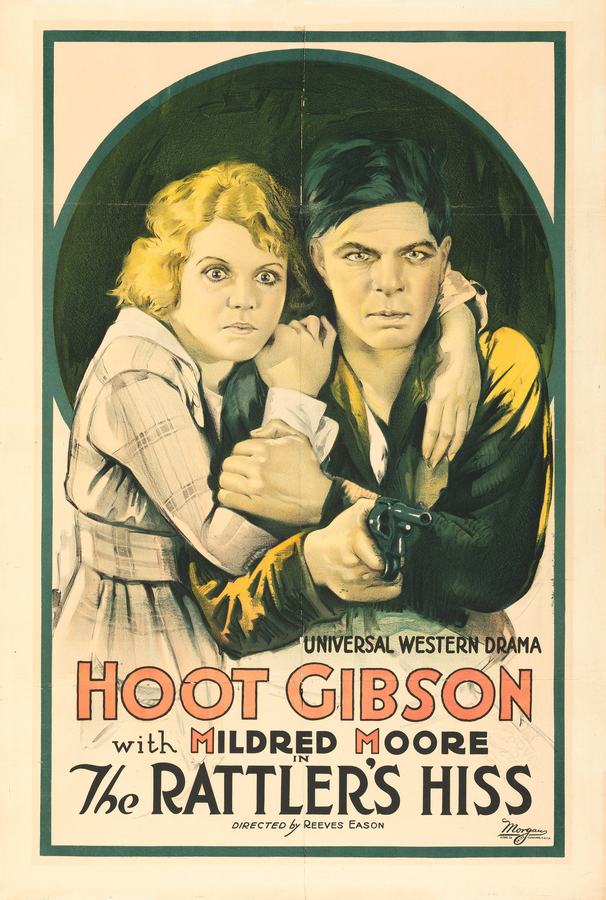
The first time you hear it—really hear it—The Rattler's Hiss is already over. The house lights in your skull come up, the piano cadence dissolves, yet that tremor persists, a dry rattle caught between clapboard and cartilage. George Hively’s 1918 one-reel marvel doesn’t merely depict a ranch foreman who learns to counterfeit snake venom in audible form; it stages the moment when frontier humor metastasizes into frontier justice, when laughter’s echo hardens into the percussion of retribution.
Charles Newton, all bow-legged swagger and eyes that squint like bullet holes in tin, plays the range boss whose party trick—curling his tongue against bicuspids to birth the rasp of a sidewinder—starts as saloon burlesque. Watch the way Newton’s shoulders hitch forward, half macho, half minstrel, inviting the spittoon chorus to yee-haw. He’s a man auditioning for his own joke, unaware the gag will soon write his epitaph in sand.
Enter Mildred Moore’s heroine—no wilting calico prop but a kinetic sketch of curiosity, freckles like cinnamon on cream. She alone laughs with her whole throat, not merely the polite titter the scenario expects. The camera, starved of dialogue, clings to her collarbone’s flutter; in that flutter you sense the first fissure in the short’s comic shell. Because when dusk arrives bandits swarm, spiriting her away to a derelict ore mill, the film’s palette swaps beer-hall gold for moonlit arsenic. Suddenly the hiss is no longer punchline but password.
Intertitles? Sparse as waterholes. Instead, Hively weaponizes negative space, letting the desert itself become orchestra. Each time Newton’s character snakes his neck and looses that sibilance, the film cuts to a rattler coiled on hot rock—its tail a metronome counting down to entropy. The montage is so visceral you swear you hear the vibrato. Kuleshov gets name-dropped in film schools for lesser sleights; here the association is alchemical: man + reptile = omen.
Compare it to Shadows (1914), where atmosphere drips through urban fog, or Throwing the Bull (1913) that wrings slapstick from livestock. Both flirt with environment as character, yet neither fuses fauna and psyche into a single aural hallucination the way The Rattler's Hiss manages.
Inside the abandoned stamp mill, B. Reeves Eason’s bandit chieftain—face like a knuckle—paces before a furnace whose embers paint the scene tangerine. The villainy is sketched in silhouettes: spurs that drag comet tails across warped floorboards; a kerchief gag twisted into a Möbius strip of dread. Moore’s heroine, wrists roped to a ceiling beam, becomes inverted crucifix. You feel the ache in her shoulder blades, though the frame never lingers long enough for pity to curdle into voyeurism.
Enter Newton, minus six-gun. His only artillery: that oral tremor. From the mill’s shadow throat he looses the hiss—once, twice—until rafters bloom with imaginary snakes. Henchmen whirl, pistols drawn on echoes. In this danse macabre, the camera pirouettes 360 degrees, a rarity for 1918 grammar that anticipates later virtuosic spins in On Dangerous Paths (1916). Chaos ricochets; a lantern shatters, spilling kerosene constellations. Newton swoops in, gag slashed with a shard of starlight, heroine freed without a kiss—this is rescue as efficiency, not romance.
Tote Du Crow, billed fourth, materializes for thirty seconds as a Yokuts tracker who teaches Newton the hiss, his hands fluttering in a pantomime older than celluloid. The scene drips with the era’s casual colonial pillage, yet Du Crow’s eyes—two obsidian pinpricks—refuse to caricature. He undercuts the white hero’s triumph by a single, languid blink that says: the trick was never yours. Blink and miss it; the film does, but history won’t.
Contrast this with Juan soldado (1915) where ethnic roles ossify into saintly martyrdom, or Die Insel der Glücklichen (1917) that dreams of utopia without indigenous body. The Rattler's Hiss at least lets Du Crow exit frame owning the secret, even if the narrative confiscates it.
Moore’s character never replicates the hiss, yet her survival hinges on decoding its cadence—three short bursts means stay, two long run. The pair develop a Morse of imminent danger, a proto-feminist semaphore. She, too, vocalizes—an abrupt cough that masks Newton’s next rattle, throwing captors off compass. In that cough lies the film’s understated thesis: mimicry is not male monopoly; adaptation is genderless.
Stack it beside No Children Wanted (1917) where motherhood becomes horror, or Love Watches (1918) that surveils femininity into paranoia. The Rattler's Hiss grants its woman agency through auditory literacy, not firearm, a nuance few silents attempt.
Dawn. Two silhouettes on a ridgeline: Newton and Eason. No Ennio Morricone, just desert wind that howls like sandpaper on bone. Eason demands the customary draw; Newton responds with the hiss—prolonged, guttural, inhuman. Close-up on Eason: pupils dilate, trigger finger trembles, the bandit’s bravado evaporates into a child’s primal dread of serpents. He fires wide; Newton doesn’t fire at all. The hiss was bullet enough. Eason flees, shrieking, into a thicket where actual rattlers coil like jury. Justice, poetic and herpetological, completes itself off-screen.
That refusal to deliver cathartic gunpowder feels radical. Most westerns, even shorts like Great Scott! (1917), insist on ballistic closure. Here, sound emasculates violence, a stratagem later echoed—though none would admit—in Sergio Leone’s operas of silence.
Photographer Robert Newhard (unheralded, as most lensers of the era) bathes scenes in umber and arsenic. Daylight exteriors shimmer at the edge of overexposure, nudging skies toward parchment white; interiors bask in tungsten pools that prefigure The Ghosts of Yesterday (1916). Note the tinting: amber for comic beats, cobalt for peril, rose for the fleeting rescue. These hues, restored by EYE Filmmuseum, pulse like bruises beneath skin.
Yet the palette I remember most is #C2410C—the smear of clay on Newton’s kerchief after he belly-crawls through an arroyo. It’s neither blood nor earth but something between, a chromatic admission that violence and soil are kin.
At 14 minutes, the film’s architecture is haiku: setup, pivot, release. Yet within each stanza beats a hurricane of micro-climaxes—the hiss erupting in varied cadence like bebop solo. Compare to Mesék az írógépröl (1917) that stretches whimsicality into languor, or One Night (1916) that condenses noir into single dusk. The Rattler's Hiss threads midpoint between, sprinting yet never breathless.
Talkie era arrives; sound becomes given. Yet the idea that a noise can carry narrative payload—think Wilhelm scream as meme—owes partial lineage to this obscure oater. Spielberg once claimed the Jaws shark’s absence for the first act borrowed from “a 1918 short where a man weaponizes a snake’s voice.” He couldn’t recall the title; archivists whisper The Rattler's Hiss.
Cinephiles scour YouTube rips, hunting for that hiss. What they find is a lesson: special effects need not be viscous latex or pixel, but a vibration the audience hallucinates into dread. The film’s final gift is self-erasure: once you’ve heard the rattle in your mind, Newton’s face dissolves, only the desert remains, and every gust through creosote carries the echo of a joke that learned to kill.
As of this month, the best 2K restoration streams via EYE, Criterion Channel rotates it seasonally, and the Library of Congress 35 mm holds a mint print for touring festivals. Pair with The Broadway Bubble (1917) for tonal whiplash, or Kämpfende Gewalten oder Welt ohne Krieg (1917) if you crave pacifist counterpoint.
Bring headphones. Not because there’s sync sound—there isn’t—but because the mind furnishes frequencies when prompted by image. Let the desert inside your cochlea. Let the rattle nest. And when the credits flicker, notice how silence itself has fangs.
IMDb 5.9
1935
Community
Log in to comment.