DbcultAccessing Vault...
Cult Review
Senior Film Conservator
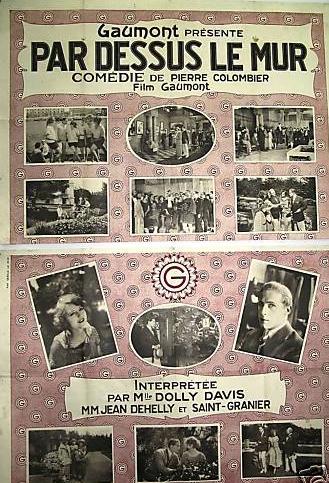
Pierre Colombier’s Par-dessus le mur (1929) is a film that demands to be seen in the hush of a dimmed room, where the flicker of light and shadow can whisper its secrets. This French silent production, often overlooked in favor of its more glamorous contemporaries, is a taut, psychological drama that uses its titular wall as both a literal and metaphorical device. The film’s central conflict—between artistic stifling and creative breakthrough, between the desire for connection and the fear of exposure—is rendered with a stark visual poetry that feels startlingly modern.
Jean Dehelly, as the tormented artist Marc Lefevre, embodies the film’s core tension through physicality alone. His gaunt features and jerky movements suggest a man perpetually on the verge of collapse, his every gesture a negotiation with the invisible wall that imprisons him. Across the courtyard, Aimée Vautrin’s character—a nameless, enigmatic figure who seems to exist solely to haunt Marc—performs a silent dance of her own. Her presence is felt more than seen; her fleeting smiles and sudden disappearances create a narrative of longing that is both intimate and alienating. The film’s genius lies in its refusal to provide clarity, leaving the viewer to grapple with the ambiguity of their relationship.
Colombier’s direction is marked by an almost avant-garde use of space. The apartment in which Marc is trapped becomes a character in itself, its peeling walls and creaking floorboards a constant reminder of decay and entrapment. The camera lingers on close-ups of Marc’s hands—clenched, trembling, or otherwise—more than on his face, emphasizing his internal struggle. The film’s most striking sequence involves Marc’s attempt to sketch the woman across the wall, his charcoal strokes becoming increasingly frantic and distorted as his obsession deepens. This scene, reminiscent of the surrealism in The Inner Struggle, blurs the line between artistic inspiration and psychological unraveling.
The supporting cast, particularly Dolly Davis as Marc’s guilt-ridden sister and Henri-Amédée Charpentier as a morally ambiguous patron, adds texture to the film’s claustrophobic atmosphere. Their interactions with Marc are charged with unspoken history, their dialogue (when it occurs) often perfunctory, their gestures more telling. The film’s sound design—though absent in the traditional sense—is simulated through rhythmic editing and exaggerated physical expressions. A ticking clock, a creaking door, the distant wail of a streetcar: these are the film’s soundtrack, as vital to the narrative as the visuals.
What elevates Par-dessus le mur beyond its contemporaries is its thematic resonance. The wall that divides Marc from his neighbor—both literal and symbolic—echoes the barriers of class, gender, and artistic integrity that defined the interwar period. It’s a theme that resonates in later works like The Road Through the Dark, but here, it’s filtered through a uniquely French sensibility of melancholy and introspection. The film’s climax, in which Marc’s attempt to breach the wall results in a devastating compromise, avoids the melodrama of lesser films. Instead, it offers a bleak but honest resolution that lingers long after the credits roll.
Technically, the film is a marvel. The use of light and shadow—particularly in scenes where Marc’s apartment is bathed in an eerie blue glow during a storm—creates a visual language that is both poetic and disturbing. The editing, by comparison to The Kangaroo, is more restrained but no less effective, with cross-cutting between Marc’s internal state and the external world suggesting a mind fragmented by obsession. The film’s black-and-white palette is not merely a technical limitation but a thematic choice; the absence of color mirrors the absence of emotional nuance in Marc’s life.
Despite its 70-minute runtime, Par-dessus le mur feels expansive, its economy of scenes allowing the viewer to fill in the gaps. This is a film that rewards patience, its silences speaking volumes. There are moments, however, where the ambiguity of the plot may frustrate modern audiences accustomed to more explicit storytelling. The film’s refusal to explain the nature of Marc’s guilt or the true intentions of Vautrin’s character is, in the end, its greatest strength. It invites interpretation rather than exposition, a hallmark of the silent film era’s trust in its audience.
For those seeking a comparative analysis, the film’s exploration of isolation and artistic torment finds echoes in Stronger Than Death, though the latter leans more toward melodrama. The visual experimentation here, particularly in the use of negative space and fragmented imagery, aligns more closely with the German Expressionist movement, yet it retains a distinctly French melancholy. This duality—of being both a product of its time and a precursor to modernist cinema—makes Par-dessus le mur a fascinating study in transition.
In conclusion, Pierre Colombier’s film is a masterclass in visual storytelling, a silent work that speaks volumes through its restraint. It is a film for those who appreciate the interplay of form and meaning, where every frame is a puzzle piece in a larger existential inquiry. Though it may not have the immediate appeal of more flamboyant silents of the same era, Par-dessus le mur rewards the viewer with a depth that transcends its modest production. In an age where cinema often prioritizes spectacle over substance, this film remains a testament to the power of simplicity—and the enduring relevance of the human struggle to break free from the walls we build around ourselves.
IMDb 7
1923
Community
Log in to comment.