DbcultAccessing Vault...
6.5/10
Senior Film Conservator
A definitive 6.5/10 rating for a film that redefined the boundaries of cult cinema. Protsess Mironova remains a cornerstone of transgressive art.
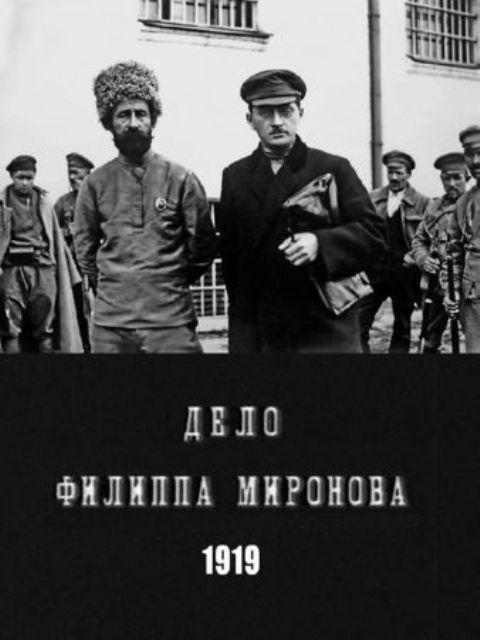
The flickering grain of Protsess Mironova is not merely the dust of a century; it is the visual static of a world being violently reborn. In 1919, a young Dziga Vertov, long before the kaleidoscopic frenzy of Man with a Movie Camera, was already sharpening his scalpel. This newsreel, documenting the trial of Red Cossack commander Filipp Kuzmich Mironov, represents a pivotal intersection where the raw urgency of journalism meets the nascent philosophy of the 'Kino-Eye'. It is a document of a man on the precipice, a military hero caught in the gears of the very revolution he helped propel.
To watch Protsess Mironova is to witness the birth of the political documentary as a weapon of statecraft, yet Vertov’s inherent artistry prevents the work from dissolving into mere stenography. The courtroom is stripped of the theatrical artifice found in contemporary dramas like The Two Orphans. Where the latter relies on the heightened emotionality of the stage to convey injustice, Vertov finds a more terrifying reality in the stillness of the tribunal. The camera lingers on the faces of the judges—men whose eyes reflect a grim adherence to the dialectic. There is a chilling lack of melodrama here; the stakes are too high for the flourishes of a silent-era potboiler.
Mironov himself is a fascinating study in cinematic portraiture. Unlike the archetypal villains of the era, such as those found in Beating Back, he does not sneer or cower. He possesses the rugged, weathered dignity of a man who has lived in the saddle. Vertov’s framing captures the isolation of the defendant. In a room full of comrades-turned-accusers, Mironov is an island. The film documents the specific tension of the Don Cossack identity attempting to reconcile itself with the monolithic expectations of the Bolshevik center—a conflict that is written in the very lines of Mironov’s face.
Technically, the film is a masterclass in the economy of the image. The lighting is naturalistic, often harsh, casting deep shadows that feel metaphorically resonant. We see the papers being shuffled, the stern gestures of the prosecution, and the occasional glimpse of the audience—the 'proletariat'—whose presence serves as a silent jury. This isn't the polished, curated justice of Convict 993; this is the haphazard, dangerous justice of the front lines. The editing, though primitive compared to Vertov’s later rhythmic montages, already shows a keen sense of pacing. He knows exactly when to hold a shot on a witness to extract a confession of character that words might fail to provide.
"The camera does not just record the trial; it participates in the verdict, turning the viewer into a witness to the inexorable march of history."
There is a stark contrast between this reality and the escapist narratives of the time. While American audiences were perhaps distracted by the whimsical errors of All Wrong, Vertov was documenting the literal life-and-death struggle of a nation’s soul. The 'Process' in the title is as much about the process of filmmaking as it is about the legal proceedings. Vertov is testing the limits of what the camera can capture—can it capture treason? Can it capture loyalty? Can it capture the moment a hero becomes a pariah?
Filipp Mironov’s story is one of the great tragedies of the Russian Civil War. A man of immense bravery, his 'mutiny' was born of a desire to protect his people from the excesses of 'Decossackization.' Vertov’s film, while intended to justify the state’s position, inadvertently preserves the humanity of the rebel. We see the friction of the era—the same kind of societal tension that drives the narrative in At Piney Ridge, though stripped of that film’s Appalachian romanticism. In Protsess Mironova, the stakes are not a family feud but the architecture of a new world order.
The film’s silence is its most powerful attribute. Without the distraction of a synchronized score or intertitles that over-explain the emotional beat, the viewer is forced to contend with the raw visual data. We are reminded of the existential weight found in Midnatssjælen, yet Vertov eschews the supernatural for the hyper-material. The 'midnight soul' here is the collective consciousness of a revolution deciding its own boundaries. Every frame of the tribunal feels heavy, as if the silver halide on the film strip is struggling to contain the gravity of the event.
In the broader context of 1919 cinema, Protsess Mironova stands as an anomaly of truth. While Aladdin from Broadway offered orientalist fantasy and The Soap Girl provided lighthearted social comedy, Vertov was plunging into the abyss of the contemporary. Even when compared to the journalistic aspirations of Perils of Our Girl Reporters, Vertov’s work feels more authentically perilous. There are no stunt doubles here; the man on screen is fighting for his life, and the men judging him are deciding the fate of millions.
The cinematic language employed here is foundational. We see the use of the close-up not for glamour, but for psychological penetration. This is a far cry from the sentimental use of the lens in Love's Pilgrimage to America. Vertov isn't interested in the 'pilgrimage' of the heart, but the pilgrimage of the state toward a perceived purity. The trial is a cleansing ritual, and the camera is the high priest’s tool. The lack of traditional narrative structure—the absence of a 'hero’s journey'—makes the experience all the more jarring for a modern viewer. It is a slice of time, unadorned and unapologetic.
Ultimately, Protsess Mironova is a ghost story. Mironov would eventually be pardoned, then rearrested and shot in the back in a prison yard in 1921. Vertov’s film remains the most vivid testament to his existence—a flickering shadow of a man caught in the transition between being a hero and a 'non-person.' The film’s existence in the archives is a miracle of survival, much like the fragile prints of Square Deal Sanderson, yet it carries a much heavier historical burden.
For the film historian, this work is the 'missing link' in the evolution of Soviet montage. You can see Vertov experimenting with the idea of the 'Interval'—the space between shots—even in this observational mode. He is learning how to manipulate time to emphasize the drudgery of the legal process and the sudden, sharp moments of accusation. It lacks the pastoral charm of String Beans or the exoticism of The Rajah, replacing them with a cold, industrial beauty that would define the next decade of Soviet art.
In the end, Protsess Mironova is a demanding watch. It requires the viewer to engage not just with the image, but with the history behind it. It is a film that refuses to entertain, choosing instead to provoke and document. In the pantheon of early cinema, it stands as a reminder that the camera is never a neutral observer. Even in its most objective moments, the choice of what to film—and what to leave in the shadows—is an act of profound political and artistic consequence. It is a haunting, essential fragment of the 20th century’s turbulent infancy.
Related explorations in justice and drama: Beatrice Fairfax Episode 12: Curiosity | Life Savers
IMDb —
1922
Community
Log in to comment.