DbcultAccessing Vault...
Cult Review
Senior Film Conservator
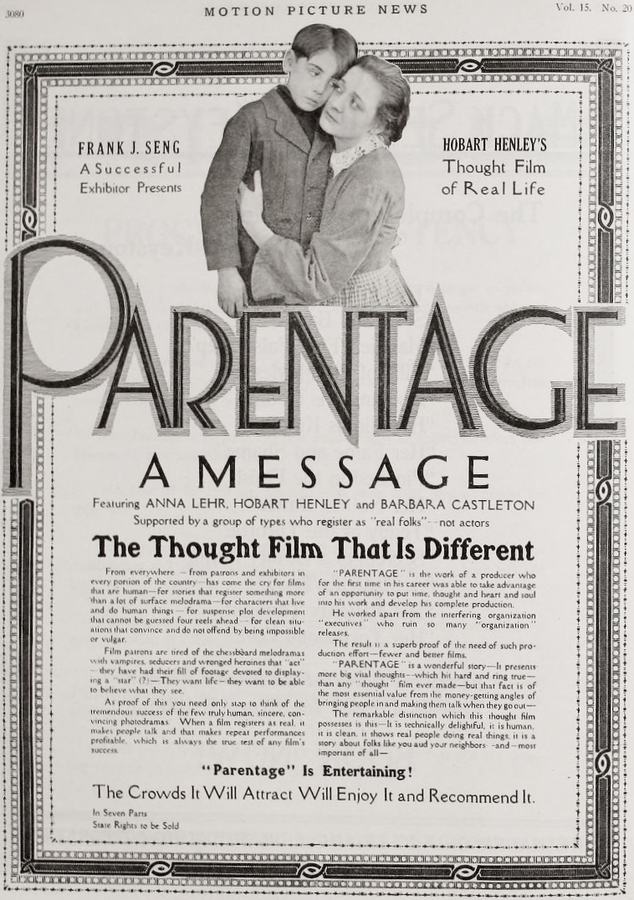
Hobart Henley’s 1917 magnum opus, Parentage, stands as a staggering monolith in the landscape of early silent cinema, a period often dismissed for its perceived melodramatic simplicity. However, to view this film through a reductive lens is to ignore the visceral, almost surgical precision with which Henley dissects the American domestic ideal. Set against the backdrop of Owentown—a name that suggests both a localized community and a broader, universal ownership of social responsibility—the film serves as a grim laboratory for the study of human development. Unlike the romanticized frontiers of Davy Crockett, Parentage is an inward journey, exploring the claustrophobic confines of a home where love is absent and greed is the only language spoken.
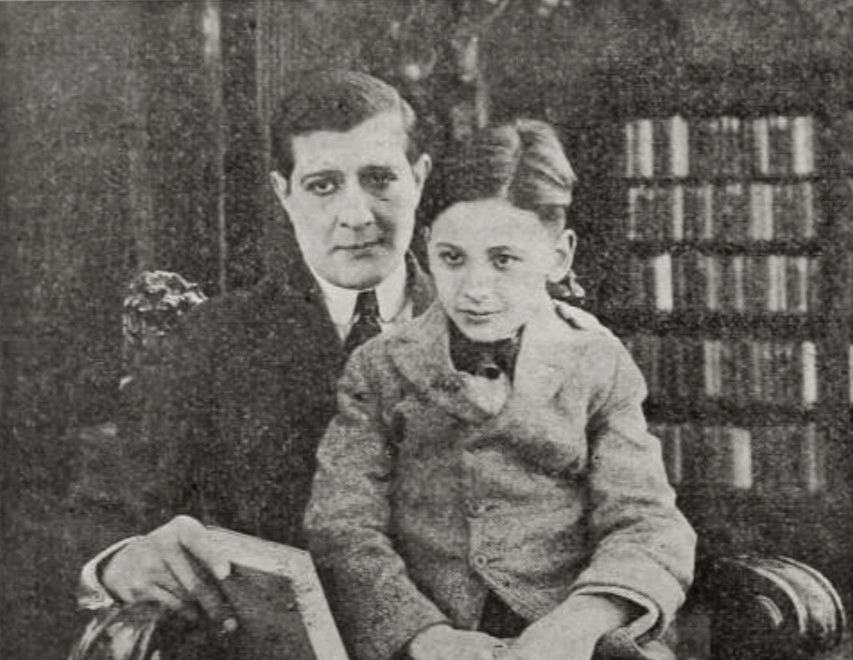
The narrative engine is fueled by the stark contrast between two households. William Welsh delivers a performance of chilling austerity as the avaricious father, a man whose every gesture is calculated in currency rather than affection. His portrayal is a masterclass in silent-era villainy—not the mustache-twirling variety, but a grounded, mundane evil that manifests as emotional starvation. We see the trajectory of his son, played with a simmering, repressed intensity, as he transitions from a neglected youth into a man whose moral compass has been permanently demagnetized. This is not a story of sudden downfall, but of slow, agonizing erosion.
Henley, acting as both writer and director, utilizes the visual medium to articulate the psychological scarring of his protagonists. The lighting in the 'neglected' household is often harsh, casting long, skeletal shadows that seem to swallow the young boy whole. This stands in luminous contrast to the warm, soft-focus benevolence of the neighboring home. In many ways, the cinematography echoes the moral weight found in The Light in Darkness, where the environment itself acts as a character, pushing the inhabitants toward their respective fates. The sea blue (#0E7490) tones of the night scenes emphasize a cold, oceanic isolation that the unwanted son feels even in a crowded room.
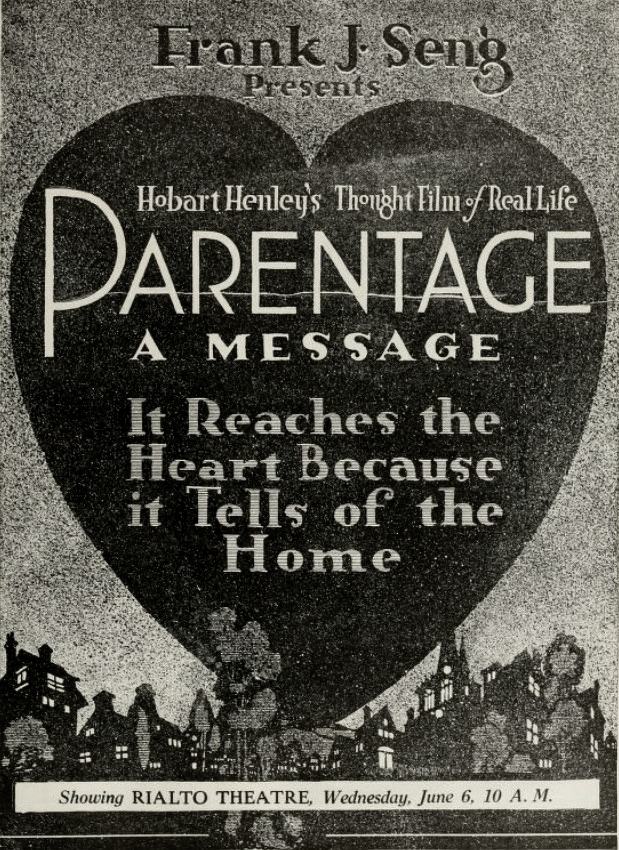
"In the silence of Owentown, the loudest sound is the shattering of a child’s potential against the granite heart of an indifferent father."
The film’s pacing is deliberate, allowing the audience to feel the weight of years passing. We witness the 'evil manhood' not as a sudden occurrence, but as the inevitable harvest of a poisoned field. The juxtaposition of the two men as adults—one a pillar of the community, the other a fractured soul—is handled with a degree of nuance that rivals the thematic depth of It Is Never Too Late to Mend. While the latter focuses on institutional reform, Parentage posits that the most vital institution is the family unit, and its failure is the ultimate societal catastrophe.
The cast, including the ethereal Lois Alexander and the grounded Barbara Castleton, provides a rich tapestry of human emotion. Alexander’s presence offers a flickering hope, a 'chance of real happiness' that serves as the film’s emotional fulcrum. Her interactions with the two men are laden with subtext; with the 'good' son, there is a rhythmic harmony, while her scenes with the 'evil' counterpart are fraught with a jagged, discordant energy. This tension reaches its zenith when the neglected son realizes that his one opportunity for salvation has been claimed by the man who already possesses everything he was denied. It is a moment of profound cosmic injustice that resonates far beyond the screen.
Gilbert Rooney and Lois Wilson provide essential supporting turns that flesh out the social strata of Owentown. Unlike the more action-oriented sequences in The Terror, the conflict here is internal and domestic. The stakes are not merely life and death, but the very essence of the human spirit. The 'avaricious' father, played by Welsh, becomes a symbol of a burgeoning industrial age where people are treated as assets to be managed or liabilities to be discarded. This subtext gives the film a modern relevancy that is quite startling for a production over a century old.
When comparing Parentage to other works of the era, such as Just Out of College, one notices a significant departure from the lighthearted tropes of youth. Henley is not interested in the follies of the young, but in the structural integrity of their upbringing. While Queen X might deal with the underworld and external threats, Parentage suggests that the true 'terror' lies within the four walls of a home where empathy has been extinguished. The film shares a certain spiritual DNA with A tiszti kardbojt in its examination of duty and honor, though Henley focuses specifically on the duty of the parent rather than the soldier.
The technical execution of the film is remarkably sophisticated. The use of double exposures and subtle transitions to denote the passage of time shows a director fully in command of his craft. The editing rhythm mimics the heartbeat of a dying hope, slowing down in moments of despair and accelerating during the frantic, futile attempts of the protagonist to reclaim his lost happiness. It lacks the whimsical nature of The Matrimaniac, opting instead for a heavy, atmospheric dread that lingers long after the final frame.
At its core, Parentage is a philosophical treatise on the concept of 'responsibility.' The parents who 'met their responsibilities' are not depicted as saints, but as functional humans who understand the gravity of bringing life into the world. Their son’s success is not a miracle, but a natural consequence of a stable foundation. Conversely, the 'evil manhood' of the antagonist is presented as a logical outcome of a fractured beginning. This deterministic view of humanity is tempered by the presence of choice, yet Henley seems to suggest that the choices available to a man are severely limited by the tools he was given as a child.
In the final act, the collision of these two lives is both inevitable and heart-wrenching. The loss of the 'one chance of real happiness' is not just a romantic failure; it is the final nail in the coffin of a soul that never had a chance to breathe. The sea blue (#0E7490) of the climax, perhaps a metaphor for the vast, uncaring ocean of fate, underscores the tragedy. This is a film that demands to be seen by anyone interested in the evolution of cinematic storytelling. It is as potent as Law of the Land but with a more intimate, psychological focus.
As we look back at Parentage, we see a precursor to the great social dramas of the mid-20th century. It possesses the DNA of films like The Question or Two Men of Sandy Bar, yet it remains uniquely focused on the formative years. Hobart Henley’s vision is a haunting reminder that while we may be the masters of our fate, our parents are the ones who build the ship. Without a sturdy hull, even the most ambitious sailor is destined to sink in the dark waters of Owentown.
In the pantheon of 1917, Parentage deserves a place of honor. It is a film that refuses to offer easy answers or a sanitized happy ending for all. It acknowledges the scars that neglect leaves behind—scars that no amount of adult effort can fully erase. The performances of William Welsh and the rest of the ensemble bring a startling reality to this silent world. For those who seek cinema that challenges the intellect and stirs the soul, this film is an essential experience. It is a dark orange (#C2410C) sunset over a landscape of missed opportunities, a beautiful yet tragic reminder of the power of the parental bond.
IMDb 6.1
1936
Community
Log in to comment.