DbcultAccessing Vault...
7.4/10
Senior Film Conservator
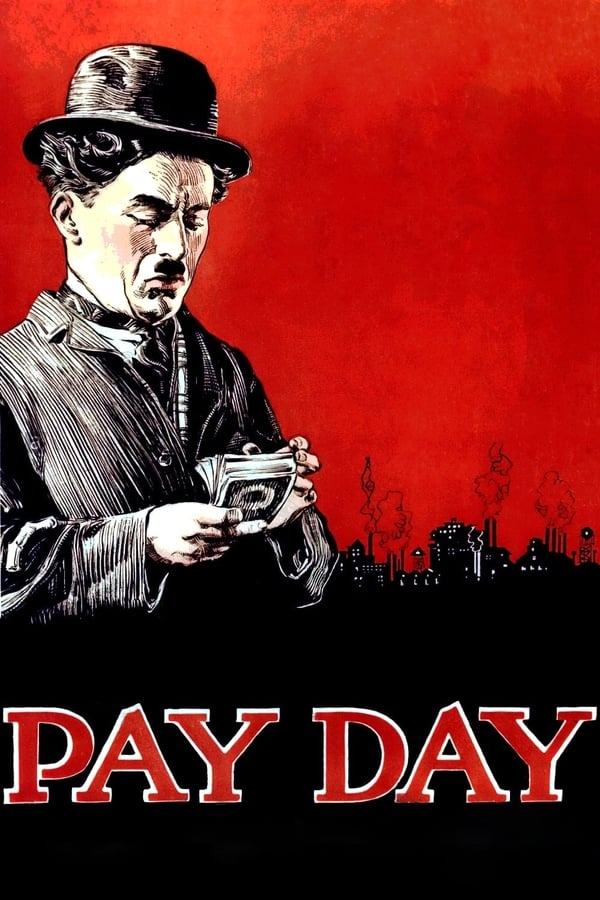
A definitive 7.4/10 rating for a film that redefined the boundaries of cult cinema. Pay Day remains a cornerstone of transgressive art.
Charlie Chaplin’s Pay Day is less a narrative than a tremor—an aftershock of brick dust and marital insomnia that ripples across twenty-two minutes of celluloid like a drunkard’s hiccup. Released in April 1922, when Hollywood was busy powdering the faces of flappers and stretching features into elephantine spectacles, this two-reeler slips in sideways, muttering that the real epic is the space between a laborer’s calloused palm and the copper coins that spill from it.
The film opens on a construction site rendered in slate grays and nicotine browns, a brutalist altar where faceless men mortar the future city. Chaplin’s bricklayer—The Tramp in everything but name, here credited simply as “Laborer”—hoists blocks with the automaton grace of a man whose spine has memorized the motions. Time is measured in dripping sweat and the foreman’s pocket watch; wages are counted out like communion wafers. There is no music on the job, only the clink of trowels and the low growl of machinery, a sonic vacuum that makes the eventual slide whistle of his payday feel almost obscene.
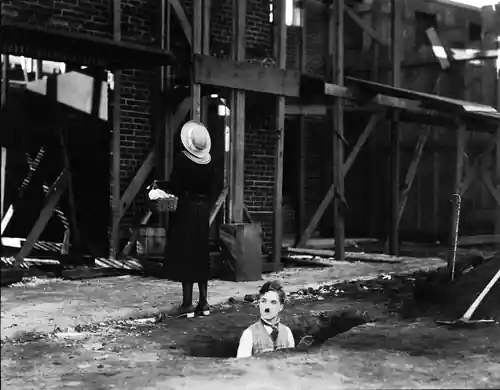
Note the kinesthetic wit: each brick is a rectangular punchline, a set-up for the cosmic gag that money, once pocketed, metastasizes into beer, cigars, and the fleeting kindness of barmaids. Chaplin’s choreography here is closer to ballet than slapstick—he pirouettes on girders, tip-toes across wet cement, and at one point uses a ladder as partner in a tango of near-death. The camera, static but spiritually restless, drinks in the geometry of peril: beams, pulleys, skylines that slice the frame into cubist anxiety.
Once the whistle blows, the film’s tone pivots from industrial dystopia to urban carnival. The bricklayer’s pockets jingle with the promise of libation; his gait loosens, shoulders unknot, and the city blossoms into a labyrinth of neon temptation. Watch how Chaplin stages the saloon: mirrors double and triple the patrons so that every glass raised becomes a kaleidoscope of working-class sacrament. Edna Purviance drifts through as a waitress whose smile is half benediction, half invoice. Their flirtation is conducted in glances timed to the foam collapsing on beer steins—an entire erotic novella compressed into three shots.

But the evening’s true antagonist is arithmetic. Each coin spent is a subtraction from the domestic ledger the wife (portrayed with domestic ferocity by Phyllis Allen) keeps in her head like a miser’s psalm. Chaplin literalizes this by superimposing the wife’s face over tavern chandeliers, a hauntological presence that turns every laugh into a hiccup of guilt. The recurring gag—money appears, money vanishes—becomes a cinematic Möbius strip: the more he grasps, the emptier his fist.
Midway, the film detours into a pool hall where geometry once again becomes metaphysics. Balls carom across green felt like miniature planets governed by the laws of alcohol and bravado. Chaplin’s cue is a wizard’s staff that never obeys; he lines up shots with the solemnity of a surgeon only to miscue spectacularly, scattering balls and egos. Syd Chaplin, sporting a moustache thick as a broom, plays a hustler whose grin could sand varnish. Their match is silent but loquacious in body language: shoulders cock, brows semaphore, and the chalk squeaks like a tiny cry for help.
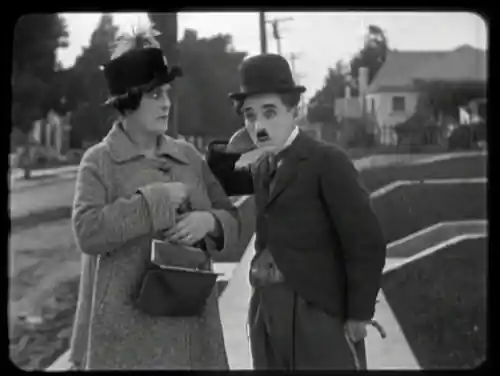
What keeps Pay Day from collapsing into sketch anthology is Chaplin’s unspoken thesis: capitalism is a temporal practical joke. The laborer’s only collateral is time—time sold, time misspent, time reclaimed by a wife waiting on the stoop with rolling pin in hand. Notice the recursive structure: the film ends where it begins, on a construction site at dawn, the man poorer, wearier, yet mysteriously lighter, as though the night’s debauch were a purgative. The final shot—his lunch pail snatched by the missus, coins vacuumed from his pockets—lands less as comeuppance than cosmic punchline, the universe yanking the rug with Buster Keaton timing.
Cinematographer Roland Totheroh shoots interiors in chiaroscuro that anticipates German Expressionism: faces half-lit by hanging bulbs, shadows stretched like taffy across walls. Exterior scenes favor deep focus so that streetcars and pedestrians become a living frieze, a reminder that the protagonist’s plight is plankton in an urban food chain. The print restored by Criterion reveals texture usually lost to dupe decay: you can almost smell the sour mash on breath, the dank sawdust underfoot.
Comparative glances: where The Idle Class satirizes the rich as feckless marionettes, Pay Day trains its lens on the wage earner whose vices are minuscule but accumulate like compound interest. If David Copperfield chronicles the education of a gentleman through adversity, Chaplin’s laborer receives a crash course in the arithmetic of survival, minus the social mobility. Meanwhile, Dr. Jekyll and Mr. Hyde dramatizes the self split into virtue and id; Chaplin achieves the same with nothing more than a pocketful of coins and a bar tab.
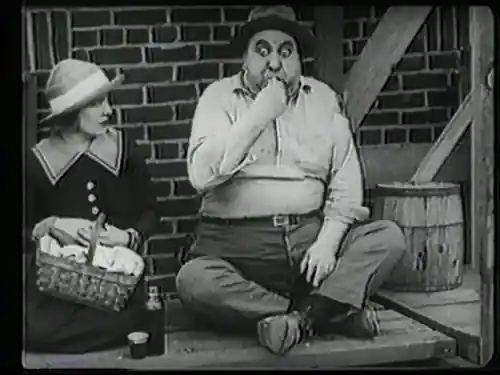
Acting nuances: Purviance, often relegated to ethereal sweetheart, here exudes a barkeep’s pragmatic eroticism—she wipes the counter as if wiping memories, her eyes promising everything deliverable in the time it takes to pour a shot. Henry Bergman cameos as a corpulent diner whose trousers split in a gag so precisely timed it feels like a haiku about gluttony. Loyal Underwood, pint-sized and pigeon-eyed, serves as Chaplin’s foil in a sequence where they split a single cigar, the smoke rings becoming matrimonial vows of camaraderie.
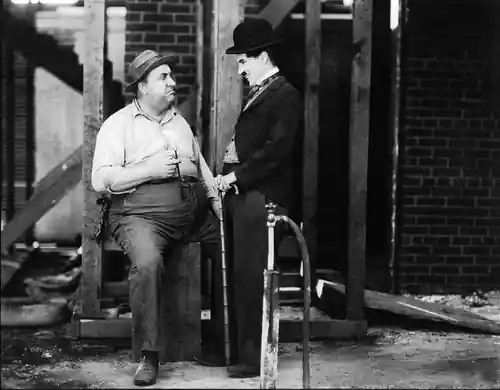
The film’s legacy is etched in the DNA of sitcom economics: from Ralph Kramden’s harebrained schemes to Homer Simpson’s donut fund, the trope of the working stiff squandering tomorrow’s security for tonight’s fleeting joy loops back to Chaplin’s bricklayer. Yet none replicate the pathos of his silence—no laugh track, no explanatory aside, just the echo of coins hitting mahogany and the soft thud of dreams landing on pavement.
Contemporary resonance: in an age of gig wages and Buy-Now-Pay-Later algorithms, Pay Day feels prophetic. The laborer’s hourly rate translates to roughly fifteen dollars in today’s currency; subtract bar markup and he’s left with bus fare and contrition. Chaplin intuited that the tragedy of the proletariat is not poverty but liquidity: money too scarce to save, too tangible to hoard, evaporating like breath on a cold morning.
Restoration notes: the 4K scan removes the flicker that once made city lights resemble fireflies in a jar. Grain is intact, preserving the tactile grit of 1922. Optional audio includes a new score by Timothy Brock for chamber ensemble—xylophones mimic the clink of coins, bassoons burp like satiated drunks. Purists can still opt for the 1970s Chaplin compilation soundtrack, but Brock’s version syncs to eyebrow twitches with surgical precision.
Viewing tip: play it as a double bill with Britain’s Bulwarks, No. 1: Women Munitioners of England to juxtapose masculine fiscal folly with wartime female industry, then chase both with You Know What I Mean for a palate cleanser of marital wish-fulfillment. The tonal whiplash will leave you dizzy, enlightened, and oddly grateful for direct deposit.
Final calculus: Pay Day runs 733 meters of 35mm, roughly the distance a laborer might stagger from site to saloon. Every frame is a breadcrumb on the trail of modernity’s original sin—turning time into tender, flesh into ledger. To watch it is to feel the cold kiss of capitalism’s coin on your own palm, and to laugh—because the alternative is to weep into your beer, and the bar tab is already too high.
IMDb 5.1
1925
Community
Log in to comment.