DbcultAccessing Vault...
Cult Review
Senior Film Conservator
Is Peaches and Plumbers worth watching today? The short answer is an emphatic yes, particularly for those with an appreciation for the foundational elements of slapstick comedy and a keen interest in early cinematic portrayals of social class dynamics. However, if your cinematic palate leans exclusively towards modern narratives with intricate character development and high production values, this particular silent-era gem might feel like a quaint, albeit charming, relic rather than a compelling contemporary watch.
This film works because it deftly leverages the universal comedic appeal of social class collision and romantic jealousy, delivering its gags with a surprising precision for its era. It fails because its narrative, while effective, remains largely superficial, prioritizing rapid-fire physical comedy over any genuine emotional depth or character nuance. You should watch it if you're a student of silent film, a fan of early American comedy, or simply curious about the roots of the romantic farce.
In the vast, often overlooked archives of silent cinema, Peaches and Plumbers emerges not as a forgotten masterpiece, but as a surprisingly robust example of early comedic storytelling. Directed with an eye for kinetic energy and physical humor, it's a film that understands its core assignment: to make audiences laugh, and to do so with an economy of dialogue and an abundance of expressive movement.
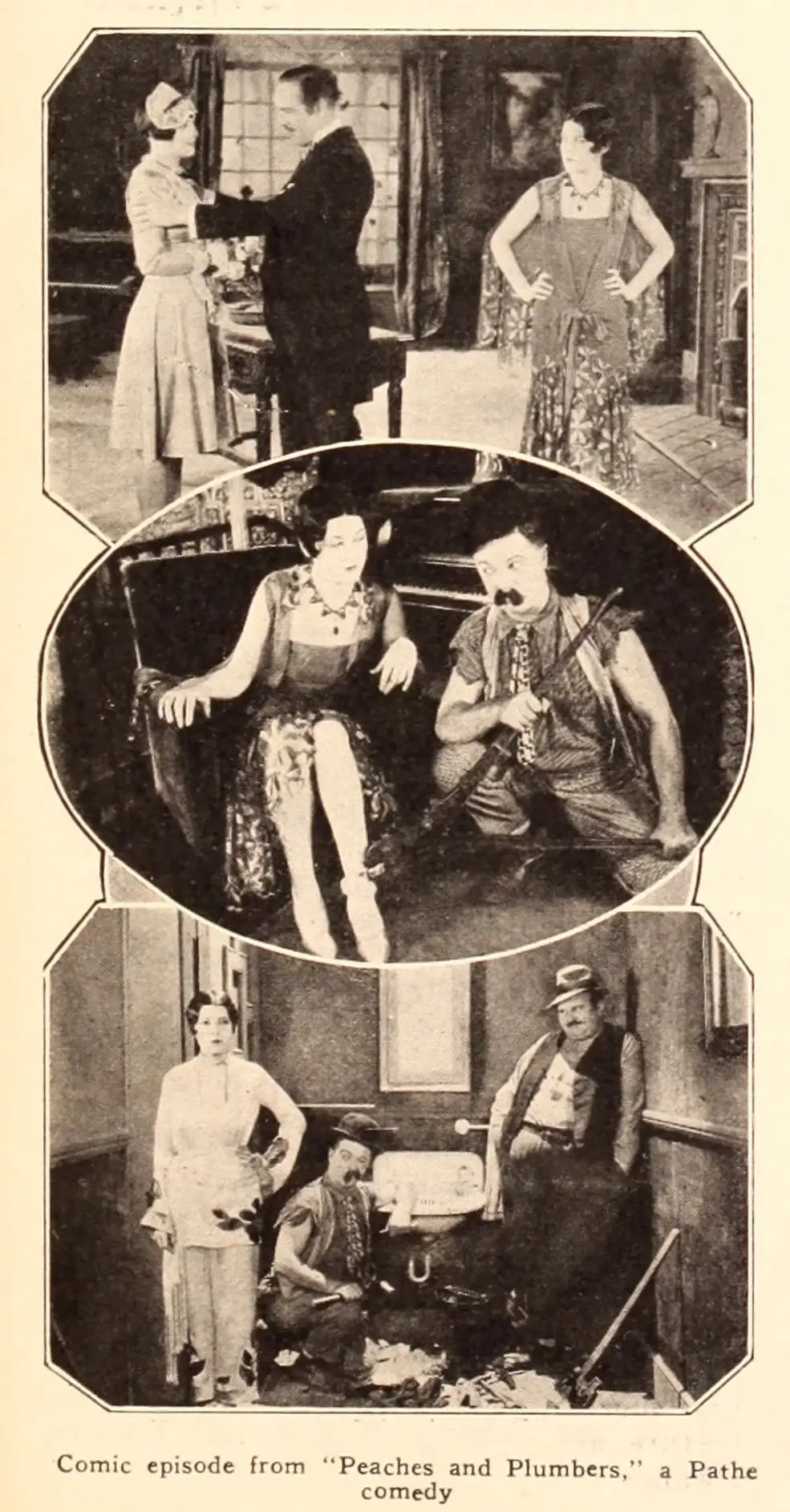
At its heart, the film is a delightful, if somewhat predictable, exploration of romantic gamesmanship gone awry. Madeline Hurlock’s society girl, a character type then as now, is driven by a desire for attention, a common thread in countless romantic comedies that followed. Her decision to ensnare a working-class plumber, rather than a suitor of her own social standing, is the spark that ignites the film’s central conflict, setting the stage for a classic clash of worlds.
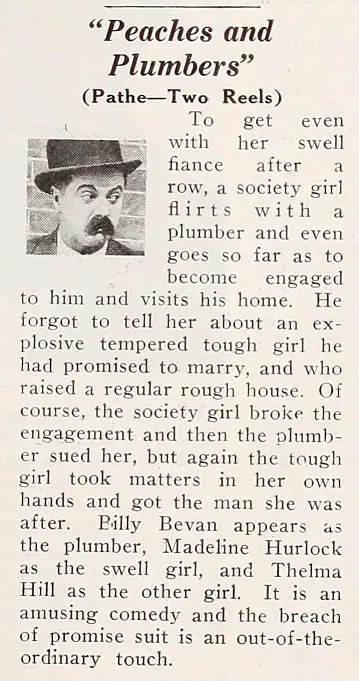
What truly elevates Peaches and Plumbers beyond mere historical curiosity is the vibrant performance of Thelma Hill. While Hurlock sets the plot in motion with her character’s calculated manipulations, it is Hill’s spirited portrayal of the plumber’s sweetheart that injects the film with genuine comedic fire. Her character is not merely a victim; she is an agent of chaos, a force of nature whose retaliatory actions are both inventive and hilariously disruptive.
The film’s pacing is typical of the era’s slapstick, moving briskly from one gag to the next, rarely lingering on any emotional beat for too long. This relentless forward momentum is both a strength and, at times, a limitation. It ensures a consistent stream of laughs but prevents any deeper exploration of the characters’ motivations or the social commentary inherent in the premise.
The direction in Peaches and Plumbers, while not groundbreaking, is certainly effective. The filmmakers understood the language of silent comedy: exaggerated gestures, clear sight gags, and a rhythm dictated by the visual punchline rather than spoken dialogue. The narrative unfolds with a straightforward clarity, ensuring that even without intertitles, the audience could largely follow the escalating absurdity.
One particular sequence involving a misunderstanding over a misplaced tool, intended as a romantic gesture but interpreted as a clumsy insult, showcases the film’s ability to build humor from simple premises. The camera work, while static by today's standards, is always positioned to capture the full breadth of the physical comedy, ensuring that every pratfall and exasperated expression lands with maximum impact.
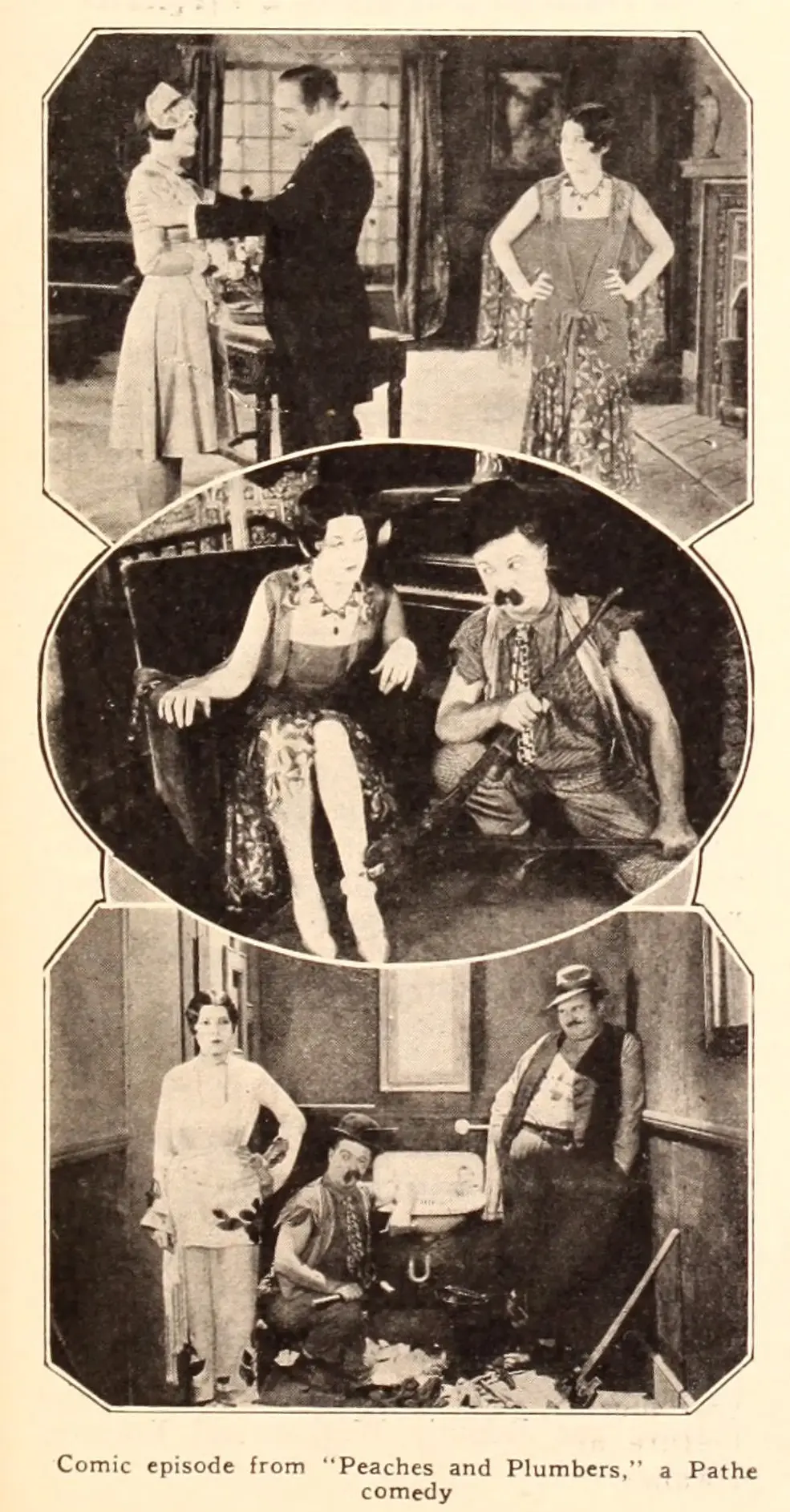
The pacing is relentless. Unlike some contemporary silent films that occasionally meander, Peaches and Plumbers maintains a brisk, almost breathless tempo. This is crucial for a film relying so heavily on physical comedy and quick-fire reactions. There’s little room for introspection; the plot is a vehicle for a series of escalating gags, culminating in a satisfying, if somewhat predictable, resolution that sees order restored, albeit with a few bruised egos.
It's fascinating how a film so reliant on physical comedy inadvertently offers a commentary on the performative nature of class and romance, even if it never fully delves into it. The silent era, in its own way, was often more direct about such social observations than we give it credit for.
Silent film acting is a unique beast, demanding a physicality and expressiveness that often feels over-the-top to modern sensibilities, yet was essential for conveying emotion and intent without dialogue. The cast of Peaches and Plumbers largely rises to this challenge, though with varying degrees of success.
Madeline Hurlock, as the instigator of the romantic chaos, is perfectly cast as the somewhat vapid socialite. Her expressions of feigned affection and calculated jealousy are clear, if a little broad. She embodies the 'peaches' of the title – sweet on the surface, but perhaps a little bruised underneath. I'd argue that while competent, her performance, by design, serves more as a catalyst than a captivating central force.
The true star power, however, unequivocally belongs to Thelma Hill. Her portrayal of the spurned sweetheart is a masterclass in silent comedic energy. Hill doesn't just react; she proacts. Her revenge schemes are executed with a delightful blend of righteous indignation and mischievous glee. Whether it’s a perfectly timed splash of water or a cleverly orchestrated public humiliation, Hill’s physical comedy is precise, energetic, and genuinely funny. She is the 'plumber's' true heart, and the force that gives the film its enduring charm. Her performance alone is reason enough to seek this film out, particularly for those interested in the often-underappreciated talents of female silent film comedians.
The supporting cast, including the hapless plumber and the boyfriend, fill their roles adequately, providing the necessary foils for Hurlock and Hill’s antics. They are caricatures, certainly, but effective ones within the comedic framework. Billy Bevan, for instance, often delivers a reliably bewildered expression that perfectly punctuates the escalating chaos.
The cinematography in Peaches and Plumbers is functional and clear, typical of its era. There are no groundbreaking camera movements or experimental angles. Instead, the focus is on clarity and ensuring the audience can clearly see the physical comedy unfolding. The use of medium shots and wide shots allows the full scope of the slapstick to be appreciated, from a character's initial reaction to their eventual pratfall.
Where the film does shine visually is in its simple yet effective set design, particularly in contrasting the two social worlds. We get glimpses of the society girl’s opulent, if somewhat generic, drawing-rooms – all ornate furniture and delicate decor – which stand in stark contrast to the more utilitarian, humble settings associated with the plumber. This visual juxtaposition subtly reinforces the class divide that underpins the entire comedic premise. A scene where the plumber attempts to navigate an overly formal tea party, for instance, relies heavily on the clash between his rough-and-tumble demeanor and the delicate porcelain surroundings.
The costumes, too, play a vital role in characterization. Hurlock's elegant, if slightly impractical, dresses immediately mark her as a woman of leisure, while Hill's more practical attire speaks to her grounded nature. These visual cues are essential in a silent film, immediately informing the audience about character and social standing without the need for exposition.
Beyond the laughs, Peaches and Plumbers touches upon surprisingly enduring themes. The most obvious is jealousy, the driving force behind Madeline Hurlock’s initial scheme. Her character’s actions are a desperate attempt to regain control and attention, a relatable human flaw that transcends time.
Then there's the theme of class distinction. The film cleverly, if superficially, plays on the perceived differences between social strata. The 'plumber' is not just a romantic rival; he represents a different world, one that the society girl initially uses as a prop. This exploitation of class for personal gain, and the subsequent chaos it unleashes, is a subtle critique, albeit one delivered with a comedic rather than a dramatic hand.
Finally, and perhaps most entertainingly, is the theme of revenge. Thelma Hill’s character embodies the audience’s desire for justice against the manipulative socialite. Her methods are not violent, but rather cleverly humiliating, turning the tables on her rival in a series of increasingly inventive ways. It’s a satisfying exploration of agency, where the seemingly less powerful character finds her voice through ingenious acts of comedic retribution.
Absolutely, but with caveats. For aficionados of early cinema, particularly silent comedies, Peaches and Plumbers is a delightful discovery. It offers a window into the comedic sensibilities of the era, showcasing the physical prowess of its performers and the straightforward charm of its storytelling. It’s a foundational piece, demonstrating how universal themes could be explored through visual humor.
If you're new to silent films, this could be a gentle entry point. Its relatively short runtime and consistent comedic beats make it less daunting than some of the more epic productions of the period. However, viewers accustomed to modern narrative complexity, sophisticated dialogue, or advanced cinematic techniques might find its simplicity challenging. It lacks the profound emotional depth of a Chaplin or the intricate visual inventiveness of a Keaton, but it never pretends to be those films.
It works. But it’s flawed. Its strength lies in its unpretentious commitment to laughter, and in that regard, it largely succeeds.
Peaches and Plumbers is far from a forgotten classic, nor does it aspire to be. What it is, however, is an exceptionally charming and consistently funny silent comedy that delivers precisely what it promises: a lighthearted romp driven by jealousy, social faux pas, and delightful revenge. It’s a testament to the enduring power of simple, well-executed physical humor and the magnetic screen presence of performers like Thelma Hill.
While it won't challenge your intellect or stir your soul in profound ways, it will undoubtedly leave you smiling. It’s a perfect film for a relaxed evening, a reminder of cinema's foundational comedic principles, and a strong recommendation for anyone looking to explore the lighter side of the silent era. Don't expect The End of the Road; expect pure, unadulterated, old-fashioned fun. This little film is a delightful peach, even if it has a few minor bruises from time.

IMDb 5.4
1933
Community
Log in to comment.