DbcultAccessing Vault...
Cult Review
Senior Film Conservator
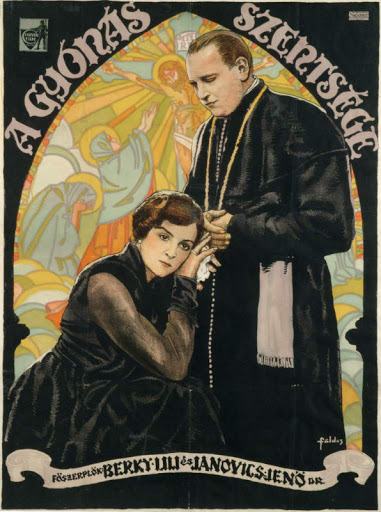
The first time you watch A gyónás szentsege you expect a dusty sermon; instead you get a blade pressed against the throat of morality. This 1918 Hungarian one-reeler, resurrected from nitrate purgatory, is less a parochial curio than a claustrophobic noir that happens to wear a cassock. Director Jenö Janovics and co-scenarist Louis N. Parker distill the entire Judeo-Christian ethical cosmos into a candle-lit room where a killer’s whisper outweighs cannon fire.
Cinematographer Aranka Laczkó paints Carpathian nights with soot and starlight: every frame is a woodcut of dread. When the murderer staggers into the presbytery, the camera dollies past a crucifix whose elongated shadow bisects his face—half penitent, half predator. Interior scenes smolder in umber chiaroscuro, while exteriors explode with Expressionist angles that predate Caligari by a full year. The result feels like a copper engraving that bleeds actual blood.
Matthias Blood, embodied by the gaunt yet magnetic Victor Varconi, is no pious cardboard cutout. His eyes carry the geological strata of doubt: each blink a tectonic shift. Watch him during the Stations of the Cross: beads slip between fingers as if counting down to detonation. The film’s genius lies in never letting him articulate the agony; instead, close-ups linger until sweat beads become theological treatises.
Imre—played with wide-shouldered vulnerability by Aladár Ihász—is the sacrificial lamb trussed by communal panic. In a town where the church bell doubles as courthouse gavel, suspicion equals verdict. The screenplay refuses to flatter the villagers; they are neither ogres nor saints, merely humans hungry for closure. Their chant outside the jail could be a pogrom or a prayer, depending on the angle of moonlight.
While priests wrestle with angels, women do the footwork. Flóra Fáy’s unnamed bride pivots from decorative fiancée to relentless sleuth without a single eyeroll-inducing transformation scene. Her investigation is a masterclass in micro-gestures: the way she pockets a torn button, the furtive glance at boot-prints in clay, the tremor in her voice when she corners the prosecutor. In 1918, giving narrative agency to a female protagonist felt almost heretical; here it feels inevitable.
The film’s central engine is the seal of confession, a plot device Hollywood would still kill for. Janovics stretches the suspense like catgut across a violin: every tick of the clock is a note that might snap into discord. When Matthias ultimately stays silent, the movie doesn’t hand out pious brownie points; it forces you to stew in the cost of principle. The absolution he grants the killer becomes a spiritual tourniquet—life saved, soul scarred.
"The camera records the heartbeat underneath the collar."
Miklós Mariházi’s murderer is never a moustache-twirling villain; his guilt is a rust that flakes with every breath. In the confessional close-up you can almost smell the iron on his breath. Meanwhile, József Berky’s prosecutor—equal parts bureaucrat and crusader—delivers a clinic in how to project menace without sneering. The ensemble operates like a chamber orchestra, each reaction shot a plucked string that resonates long after the fade-out.
Janovics cuts from the killer’s whispered "forgive me" to the creak of gallows being built; the splice is a slap. Cross-cutting reaches fever pitch when Imre’s betrothed races across wheat fields while the priest kneels in prayer, both racing toward separate salvations. The montage predates Griffith’s later intolerance symphonies, yet feels more intimate—like a scalpel rather than a broadsword.
Though original music is lost, modern festival restorations often pair the film with minimalist strings and tolling bells. The effect is seismic: each reverberation underlines that heaven itself is on trial. I caught a 2019 Bologna screening where cellos growled like distant thunder; by the final pardon the audience exhaled as one organism, a collective amen soaked in relief and shame.
If you crave more conscience-scarred clerics, queue up The Port of Doom with its whisky-soaked padre, or Silence of the Dead where monastic vows collide with political murder. For courtroom nail-biters sans collar, The Silent Lie offers a female whistleblower navigating perjury traps. And should Hungarian silent cinema hook you, Sunshine Alley supplies pastoral lyricism minus the doom.
Color symbolism sneaks in via tinting: candle flames glow yellow, hinting at fragile hope; the killer’s memory flashback washes in sulphur, a visual stench. These flourishes feel avant-garde even now, predating the digital tinting craze by a century. When the final reel shifts to sea-blue dawn, the relief is chromatic as much as narrative.
Make no mistake: the film still kneels at the altar of patriarchy—priest, prosecutor, patriarchal God. Yet the bride’s sleuthing subverts the damsel trope without grandstanding. She doesn’t brandish pistols; she wields empathy, memory, and obstinacy. In doing so, she cracks open a space where female agency can breathe within a suffocating scaffold of male authority.
Long after credits, what lingers is the acrid perfume of ethical stalemate. Does sacred silence ennoble faith or enable atrocity? The film refuses catharsis; it leaves you handcuffed to ambiguity, rattling the bars of certainty. Every revisit nudges the moral fulcrum; today I side with the seal, tomorrow maybe with the gallows. That instability is the hallmark of timeless art.
Until recently, only a 9.5 mm Pathé condensation survived in the Hungarian Film Archive. A 4K restoration premiered at Il Cinema Ritrovato, combining two partial negatives and reinstating censored intertitles. Blu-ray is rumored via Arbela Masters with scholar commentary and a 40-page booklet dissecting canonical law. Streamers beware: bootlegs on shady silo sites are bleached, cropped, scored with generic piano—heresy against a film about sacramental purity.
Modern blockbusters lob moral questions like grenades then duck behind explosions. A gyónás szentsege plants a seed of conscience and lets it grow through the floorboards of your comfort zone. In an era of data leaks and whistleblower chic, the sanctity of a whispered confession feels both archaic and radical. Engage with it, and Netflix thrillers suddenly taste like sugared water.
A cathedral in miniature, carved from guilt, love, and celluloid. The performances vibrate at a frequency that sound cinema rarely attains, and the finale lands like a psalm whispered in a prison yard—simultaneously crushing and exalting. Seek it out, preferably on a big screen with a congregation of strangers. When the lights rise, you may not believe in God, but you will believe in film’s power to rend and redeem.
IMDb 5.7
1936
Community
Log in to comment.