DbcultAccessing Vault...
Cult Review
Senior Film Conservator
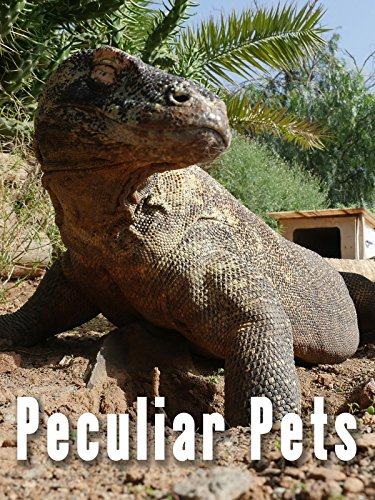
There is a profound, almost pathological restlessness inherent in the modern human condition that drives certain individuals to seek companionship within the jaws of death. Peculiar Pets is not merely a documentary about animal husbandry; it is a haunting exploration of the liminal space between civilization and the untamed wild. The film introduces us to a demographic for whom the mundane presence of a golden retriever is an insufficient balm for their existential isolation. Instead, they curate living rooms that double as terrariums for Komodo Dragons and sanctuaries for Iberian Lynxes. This is a cinematic journey into the heart of a very specific kind of madness—one fueled by the hubristic belief that love can override millions of years of predatory evolution.
The documentary’s visual language is purposefully jarring. We see the mundane artifacts of middle-class life—crocheted throw pillows, family photographs, television sets—juxtaposed against the scaly, prehistoric indifference of a monitor lizard. The cinematography captures the tension in every frame; there is a constant, low-frequency anxiety that permeates the screen. Unlike the controlled environments seen in The House of Mystery, where the secrets are human-made and architectural, the mysteries in Peculiar Pets are biological and unpredictable. The film forces the viewer to confront the reality that these animals do not possess the capacity for the loyalty we project upon them.
One of the most compelling aspects of the film is the psychological profile of the owners. These are not the typical 'animal lovers' found in your local park. There is a sense of social detachment that mirrors the themes found in One Man in a Million, where the protagonist exists on a plane separate from the rest of society. The subjects of Peculiar Pets often view their animals as the only creatures capable of understanding them, ignoring the fact that a lynx’s 'understanding' is primarily focused on the carotid artery. The film expertly dissects this delusion, showing how owners anthropomorphize reptilian stares and feline growls into complex emotional responses.
The narrative structure of the documentary is episodic yet cohesive, moving from the humid enclosures of reptile enthusiasts to the high-fenced compounds of big cat owners. Each segment feels like a psychological thriller. There is a sequence involving a large monitor lizard that rivals the tension of Der Kampf mit dem Drachen, though the 'dragon' here is real and the 'knight' is a middle-aged man in cargo shorts. The threat is not mythical; it is visceral and immediate. The film doesn't need to resort to jump scares; the mere sight of a child playing near a creature that could swallow their arm whole is enough to keep the audience in a state of perpetual unease.
Technically, the documentary is a masterclass in lighting and sound design. The rustle of dry scales against linoleum, the low, guttural hiss of a frightened lynx—these sounds are amplified to create a sensory experience that is both beautiful and terrifying. The filmmakers use a color palette that oscillates between the sterile whites of the home and the vibrant, earthy tones of the animals' natural origins. This contrast highlights the absurdity of the situation. It reminds one of the thematic duality in The Seventh Sin, where the beauty of the setting often masks a deeper moral or physical rot.
The editing is particularly sharp, often cutting from an owner’s declaration of 'pure love' to a close-up of the animal’s unblinking, predatory eye. It is a subtle commentary on the one-sided nature of these relationships. While the humans provide food, shelter, and affection, the animals provide only a reflection of the owner’s desire for something extraordinary. The documentary suggests that this is a form of emotional colonialism—an attempt to claim and domesticate something that is fundamentally wild. The danger inherent in this pursuit is treated with a gravity that recalls the high-stakes drama of The Debt, where the cost of one's choices eventually comes due.
Beyond the personal stories, Peculiar Pets touches upon the broader ethical implications of the exotic pet trade. The film asks difficult questions about conservation and animal rights without becoming a preachy polemic. Is it more humane to keep an endangered lynx in a suburban backyard than to let it die in a shrinking wild? The film doesn’t provide easy answers. Instead, it presents the messy, complicated reality of these lives. We see the legal battles, the neighborly disputes, and the constant fear of the 'beast' escaping. This sense of living outside the law, or at least on its fringes, evokes the outlaw spirit of Jesse James as the Outlaw, but without the romanticism of the Wild West.
There is a recurring motif of the 'unseen danger.' Much like the suspense built in The Case of Lady Camber, the documentary relies on the viewer’s knowledge of what could happen. We know what these animals are capable of, even when they are being portrayed as 'docile.' This creates a subtext of impending doom that makes the mundane scenes of feeding and cleaning feel like high-stakes gambles. When an owner discusses the 'personality' of their Komodo Dragon, the viewer is reminded of the deceptive appearances in The Lure of Heart's Desire—where the thing one wants most is the very thing that will lead to their undoing.
In its final act, the documentary shifts its focus to the tragic outcomes that often define this lifestyle. It doesn't shy away from the scars—both literal and figurative. We see the aftermath of 'accidents' that were, in hindsight, inevitable. The grief of the owners is palpable, yet it is often mingled with a stubborn refusal to blame the animal. This psychological complexity is what elevates Peculiar Pets above standard reality television. It is a profound look at the human need for connection, however distorted that need may become. The subjects are not villains, nor are they heroes; they are individuals caught in a web of their own making, much like the characters in A Night in New Arabia who find themselves in situations far beyond their control.
Ultimately, Peculiar Pets is a cautionary tale for the modern age. It serves as a reminder that nature is not a plaything and that some boundaries are meant to be respected. The film leaves the viewer with a sense of profound unease, a feeling that the thin veneer of civilization is much more fragile than we care to admit. It is a brilliant, unsettling, and deeply human documentary that deserves to be seen by anyone interested in the darker corners of the human heart and the beautiful, terrifying creatures that inhabit them. It stands as a testament to the fact that sometimes, the most 'peculiar' thing in the room isn't the animal—it's the person holding the leash.
For those who enjoy films that explore the fringes of human behavior and the consequences of obsession, this documentary is an essential watch. It shares a certain DNA with The Eagle in its depiction of a solitary figure’s quest for something larger than themselves, though the 'conquest' here is far more intimate and far more dangerous. Peculiar Pets is a mirror held up to our own desires, asking us what we are willing to risk for a touch of the extraordinary.

IMDb —
1920
Community
Log in to comment.