DbcultAccessing Vault...
Cult Review
Senior Film Conservator
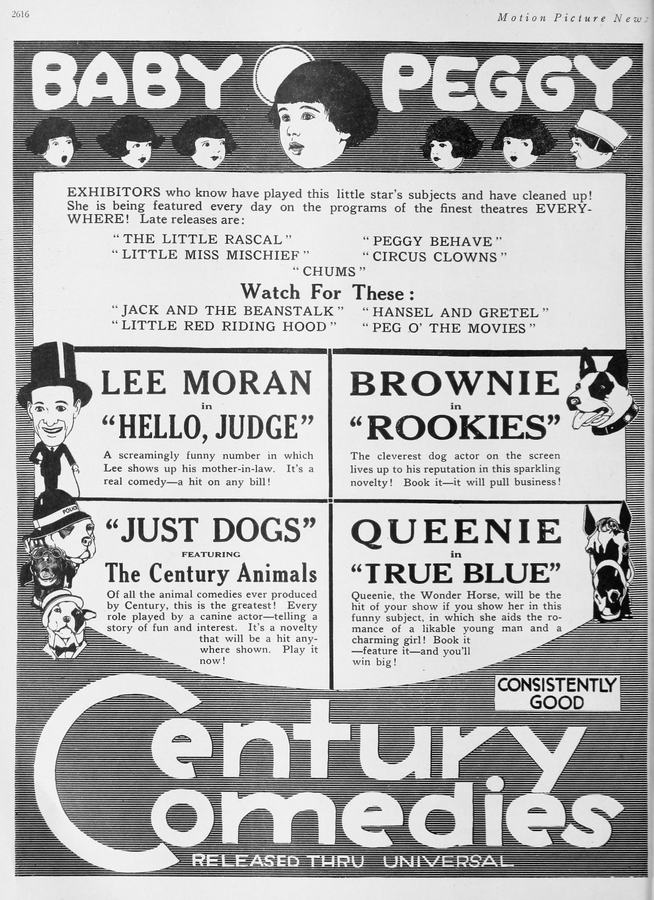
The year 1923 stood as a pivotal junction for the American cinematic apparatus, a moment when the industry began to gaze inward with a mixture of reverence and ruthless parody. In the midst of this self-reflexive awakening, Peg o' the Movies emerged not merely as a vehicle for a child star, but as a sophisticated deconstruction of the Hollywood mythos. Baby Peggy, the diminutive powerhouse known to history as Diana Serra Cary, occupies the frame with a gravitas that belies her years, navigating the chaotic geography of Universal City with the confidence of a seasoned veteran. Unlike the more traditional narratives of the era, such as the earnest rural struggles depicted in Main Street, this short film revels in the artifice of the studio lot, turning the production process itself into a comedic battlefield.
The film’s opening gambit is nothing short of brilliant. We witness Peggy arriving in a hammock slung beneath a freight car—a gritty, hobo-chic entrance that immediately juxtaposes the innocence of childhood with the harsh realities of the Great American Rail. Clad in the iconic garb of William S. Hart, Peggy isn't just playing dress-up; she is inhabiting a specific masculine archetype that dominated the silent screen. This performance of ruggedness serves as a sharp contrast to the more polished urbanity found in Manhattan Madness. When she hurls a brick at an actor she perceives as a genuine thief, the film brilliantly exposes the fragility of cinematic verisimilitude. The director’s frustration is palpable, a comedic echo of the logistical nightmares often portrayed in No Money, No Fun.
This incident with the brick is the catalyst for a larger exploration of the 'mistake' as an art form. In the early 1920s, the boundary between the set and the world was often porous, and Peg o' the Movies exploits this to create a sense of anarchic joy. The disruption of the 'perfect scene' is a recurring theme in silent comedy, yet here it feels more pointed. It suggests that the purity of the child’s perspective is the only thing capable of piercing the vanity of the studio system. While films like The Sheriff's Son played their Western tropes straight, Peggy’s presence acts as a solvent, dissolving the seriousness of the genre into something far more interesting and meta-textual.
The narrative pivot from Western hero to the 'vamp' archetype is where the film truly ascends into the stratosphere of high satire. The 'vamp'—personified by Theda Bara in the 1915 classic A Fool There Was—was a figure of predatory female sexuality, a cultural phenomenon that fascinated and terrified the American public. To have a five-year-old girl replicate these hyper-sexualized gestures is a daring move that could easily have devolved into the grotesque. However, under the direction of Alf Goulding, the sequence becomes a masterclass in physical mimicry and social commentary. Peggy’s 'vamping' is a critique of the performative nature of femininity in Hollywood, a theme that resonates with the marital tensions explored in Husbands and Wives.
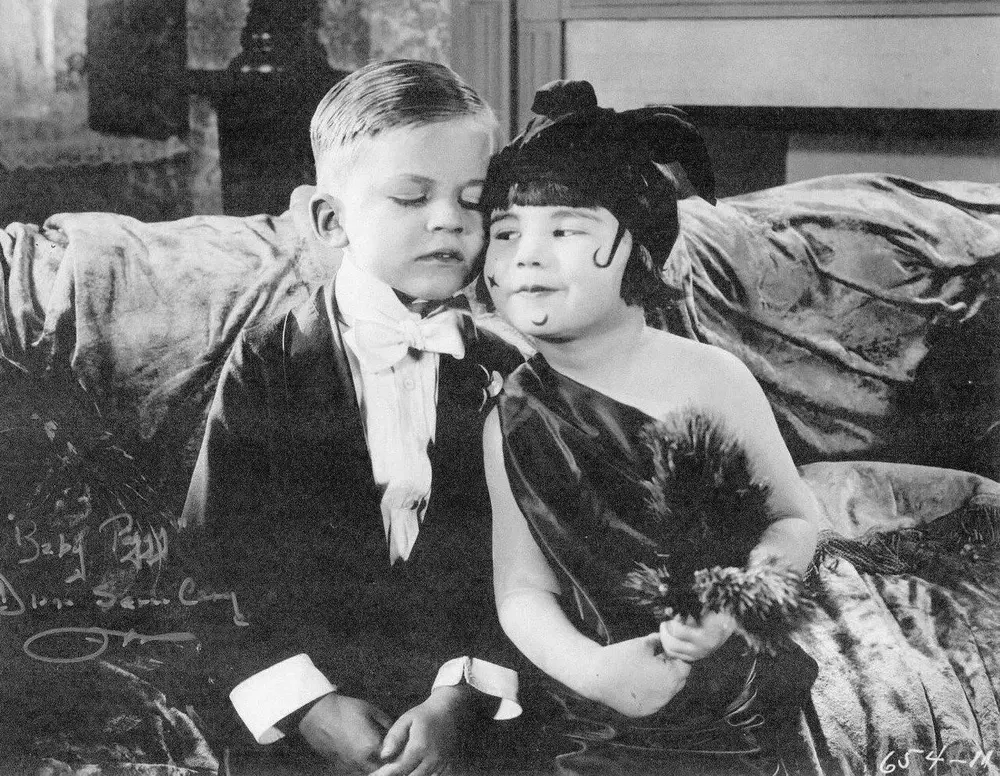
When Peggy looks the director in the eye and utters the immortal line, "you ain't seen nothing yet," she isn't just quoting a future talkie; she is signaling the arrival of a new kind of stardom. Her performance in the parody sequence is uncanny. She captures the heavy-lidded gazes, the dramatic swoons, and the calculated allure of the silent sirens with terrifying precision. This isn't the wide-eyed innocence of Innocence; it is a sophisticated understanding of how the camera consumes the female form. The humor arises from the absurdity of the mimicry, but the underlying bite comes from the recognition of how quickly the industry commodifies personality.
The physical setting of Universal City serves as a silent protagonist in its own right. We see the scaffolding of the dream factory, the dusty roads that would eventually become the backlots of legend. The film captures a sense of place that is often lost in more stylized productions like Whispering Shadows. There is a raw, documentary-like quality to the exterior shots that anchors the comedy in a specific historical reality. The use of location shooting provides a texture that rivals the atmospheric depth of Hitchin' Posts, allowing the audience to feel the heat of the sun and the grit of the California soil.
Max Asher and Lillian Hackett provide excellent support, playing their roles with a frantic energy that complements Peggy’s more controlled performance. Asher, in particular, embodies the exasperated industry professional, a character type that would become a staple of Hollywood-on-Hollywood films. His interactions with Peggy are reminiscent of the comedic friction in Here's Your Man, where the clash of egos drives the narrative forward. Yet, in Peg o' the Movies, the power dynamic is inherently skewed; the child is the one with the talent and the agency, while the adults are merely reacting to her gravitational pull.
Visually, the film utilizes the standard vocabulary of the 1920s short—iris shots, rapid-fire editing during chase sequences, and expressive intertitles—but it applies them with a rhythmic precision that feels modern. The cinematography captures the scale of the studio, contrasting Peggy’s small stature with the vastness of the sets. This visual dichotomy emphasizes her role as an intruder in an adult world, a theme also present in The Girl Who Wouldn't Quit. The lighting, primarily naturalistic for the outdoor scenes, shifts into a more dramatic, high-contrast style for the 'vamp' parody, mirroring the shift from reality to the heightened artifice of the silver screen.
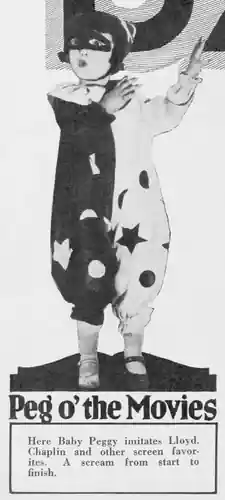
One cannot discuss this film without acknowledging its place in the lineage of child-star vehicles. Unlike the saccharine sentimentality that would later define the genre, Peg o' the Movies possesses a cynical edge. It recognizes the absurdity of a child working in a factory of illusions. This self-awareness is what keeps the film fresh a century later. It avoids the pitfalls of Lost: A Bridegroom, which often relied on more conventional slapstick tropes. Instead, it leans into the meta-narrative, making the film a document of its own creation.
The enduring appeal of Baby Peggy lies in her ability to channel the zeitgeist of the 1920s into her tiny frame. In Peg o' the Movies, she isn't just a child playing a role; she is a mirror held up to an industry in flux. The film's conclusion, where she finally gets her 'chance,' is both a triumph of the character and a wry comment on the nature of 'making it' in Hollywood. It shares a certain thematic DNA with The Game of Three, where identity and performance are inextricably linked. The resolution is satisfying, not because it offers a fairy-tale ending, but because it validates Peggy’s chaotic energy as a legitimate artistic force.
As we look back at the film through the lens of modern cinema, its influence is evident in every meta-comedy that has followed. The way it deconstructs the Western hero—a precursor to the themes in The Tenderfoot—and the way it parodies the 'vamp' archetype shows a level of cultural literacy that was rare for the time. Even the darker undertones of the studio system, which would be explored more overtly in Trapped by the Mormons (albeit in a different genre), are present here in the way the director treats his 'actors' as mere props to be manipulated.
Ultimately, Peg o' the Movies is a testament to the power of the image and the enduring charisma of its lead. It is a film that refuses to be pigeonholed as mere 'juvenile' entertainment. Instead, it demands to be seen as a vital piece of Hollywood history, a comedic exploration of the blurred lines between life and the movies. It is as complex and layered as Your Wife and Mine, proving that even in the shortest of formats, a great artist like Baby Peggy can leave an indelible mark on the medium. To watch this film today is to witness the birth of the modern celebrity, captured in the amber of 35mm film, forever throwing bricks and vamping for the camera.
IMDb —
1922
Community
Log in to comment.