DbcultAccessing Vault...
4.6/10
Senior Film Conservator
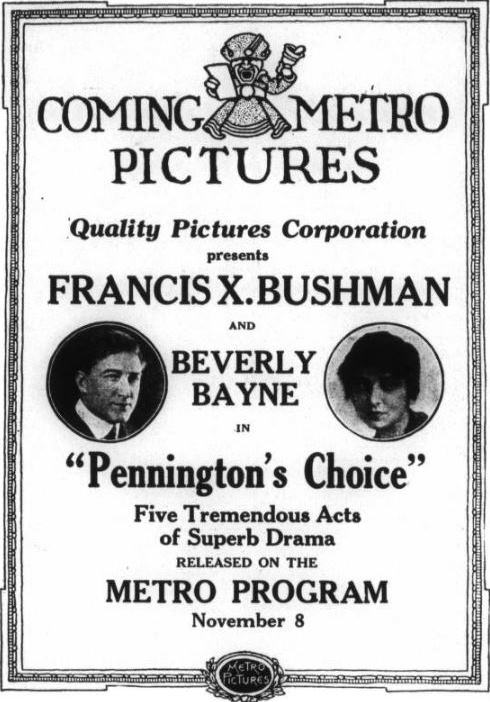
A definitive 4.6/10 rating for a film that redefined the boundaries of cult cinema. Pennington's Choice remains a cornerstone of transgressive art.
The first time we see Robert Pennington he is framed against a Tiffany window, a champagne flute trembling like a tuning fork in his manicured grip; the last time, he is silhouetted by the ember-glow of a cedar campfire, his once-pristine collar now a noose of sweat and sawdust. Between these two tableaux sprawls a forgotten 1920 silent that bruises the retina with its savage lyricism—Pennington’s Choice, a film whose very title is a cruel joke, because every choice here is stripped from its protagonist until only the raw imperative to endure remains.
Director Wellington A. Playter—better known for brandishing villainous moustaches than for orchestrating visual operas—delivers a northern Odyssey shot through with the amber of nitrate and the metallic tang of adrenaline. The print, recently resurrected from a Montreal archive’s frost-bitten vault, flickers like a lantern ghost, yet its emotional voltage is undiminished: a daredevil collision between Gatsby-era opulence and the primordial snarl of the Canadian shield.
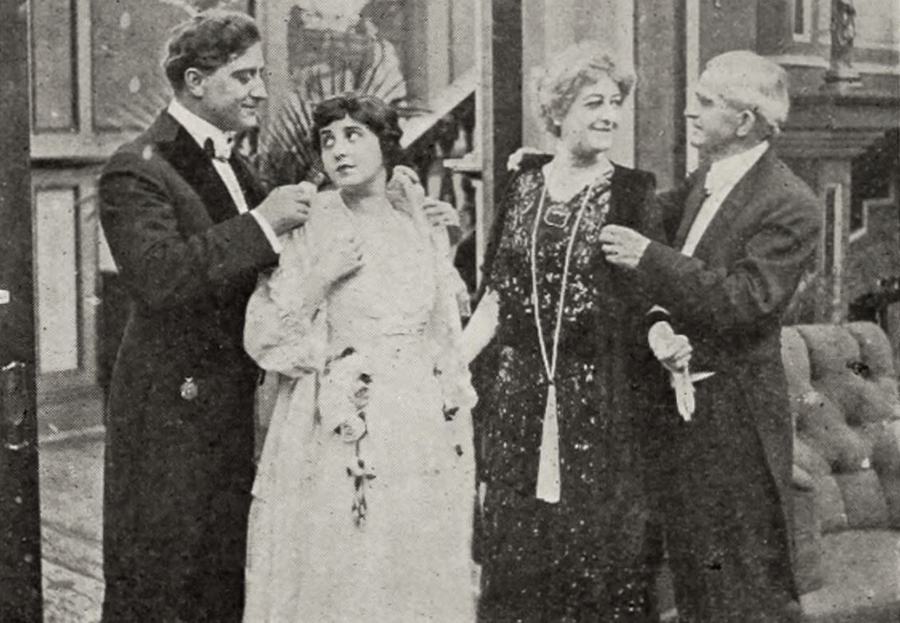
The film’s prologue is a vertiginous carnival of top hats and ostrich feathers, rendered in soft-focus like a fever dream of Fitzgerald’s unpublished notes. Pennington—played by Francis X. Bushman at the apex of his matinée-idol sovereignty—glides through ballroom sequences that feel lit by comet dust. Yet Bushman’s eyes, famously described by Photoplay as “two blueberries soaked in midnight,” betray a hairline fracture of ennui. Into this porcelain diorama strides Eugenia Blondeau, Beverly Bayne’s wood-nymph in silk georgette, her pupils already tuned to boreal constellations. Their courtship is conducted in subtitle-cards that read like haiku carved on birch bark: “I offer you a kingdom of elevators and starlight.” “I offer you a forest that devours kingdoms.”
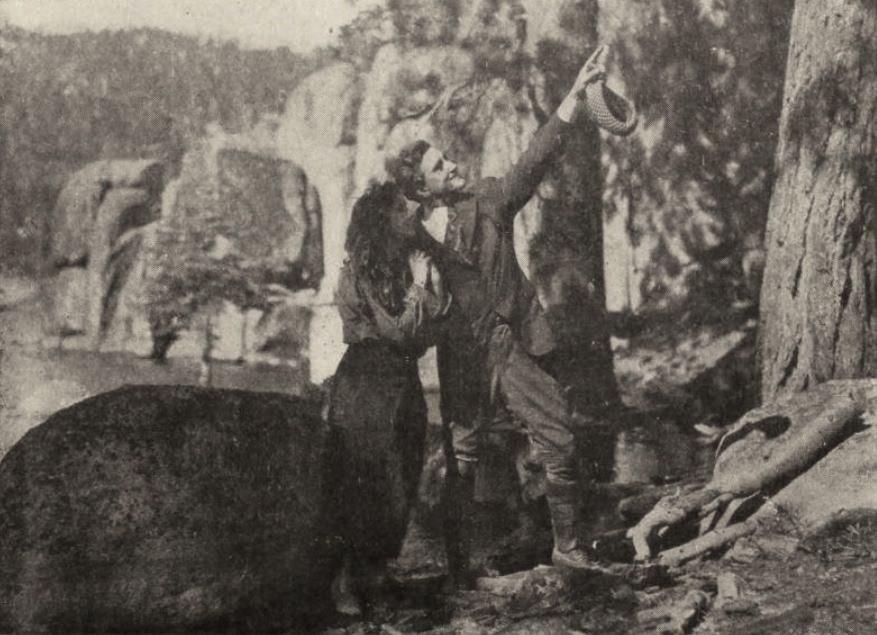
Cut to the rattling colonist car that vomits Pennington onto a siding somewhere north of Québec City. Cinematographer H. O’Dell swaps chiaroscuro salons for a vista so white it hurts the molars. The camera lingers on Pennington’s patent-leather shoes sinking into snow like sacrificial wafers; each frame is a memento mori for urban hubris. Enter Pierre, the guide—Gibson Gowland in a role that prefigures his later Greed brutality—his face a topographical map of contempt. The trek through cedar and black spruce becomes a Stations of the Cross, except the stigmata are blisters.
Blondeau père, essayed with granite implacability by Wellington A. Playter himself, greets the candidate with a medical inspection that borders on vivisection. He pronounces the city boy “soft as April ice,” a verdict delivered in both English and joual subtitles that hiss across the screen like musket fire. The ensuing month of “primitive life” is a syllabus of humiliation: hauling water, skinning beavers, sleeping on balsam boughs that tattoo their needles into his epidermis.
Just as Pennington’s spirit begins to carbon-harden, the narrative detonates its most perverse device: Marie, Eugenia’s doppelgänger, also embodied by Bayne. Through trick photography and matched dissolves, the twins share frames without ever seeming to breathe the same oxygen. Marie’s seduction is less erotic than ontological—she is the id of the forest, tempting Pennington to relinquish memory and simply become wild. Bushman’s acting here is a masterclass in micro-tremors: the way his pupils oscillate between twin faces, as though watching a tennis match played with his own soul.
Yet fidelity to the absent Eugenia becomes the film’s north star. In a ravishing night-interior lit only by a single kerosene lamp, Marie offers herself wrapped in wolf-pelt; Pennington, voice supplied by intertitle, whispers: “I gave my word to the frost, and the frost keeps its own.” The line, cornball on paper, achieves cathedral solemnity thanks to Bayne’s reaction: a single tear that freezes mid-cheek, turning into a bead of light.
Louis and Roland—Lester Cuneo and Arthur Housman—appear first as silhouettes against snow, then as wolfish specters whose idea of hospitality is to maroon Pennington in a cabin for five days without provisions. The siege sequence is staged like a frontier And Then There Were None: bullets of wind punching through chinked logs, a stew of paranoia thick enough to chew. When Pennington finally escapes, the camera follows his flailing run through underbrush in a handheld shot that predates The Passion of Joan of Arc by eight years, the trees strobing past like prison bars.
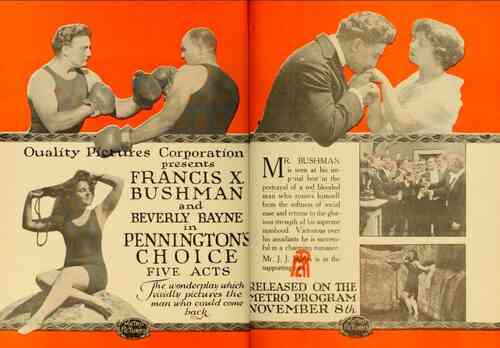
Salvation arrives in the bruised, bear-like form of real-life heavyweight Jim Jeffries, playing himself with the laconic swagger of a man who once knocked out Bob Fitzsimmons. Their meeting is pure McCulley pulp: two battered males bonding over a campfire, exchanging fisticuff philosophy while a northern lights curtain ripples overhead. Jeffries trains Pennington in the sweet science using snow-shoes as focus mitts; every jab lands with a poof of crystalline powder, turning violence into ballet.
The plot’s final act hinges on a letter—filched from the mustache-twirling Jean (Maurice Cytron)—that warns the Blondeau land grant will lapse unless a hundred-thousand-dollar deposit reaches Montreal by midnight. Pennington’s gallop through drifts and across half-frozen rivers is intercut with telegraph wires vibrating like harp strings, a visual poem that equates money with incantation. The deadline sequence is Eisenstein before Eisenstein: close-ups of clock hands, hooves, train wheels, and the flicker of a bank vault door slamming shut at the twelfth chime.
When Pennington returns, bloodied but solvent, the Blondeau brothers ambush him once more. The ensuing fight is a symphony of savage geometry: fists arc like comets, bodies crash into snow that blooms red like poppies. Bushman, who reportedly performed his own stunts, sells every punch with the torque of a man exorcising not just adversaries but an entire civilization’s effeteness. Victory earns him not applause but something quieter—Louis removing his hat, Roland offering a flask of caribou rum. The land is saved, yet the patriarch still withholds benediction.
The dénouement unspools in a moon-lit shack nicknamed the “Love Cottage,” a structure so ramshackle it seems held together by sighs. Eugenia steps from shadow, twin ruse dissolved, eyes shining with ancestral starlight. Pennington’s confession—“I spoke fidelity to your reflection, and found you there”—risks mawkishness, yet Bushman undercuts it with a half-smile that knows the absurdity of words after ordeal. Their kiss is filmed in profile against a windowpane where frost etches the initials “E + R,” as though nature itself graffiti-tags their union.
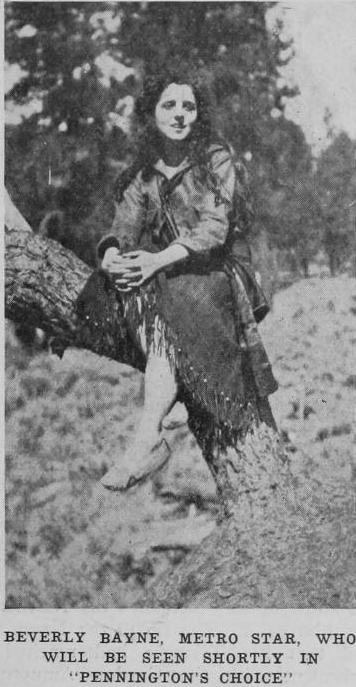
Bushman’s arc from satin lounge-lizard to scarred woodsman deserves reclamation in acting syllabi. Watch the way his gait recalibrates: early scenes glide on ballroom wax, later he stomps like a man who has learned the earth can bite. Bayne’s dual turn is less gimmick than Greek device; she differentiates the twins through breath—Eugenia’s inhalations shallow and anticipatory, Marie’s deep and predatory. Helen Dunbar, as Mrs. Allison, provides a salt-dry comic cameo, clutching a lapdog that looks as terrified of the forest as Pennington should be.
The tinting strategy—amber for Manhattan sapphire for twilight snow, crimson for fisticuffs—turns each reel into stained glass. A dissolve from a chandelier to an icicle achieves the impossible: equating luxury with menace. The camera’s love affair with negative space makes the forest a sentient character; branches claw the frame like fingers hungry for trespassers.
Though originally accompanied by house conductors, the restored Blu-ray offers a new score by a Québécois collective who deploy hurdy-gurdy, bones, and breathy flutes. The cue for the midnight ride layers galloping percussion under a hymn tune from Ave Maris Stella, turning fiscal urgency into spiritual exaltation.
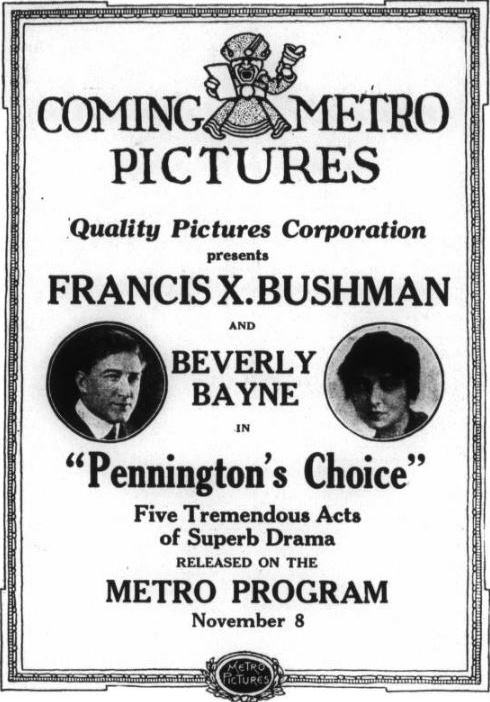
In DNA, Pennington’s Choice is cousin to The Story of the Kelly Gang: both fuse landscape and legend, both posit outlawry as crucible of identity. Yet where Kelly mythologizes the bandit, Pennington domesticates the wild into a dowry. Its gender politics may creak—Eugenia’s final worth is still measured by her capacity to forgive male ineptitude—but the film’s candor about class anxiety feels bracingly modern.
The picture vanished from screens by 1923, eclipsed by Bushman’s leap to Metro and Bayne’s retirement into matrimony. Yet its DNA persists in every later saga that flings a soft-handed protagonist into the maw of nature—think The Revenant minus the bear, or Outlander minus time-travel. The film’s thesis is simple: you do not know your own outline until the world has had its chance to erase it.
Watch it for the boxing lesson under aurora borealis, for the image of a tuxedo cuff snagged on barbed wire, for the intertitle that reads “Civilization is only ever a pocket away from barbarism—check yours.” Most of all, watch it to remember that silent cinema could howl louder than talkies ever dared.
Verdict: A frost-bitten fever dream that deserves pride of place beside Little Jack and Beating Back in any cinephile’s survival-romance canon. Thaw it out; let it bite you.
IMDb —
1929
Community
Log in to comment.