DbcultAccessing Vault...
Cult Review
Senior Film Conservator
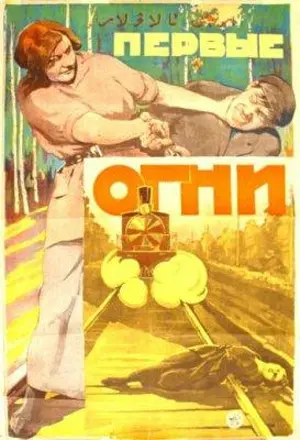
Is 'Pervye ogni' worth watching today? Short answer: yes, but with significant caveats. This early Soviet silent film offers a fascinating, if sometimes challenging, window into a pivotal era of cinematic and historical development, making it a compelling watch for specific audiences.
This film is unequivocally for cinephiles, historians, and those with a keen interest in early Soviet propaganda and the foundations of montage theory. It is decidedly NOT for viewers seeking modern pacing, complex character psychology, or purely escapist entertainment. Its value lies in its historical context and the raw, unrefined power of its storytelling.
"Pervye ogni" (First Lights), a foundational work by Yuri Tarich, stands as more than just a historical artifact; it is a declaration. Released in an era of profound societal upheaval, it encapsulates the fervent idealism and radical ambition of early Soviet cinema. While often overshadowed by the later, more technically audacious works of Eisenstein or Vertov, Tarich’s film possesses a distinct, almost primal energy that speaks volumes about its time.
It works. But it’s flawed. Its brilliance isn't in its subtlety, but in its unwavering, almost naive conviction. The film’s narrative, centered on the electrification of a remote village, is less about individual struggles and more about the triumph of the collective will, a recurring motif that defines its artistic and ideological core.
"Pervye ogni" is a testament to cinema's power as both art and instrument, a stark reminder of a time when the screen was a canvas for revolution.
Yuri Tarich, as both writer and director, crafts a narrative that is less a personal drama and more a grand ideological statement. His screenplay, co-written, is sparse in individual dialogue (being a silent film, this is inherent) but rich in symbolic imagery. The struggle against nature, the communal labour, and the eventual triumph of the electric light are all meticulously structured to reinforce the core tenets of the new Soviet state.
Tarich’s direction is characterized by a deliberate, almost reverent approach to his subject matter. He doesn't shy away from grand, sweeping shots of landscapes and mass movements, often juxtaposing the vastness of the land with the determined, yet small, figures of the workers. A prime example is the sequence depicting the arduous transportation of heavy machinery across uneven terrain; it’s a ballet of human effort against brute force, orchestrated with an eye for both realism and heroic scale.
Where Tarich truly shines, and perhaps where he also reveals the limitations of his era's cinematic language, is in his ability to imbue mundane tasks with monumental significance. The simple act of stringing a wire or digging a trench becomes an act of revolutionary heroism. This directorial choice, while effective for its time, can feel overly simplistic to a contemporary audience accustomed to more nuanced depictions of labour and political struggle.
One could argue that Tarich's greatest strength is also his greatest weakness: his unwavering commitment to the message. He prioritizes the collective narrative over individual arcs, making the film a powerful historical document but a less engaging character study. Unlike Charlie Chaplin's The Idle Class, which explored social strata through personal comedy, Tarich's work is an instructional epic.
The acting in "Pervye ogni" is typical of the silent era – broad, expressive, and often verging on theatrical. Yet, within these conventions, the ensemble cast delivers performances that, while lacking modern subtlety, convey a raw authenticity crucial to the film's impact. Georgi Kovrov, likely portraying the idealistic party worker or engineer, embodies the steadfast resolve of the revolutionary. His gestures are purposeful, his gaze often fixed on the distant horizon, projecting an unshakeable belief in the future.
Vasiliy Aristov and Aleksandr Antonov, playing perhaps the more grounded or even skeptical villagers, provide a necessary counterpoint. Their initial resistance or weariness, conveyed through slumped shoulders and furrowed brows, makes the eventual embrace of progress feel earned. Antonov, in particular, has a few moments where his physical presence alone communicates a weariness that speaks volumes about the challenges faced by the common people.
Zoya Kozitskaya, likely the film's central female figure, breaks through the collective anonymity with a performance that balances strength and vulnerability. Her character, perhaps representing the evolving role of women in the new society, isn't just a symbol but a participant in the arduous work. A scene where she is shown working alongside men, her face smudged with dirt but her eyes alight with determination, stands out as a powerful image of gender equality in action, something quite progressive for the period.
The collective performance of the uncredited villagers, however, is arguably the most powerful. Their faces, often filmed in close-up, tell a story of hardship, hope, and collective endeavour that no single actor could fully convey. This emphasis on the masses over the individual is a hallmark of early Soviet cinema, and in "Pervye ogni," it's executed with compelling effect, giving the film a powerful, almost choral quality.
The cinematography of "Pervye ogni" is a testament to the evocative power of black and white film, skillfully employed to underscore the film's central themes. The visual language is stark, often employing high-contrast lighting to emphasize the struggle between the old darkness and the new light. The use of chiaroscuro isn't merely aesthetic; it's narrative. Scenes depicting the village before electrification are often bathed in a soft, almost sepia-toned gloom, emphasizing their isolation and backwardness.
Conversely, the arrival of the electric light is heralded by crisp, almost blinding illumination. The climactic sequence, where the first light bulb flickers to life, is shot with a reverence that borders on the spiritual. The camera lingers on the faces of the onlookers, their expressions shifting from disbelief to awe, bathed in this new, artificial glow. This moment, simple as it is, is rendered with profound visual poetry, demonstrating the transformative power of light.
The film also makes extensive use of location shooting, capturing the vast, untamed Russian landscape with a sense of both grandeur and challenge. The sweeping vistas, the winding rivers, and the rugged terrain are not just backdrops but active participants in the drama, constantly reminding the audience of the scale of the undertaking. The camera work, while not as dynamic or experimental as some contemporaries, is always purposeful, serving the story's ideological framework.
Compared to the intricate sets of a contemporary like Pretty Ladies, "Pervye ogni" grounds itself in the raw reality of its environment. The framing often places human figures against monumental natural elements or burgeoning industrial structures, visually asserting the dominance of collective endeavour over individual fragility. It’s a powerful, if sometimes unsubtle, use of visual metaphor.
The pacing of "Pervye ogni" is deliberate, mirroring the monumental, often slow-burning effort it depicts. This is not a film driven by rapid-fire action or intricate plot twists. Instead, it unfolds with a measured rhythm, allowing the audience to absorb the scale of the undertaking and the sheer physical effort involved in bringing electricity to a remote region. Long takes are used to emphasize communal labour, drawing the viewer into the repetitive, yet ultimately rewarding, process.
This measured pace, while integral to the film's tone, can be a point of friction for modern viewers. It demands patience and a willingness to engage with a different cinematic sensibility. However, for those who adapt, the deliberate rhythm becomes hypnotic, reinforcing the idea that monumental change is not instantaneous but the result of sustained, collective effort. It is a stark contrast to the quick cuts and rapid narrative progression we see in films like Everything But the Truth.
The tone is overwhelmingly optimistic and didactic, imbued with the fervent idealism of the early Soviet project. There are moments of struggle and despair, certainly, but these are always framed as temporary setbacks on the path to inevitable triumph. The film never wavers from its central message: progress, driven by collective will and revolutionary spirit, is unstoppable. This unwavering positivity, while perhaps simplistic, is also one of the film's most striking features, offering a glimpse into a period of genuine, if sometimes misplaced, hope.
The film's emotional register is less about individual sorrow or joy and more about the shared experience of the collective. The moments of triumph are grand and communal, often culminating in celebrations that feel both authentic and carefully staged to maximize their ideological impact. This tone, while distinct from later, more cynical portrayals of the Soviet experiment, is crucial for understanding the foundational myths of the era.
Absolutely, for the right audience. If you are a student of film history, a scholar of Soviet culture, or simply someone curious about the origins of cinematic propaganda and the powerful impact of silent storytelling, then "Pervye ogni" offers immense value.
It's an essential piece for understanding the development of montage theory and the use of cinema as a tool for social engineering. While it may not offer the emotional depth or narrative complexity of a contemporary drama, its historical significance and raw artistic conviction make it a compelling, if demanding, viewing experience.
For casual viewers, it might prove a challenging watch due to its age, silent format, and overt ideological messaging. However, for those willing to engage with its context, it provides a unique and powerful glimpse into a pivotal moment in human history and cinematic evolution.
"Pervye ogni" is not a film to be consumed casually; it is a film to be studied. Its true value lies not in its entertainment factor, but in its profound historical and cinematic significance. It offers an unparalleled glimpse into the fervent, often brutal, idealism that shaped a nation and its early artistic output. While its didacticism might grate on modern sensibilities, and its pacing demands patience, one cannot deny its power as a cultural document.
For those willing to approach it with an open mind and an appreciation for its context, "Pervye ogni" flickers with a raw, enduring energy. It’s a powerful, if imperfect, testament to the transformative potential of both electricity and cinema, illuminating a path from the past to a future that, for a time, seemed infinitely bright. It’s not a masterpiece in the conventional sense, but it is an indispensable piece of the cinematic puzzle, a film that speaks volumes about the birth of an ideology through the lens.
IMDb 5.5
1936
Community
Log in to comment.