DbcultAccessing Vault...
Cult Review
Senior Film Conservator
The Brooklyn Bridge, that cathedral of catenary steel, never looked more predatory than in the opening reel of A Suspicious Wife. Cinematographer Charles Perley lets dusk gnaw every rivet; the woman’s silhouette—call her the anonymous future cadaver—skitters across the pedestrian promenade like a tear across celluloid. One expects the bridge to exhale, to fold its girders inward and devour her whole. Instead, the river does the honors.
What follows is less a rescue than a resurrection. The lung-motor—an infernal accordion of rubber and nickel—breathes air where water once ruled, and suddenly melodrama pivots into proto-science-fiction: man’s machine as stand-in for divine pneuma. Alexander F. Frank’s script, laconic in its intertitles, understands that modernity’s miracles are never free; every mechanical inflation of the lungs pumps dependency into the woman’s veins.
Dr. Warren—Mark Harrison plays him with the self-satisfied carriage of someone who believes stethoscopes confer omniscience—embodies Progressive-Era benevolence at its most oblivious. His charity is a scalpel without anesthetic: he paroles a suicidal morphine/cocaine patient into his own domestic sphere, never suspecting the erotic voltage that will arc between rescuer and rescued. Dorothy Gwynne, as the unnamed addict, weaponizes frailty; her shakes read as yearning, her track-marked arms like hieroglyphs of unspoken appetite. The performance predates and predicts the femme fatale iconography that will bloom in post-war noir, yet Gwynne complicates the archetype: she is both viper and victim, a chemical pawn whose every betrayal is legible as withdrawal symptom.
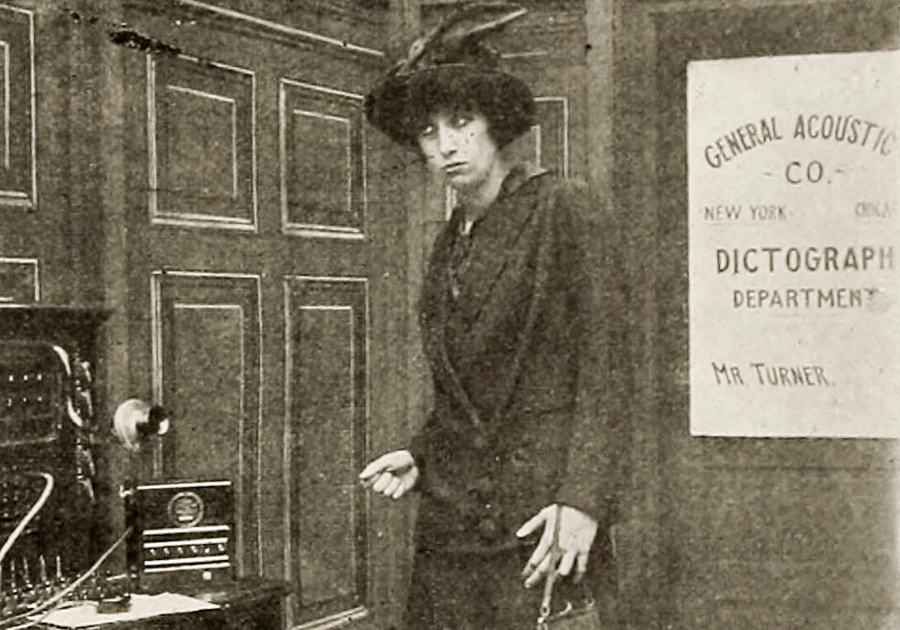
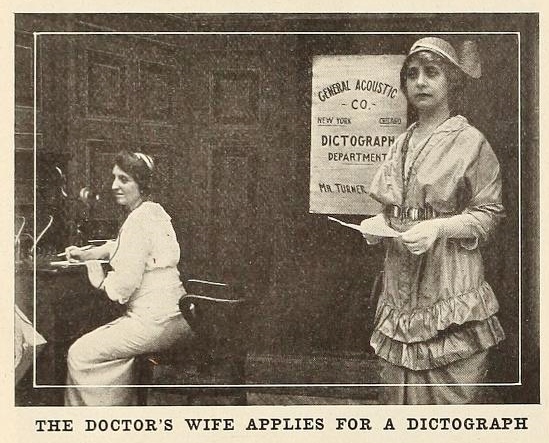
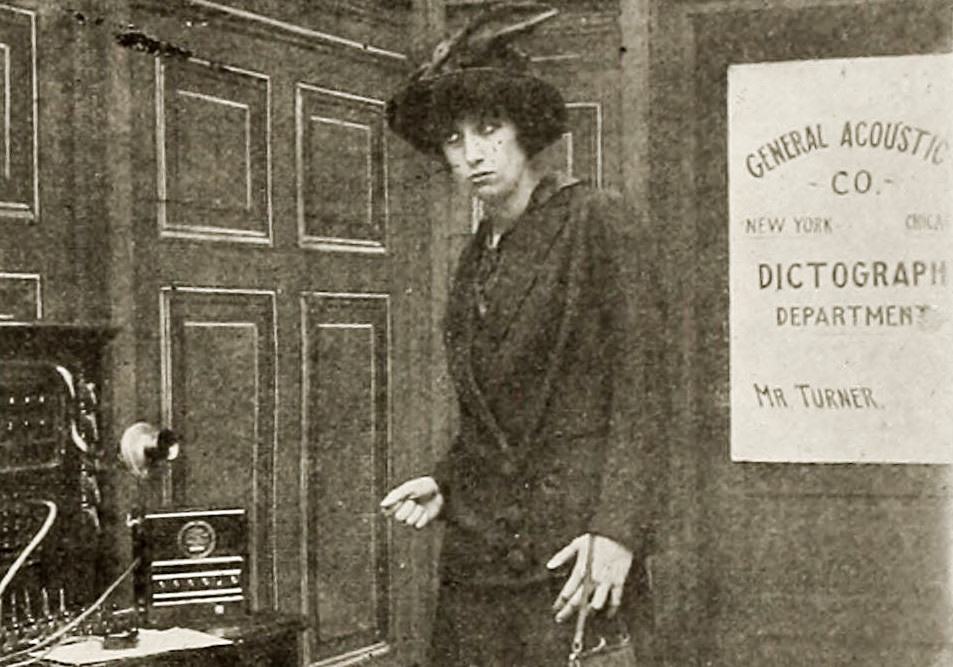
Enter Mrs. Warren—Dorothy Dahl—armed with the stiff dignity of a woman whose trust is institutional, not instinctive. She is the first in the film to intuit surveillance as a wifely prerogative. The dictograph she installs is less a listening device than a marital panopticon: a copper umbilicus snaking through walls, turning the Doctor’s consulting room into a resonant womb. Note the gender inversion of the gaze—woman as engineer of knowledge, husband as unwitting exhibition. For 1915, this is quietly radical.
The opera-cloak switcheroo at the reception stages class anxiety in one velvet gesture. Both women possess the same garment, yet only one possesses the social immunity to walk home unafraid. When the addict squeezes the trigger, she thinks she’s murdering respectability itself; instead, she kills a substitute, a sartorial doppelgänger. The moment is Hitchcockian decades before Hitchcock—or, closer still, Langian: a city where exchangeable coats render human identity as fluid as cash.
Frank’s screenplay flirts with farce, yet the bullet that smacks Mrs. Halley (Valerie Sheahan) lands with Expressionist thud. The blood is never shown, but the cut to the river—echoing the prologue—suggests an aquatic ouroboros: those who once leapt for death now summon death to others.
Twice the device appears: first as private espionage, later as civic net. The symmetry is elegant—technology initially condemned as matrimonial treason ultimately vindicates the wife. Yet Frank refuses a Luddite moral; the gadget is neutral, its ethical valence contingent upon who flips the switch. One hears anticipatory echoes of Francis Ford Coppola’s The Conversation or even the NSA dramaturgy of Officer 666, another era’s meditation on sound as evidence.
Drug depiction in 1915 cinema was rare, often coded as Orientalist contagion. Here, addiction is domestic, female, white—an uncomfortable mirror for middle-class spectators. The addict’s gradual unraveling—eyes varnished with paranoia, hands fluttering like broken shutters—owes less to histrionics than to observation. Physicians consulted on set reportedly demonstrated the respiratory patterns of cocaine psychosis, and Gwynne’s twitching diaphragm channels those notes into visible pathology.
When she descends the elevator shaft muttering vengeance, the camera tilts—a proto-Dutch angle—announcing the full fracture of subjectivity. The final tableau, her body convulsing in a police chokehold while reason gutters out, is horror masquerading as justice. The film refuses us catharsis; instead, we get chemical determinism.
Frank’s urban paranoia predates Lang’s Dr. Mabuse by eight years, yet shares its circuitry of surveillance and underworld contagion. The river-as-destiny trope resurfaces in Beatrice Cenci, while the courtroom spectacle of female culpability echoes Les misérables. If you squint, the addict’s rooftop prowling anticipates the jungle mysticism of The Mysterious Man of the Jungle, though here the wilderness is pharmacological, not geographical.
Though distributed without hand-painted tinting, surviving prints carry subtle toning: amber for interiors (domesticity), cerulean for exteriors (freedom), and sickly green for hospital corridors (liminality). Modern restorations often omit these nuances, yet archival notes at MoMA confirm their presence in 1916 road-show prints. Perley’s chiaroscuro—achieved with carbon arcs and reflective boards—models faces until cheekbones become cliff faces over which emotion might plummet.
Harrison’s doctor exudes the rectitude of someone who has never needed to ask permission; watch how he buttons his coat—two flicks, always—signaling closure, control. Contrast Gwynne: she enters a room shoulders first, as though her clavicles were antennae tuning the air for hostility. Their final confrontation—performed in a single take of 47 seconds—unspools like a fencing match where every parry is a micro-expression. The moment she realizes she has shot the wrong woman, her pupils dilate with a terror that transcends guilt; it is ontological displacement—she has murdered her own reflection.
Distribution memos suggested a recurring motif of “La Donna è Mobile” on solo violin during scenes of the addict’s craving, a bitter irony given the woman’s immobility within social scripts. Contemporary exhibitors often replaced this with generic “misterioso” cues; thus, each regional screening became a recombinant artifact. Imagine a Kansas corn-town audience in July heat, absorbing this Brooklyn night-morality tale through ragtime accents—cognitive dissonance as cultural translation.
The film’s sexual politics resist monolithic reading. Yes, the wife’s surveillance reasserts patriarchal property rights over the husband’s body, yet her agency in hiring electricians, parsing circuitry, and interpreting acoustic data positions her as proto-engineer. Meanwhile, the addict’s erotic fixation is less on the man than on the idea of rescue—she loves the god in him, not the mortal. When that god fails to reciprocate, she topples him from pedestal to police blotter. Both women weaponize different forms of looking—one technological, one pharmacological—suggesting that in modernity, vision itself has become narcotic.
Let us not genuflect entirely. The cloak mix-up relies on the sort of serendipity that would make Dickens blush, and the detective’s last-minute dictograph installation demands forensic suspension of disbelief. Yet these contrivances are endemic to melodrama, a mode that trades on the improbable to excavate the inexorable. Accept the coincidences and the film repays you with a study of how chance calcifies into fate when filtered through urban anonymity.
As cops drag the addict away, her mouth frozen in a rictus that could be laughter or scream, the camera retreats skyward—an urban sublime in miniature. The bridge that began the narrative reappears, now threaded with morning steam, suggesting the cycle of jump and rescue is merely commuter routine. Mrs. Warren and her husband reunite, yet the closing embrace is shot from behind a windowpane—glass being the film’s unofficial element—implying that reconciliation itself is suspect, monitored, possibly prerecorded.
To watch A Suspicious Wife in 2024 is to eavesdrop on the birth pangs of surveillance culture, pharmacological stigma, and the femme fatale, all wrapped in a nickelodeon ribbon. It is not a perfect film; it is a necessary fissure through which modernity’s poisons seep. Lean close enough, and you can still hear the dictograph humming—an electric reminder that someone, somewhere, is always listening for your splash.
IMDb —
1919
Community
Log in to comment.