DbcultAccessing Vault...
4.8/10
Senior Film Conservator
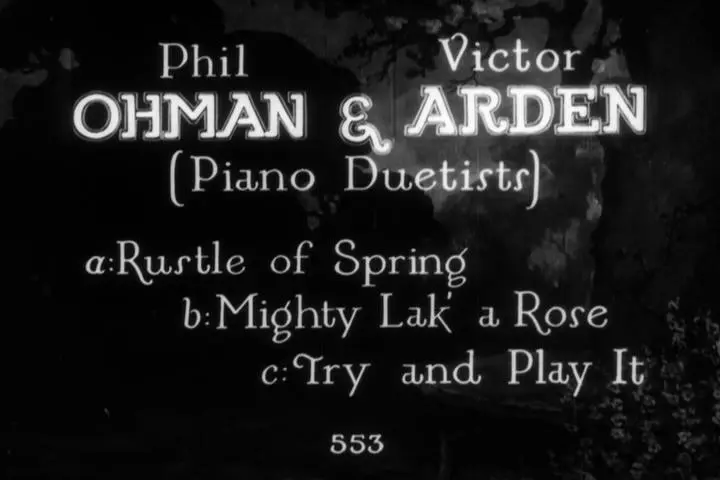
A definitive 4.8/10 rating for a film that redefined the boundaries of cult cinema. Phil Ohman & Victor Arden (Piano Duetists) remains a cornerstone of transgressive art.
Is Phil Ohman & Victor Arden (Piano Duetists) worth your precious time today? Short answer: yes, absolutely, but with a significant asterisk. This isn't a film designed for casual popcorn consumption; it's a historical document, a sonic and visual snapshot from an era when moving pictures were just learning to speak. It’s a niche experience, but a profoundly rewarding one for the right viewer. This film is unequivocally for cinephiles, music historians, and anyone fascinated by the origins of recorded performance and early 20th-century popular music. It is decidedly not for those seeking conventional narrative, high production values, or fast-paced entertainment.
It's a time capsule. Nothing more, nothing less. Its value isn't in its plot, but in its very existence.
This film works because it offers an unfiltered, authentic look at two masters of their craft performing live, captured during a pivotal moment in cinematic history. The sheer technical skill of Ohman and Arden is undeniable, a testament to an era of musical showmanship. It fails, however, in its capacity to engage a modern audience accustomed to dynamic storytelling and complex visual language; its static nature can feel alienating. You should watch it if you appreciate historical context, musical virtuosity, and the raw, unpolished charm of cinema's nascent years, or if you simply want to understand the foundational elements upon which all future musical films were built.
To truly appreciate Phil Ohman & Victor Arden (Piano Duetists), one must first step back into the nascent days of sound cinema. This isn't merely a performance; it’s a technological marvel for its time. In the late 1920s, the advent of synchronized sound was revolutionizing the film industry, transforming silent pictures into 'talkies.' But before the elaborate musicals and dramatic dialogues, there were shorts like this: simple, direct showcases of sound's capability. They were proving grounds, demonstrations of what the new medium could achieve.
Musical shorts were particularly vital in this transitional period. They offered immediate gratification, a clear and undeniable demonstration of sound's fidelity. Audiences were captivated not just by the music itself, but by the sheer novelty of hearing it emanate from the screen. This film, therefore, stands as a crucial artifact, illustrating the early commercial and artistic applications of sound technology, long before the complex narratives of films like The Jazz Singer (though not in the provided list, it's a relevant conceptual comparison) fully solidified the talkie era.
The significance of Ohman and Arden’s performance extends beyond mere entertainment. It’s a documentation of a specific musical style and a performance tradition that was immensely popular. Piano duets, with their intricate harmonies and rhythmic interplay, were a staple of vaudeville and radio. Capturing such an act on film preserved a fleeting art form, making it accessible to a wider audience and, more importantly, to future generations. Without these early efforts, much of that cultural heritage would be lost to time, existing only in faded memories and dusty sheet music.
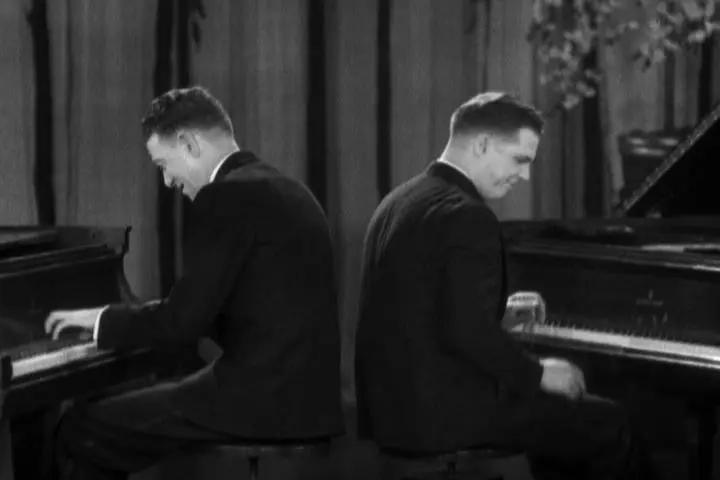
Viewing this film today is like peering through a temporal window, observing not just the artists, but the very act of cinematic evolution itself. The raw, unpolished quality of the recording, the static camera, and the direct presentation all speak volumes about the era's technological limitations and its boundless ambition. It’s a stark reminder that even the most rudimentary beginnings can hold profound historical and artistic weight.
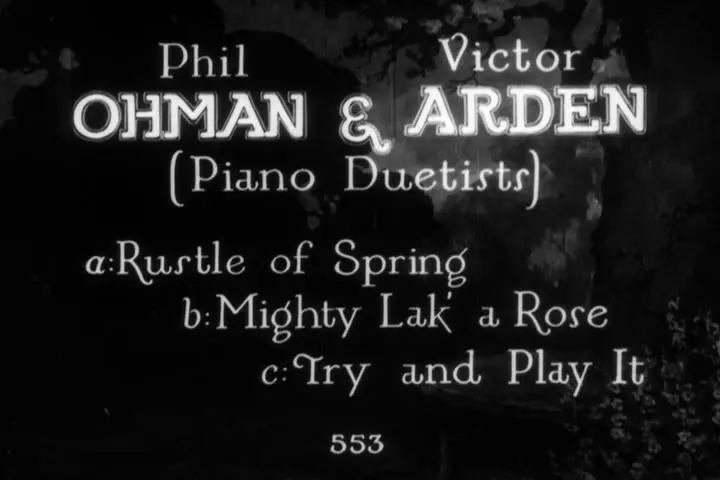
The heart of Phil Ohman & Victor Arden (Piano Duetists) lies squarely in the performance of its titular musicians. Phil Ohman and Victor Arden were not just pianists; they were showmen, and their virtuosity is the film’s undeniable centerpiece. The plot summary rightly highlights their ability to entertain with “three tunes on the piano in a variety of ways and remaining syncopated.” This seemingly simple description belies a complex musical conversation unfolding on screen.
Their musicality is immediately apparent. From the first notes, there's an astonishing precision in their playing. They navigate intricate passages with a seamless, almost telepathic coordination. One can practically hear the years of practice and collaborative understanding in every chord and arpeggio. The 'variety of ways' they approach the tunes isn't just about different melodies; it’s about their dynamic range, their use of tempo shifts, and their ability to weave complex counter-melodies that complement rather than compete.
The syncopation, a hallmark of early 20th-century popular music, particularly ragtime and jazz-influenced styles, is executed with a playful yet disciplined flair. This isn't just about hitting the right notes; it’s about the rhythmic vitality, the off-beat accents that give the music its irresistible swing and energy. For instance, in what appears to be their second piece, a more lively, almost stride-piano-esque number, their hands dance across the keys, one laying down a robust bass line while the other improvises dazzling runs in the treble, all perfectly locked into a syncopated groove.
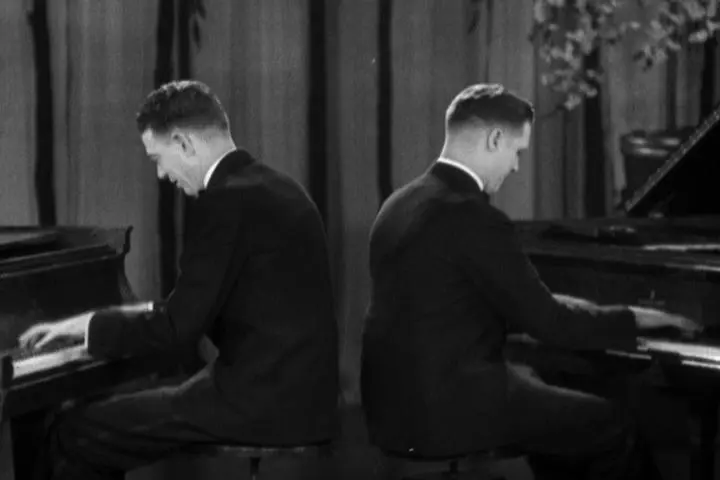
Beyond the technical prowess, there’s a captivating stage presence. While the camera remains largely static, their body language speaks volumes. The subtle nods, the shared glances, the way they lean into the music – it all conveys a deep immersion in their art and a palpable connection with each other. It’s a masterclass in non-verbal communication, demonstrating how two performers can create a unified artistic statement. This isn't 'acting' in a dramatic sense, but rather a performance of self, a sincere presentation of their musical identities.
One could argue that the very simplicity of the film's premise enhances their performance. There are no distractions, no elaborate sets, no supporting cast. It's just two men, a piano, and their music. This minimalist approach forces the viewer to focus entirely on the sound and the subtle visual cues of their interplay. It allows the true artistry of Ohman and Arden to shine through without dilution, making their virtuosity all the more striking. It’s a testament to the power of unadorned talent, and a refreshing contrast to the often over-produced musical acts of today.
The directorial and cinematographic choices in Phil Ohman & Victor Arden (Piano Duetists) are, by modern standards, incredibly rudimentary. Yet, within the context of early sound film, they are deliberate and effective. The film is characterized by a largely static camera, positioned to capture both pianists and the piano itself within a single, wide shot. This isn't a failure of imagination; it's a pragmatic decision dictated by the technology of the era.
Early sound recording was often done with a single microphone, and moving the camera, or cutting between shots, presented immense technical challenges for maintaining synchronized audio. Thus, the static, wide frame serves to keep both performers within the audio field and offers an unobstructed view of their hands on the keyboard. This compositional choice, though born of necessity, inadvertently creates a sense of intimacy and authenticity. We are positioned as if we are a privileged audience member in a small hall, observing the performance unfold directly before us.
The cinematography focuses on clarity. While details might be soft by contemporary standards, the lighting is sufficient to illuminate the performers and their instruments. There’s a utilitarian beauty to it; the frame is uncluttered, allowing the viewer's eye to be drawn naturally to the action – the intricate dance of fingers across the keys, the subtle expressions on the musicians' faces. It’s a no-frills approach that prioritizes content over visual spectacle, a stark contrast to the emerging visual grammar of Hollywood.
An unconventional observation here is how the film's technical limitations actually enhance its historical value. The lack of cuts, the single perspective, and the raw audio quality are not flaws but rather genuine artifacts. They provide an unvarnished record of what it was truly like to experience such a performance as a contemporary audience member. It's a window into the past, not a meticulously recreated one, but an actual slice of it. This directness, this almost documentary-like approach, is what makes it so compelling for historians and enthusiasts of early cinema. It’s a candid snapshot, not a polished portrait.
The 'directing' here is essentially the framing of a live event. There's no dramatic blocking, no complex camera movements. The director's primary role was to ensure the performance was audible and visible. And in that, they succeeded admirably. The result is a film that, despite its technical simplicity, manages to convey the energy and skill of its subjects effectively, allowing the music itself to be the primary storyteller.
The pacing of Phil Ohman & Victor Arden (Piano Duetists) is dictated entirely by its musical structure. With three distinct tunes performed sequentially, the film follows a natural ebb and flow, mirroring the progression of a live concert set. There are no jarring cuts or sudden shifts; the transitions between pieces are smooth, allowing the audience to savor each melody before moving on. This deliberate pacing contributes to the film's overall authenticity, replicating the experience of attending a recital.
The choice of three tunes offers a pleasing variety without overstaying its welcome. One can imagine an opening number, perhaps a bright, energetic piece to capture attention; followed by a more lyrical or melancholic interlude to showcase their expressive range; and concluding with a show-stopping, complex finale. This common structure in live performance ensures a dynamic yet cohesive viewing experience. The film’s brevity, a characteristic of many early shorts, also contributes to its effective pacing, ensuring that the audience's attention is held for the duration of the performance.
The tone of the film is one of genuine, unadulterated entertainment. There’s a palpable sense of joy and professionalism emanating from Ohman and Arden. Their music, rich with syncopation and melodic charm, evokes a bygone era of sophisticated yet accessible popular music. It's a tone that is both nostalgic and celebratory, capturing the spirit of an age where live music was a primary form of entertainment and virtuosity was highly prized. The film feels earnest, a straightforward presentation of talent for an appreciative audience.
This unpretentious tone is a significant strength. It doesn't attempt to be anything it's not. It simply presents a musical act, allowing the skill and charisma of the performers to carry the entire piece. There's no artifice, no pretense. It's pure, undiluted performance, preserved on celluloid. This honesty, coupled with the energetic musical output, creates a film that, despite its age and technical simplicity, manages to feel vibrant and engaging for those willing to engage with its historical context. It works. But it’s flawed.
Yes, Phil Ohman & Victor Arden (Piano Duetists) is absolutely worth watching today, especially for those with a keen interest in film history or early 20th-century music. It offers a unique window into the birth of sound cinema and the performance styles of the era. Its historical value is immense, serving as a primary source for understanding how music was captured and presented on screen in its earliest days. For a modern audience, it's a brief, fascinating glimpse into a foundational moment in entertainment history.
While Phil Ohman & Victor Arden (Piano Duetists) is a significant historical piece, it’s important to weigh its strengths against its inherent limitations for a contemporary audience.
Phil Ohman & Victor Arden (Piano Duetists) is not a film one watches for a thrilling plot or groundbreaking cinematography. Instead, it’s a direct, unpretentious invitation to witness a pivotal moment in cinematic and musical history. It’s a testament to the raw talent of two musicians and the nascent power of synchronized sound. For those who approach it with an appreciation for its historical context and its role as a foundational piece, it offers a profoundly rewarding experience. It’s a short, sharp burst of musical energy that illuminates the origins of an entire art form. Its value is less in its cinematic artistry and more in its historical veracity. I wholeheartedly recommend it for anyone curious about the roots of modern entertainment. It's a reminder that even in its simplest forms, cinema has always had the power to capture and preserve the magic of human performance.
Community
Log in to comment.